


Recombinant Human FGF R3 (C-6His)
Alternative NamesFibroblast growth factor receptor 3; FGFR-3; CD333; FGFR3; JTK4; IIIc
规格参数 Specifications
| 纯度Purity | Greater than 95% as determined by reducing SDS-PAGE |
|---|---|
| 内毒素Endotoxin | <1 EU/µg as determined by LAL test. |
| 蛋白构建Protein Construction |
【Glu23-Gly375】序列区间-6HisC 端标签
|
| Accession | P22607 |
| 表达宿主Expression Host | HEK293 |
| 种属Species | Human |
| 预测分子量Predicted MW | 39 kDa |
| 制剂Formulation | Lyophilized from a 0.2 μm filtered solution of PBS, pH 7.4. |
| 运输方式Shipping | The product is shipped with ice bag. Upon receipt, store it immediately at the temperature listed below. |
| 稳定性&储存Stability & Storage | 12 months at -20°C to -80°C in lyophilized state.6 months at -20°C to -80°C under sterile conditions after reconstitution.7-10 days at 2°C to 8°C under sterile conditions after reconstitution.Please minimize freeze-thaw cycles. |
| 复溶Reconstitution | Always centrifuge tubes before opening. Do not mix by vortex or pipetting. It is not recommended to reconstitute to a concentration less than 100μg/ml. Dissolve the lyophilized protein in distilled water. Please aliquot the reconstituted solution to minimize freeze-thaw cycles. |
!
本司产品仅用于科研,不用于临床诊断和治疗。
产品图片 Product Images点击图片可查看原图
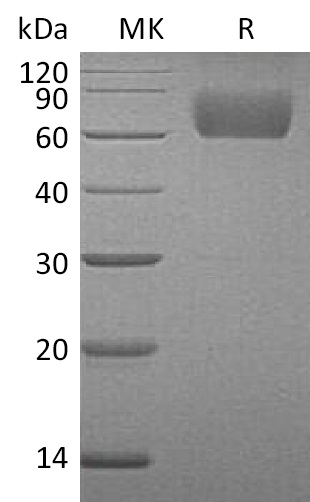 |
Greater than 95% as determined by reducing SDS-PAGE. |
靶点信息 Target Information
| 分子别名Alternative Names | Fibroblast growth factor receptor 3FGFR-3CD333FGFR3JTK4IIIc |
|---|---|
| 功能Function | Tyrosine-protein kinase that acts as cell-surface receptor for fibroblast growth factors and plays an essential role in the regulation of cell proliferation, differentiation and apoptosis. Plays an essential role in the regulation of chondrocyte differentiation, proliferation and apoptosis, and is required for normal skeleton development. Regulates both osteogenesis and postnatal bone mineralization by osteoblasts. Promotes apoptosis in chondrocytes, but can also promote cancer cell proliferation. Required for normal development of the inner ear. Phosphorylates PLCG1, CBL and FRS2. Ligand binding leads to the activation of several signaling cascades. Activation of PLCG1 leads to the production of the cellular signaling molecules diacylglycerol and inositol 1,4,5-trisphosphate. Phosphorylation of FRS2 triggers recruitment of GRB2, GAB1, PIK3R1 and SOS1, and mediates activation of RAS, MAPK1/ERK2, MAPK3/ERK1 and the MAP kinase signaling pathway, as well as of the AKT1 signaling pathway. Plays a role in the regulation of vitamin D metabolism. Mutations that lead to constitutive kinase activation or impair normal FGFR3 maturation, internalization and degradation lead to aberrant signaling. Over-expressed or constitutively activated FGFR3 promotes activation of PTPN11/SHP2, STAT1, STAT5A and STAT5B. Secreted isoform 3 retains its capacity to bind FGF1 and FGF2 and hence may interfere with FGF signaling. |
| 亚细胞定位Subcellular Location | [Isoform 1]: Cell membrane; Single-pass type I membrane protein. Cytoplasmic vesicle. Endoplasmic reticulum. Note=The activated receptor is rapidly internalized and degraded. Detected in intracellular vesicles after internalization of the autophosphorylated receptor.; [Isoform 2]: Cell membrane; Single-pass type I membrane protein.; [Isoform 3]: Secreted.; [Isoform 4]: Cell membrane; Single-pass type I membrane protein. |
| 数据库链接Databases |
基因功能参考文献50 条
- Authors found that, mechanistically, FGFR3-AS1 silencing decreased the activation of the PI3K/AKT signaling pathway. PMID: 29463348 : 29463348
- Our results identified FGFR3(high)/Ki67(high) papillary pTa tumors as a subgroup with poor prognosis and encourage histological grading as high grade tumors. PMID: 30154342 : 30154342
- Patients with FGFR3 mutations or FGFR3-TACC3 fusion may constitute potential candidates for a novel FGFR-targeted therapy in the perioperative setting. PMID: 30064409 : 30064409
- Data suggest that FGFR3 with mutation found in SADDAN (but not FGFR3 with mutation found in TDII) affects cytoskeleton organization in chondrocytes by inducing tyrosine hyperphosphorylation of paxillin; binding of FGFR3 to PLCG1 appears to be involved. (PLCG1 = phospholipase C gamma 1; SADDAN = Severe Achondroplasia with Developmental Delay and Acanthosis Nigricans; TDII = Thanatophoric Dysplasia type II) PMID: 29242050 : 29242050
- Here, we present a case with prenatal ultrasonographic findings suggestive of TD, and highlight the patient's postnatal dysmorphic features and typical radiographic findings. The definitive diagnosis of TD type I (TDI) was made postnatally, when molecular genetic analysis revealed the previously described p.R248C mutation in FGFR3. This case is reported due to its relative long life span and the molecular diagnosis. PMID: 30226972 : 30226972
- FGFR3 expression indicated an adverse prognosis for lung adenocarcinoma individuals and promoted metastatic potential of lung adenocarcinoma cells PMID: 29850625 : 29850625
- FGFR1, as well as its downstream regulatory PI3K/AKT kinases, may serve as potential biomarkers for the invasiveness and prognosis of laryngeal cancer. PMID: 29299828 : 29299828
- FGFR3-AS1 expression levels were higher in high grade tumors than those in low grade tumors. FGFR3-AS1 expression levels were higher in invasive tumors than those in non-invasive bladder tumors. PMID: 29226855 : 29226855
- Disease-free survival (DFS) was then calculated according to FGFR3 IHC expression. PMID: 30061236 : 30061236
- The gene FGFR3 is responsible for the production of the FGFR 3 protein that converts cartilage to bone. All people with a single copy of the mutated gene FGFR3 have Achondroplasia. PMID: 29185944 : 29185944
- genetic association studies in pediatric population in Japan: Data suggest that mutations in ACAN (aggrecan), FGFR3 (fibroblast growth factor receptor-3), or GHRHR (growth- hormone-releasing-hormone receptor) are associated with idiopathic short stature in the population studied. PMID: 28768959 : 28768959
- HPV-positive vulvar squamous cell carcinoma is characterized by oncogenic FGFR3 mutations that helps classify this subtype as a separate disease. Inhibitors of FGFR3 merit consideration as a therapeutic strategy in this neglected cancer in women PMID: 28377483 : 28377483
- Results show that olfactory neuroblastoma tumors harbor recurrent chromosomal copy-number changes, including FGFR3 amplification associated with overexpression. PMID: 28775129 : 28775129
- FGFR3-TACC3 is a recurrent resistance mechanism, which can bypass EGFR blockade by all generations of EGFR TKIs in NSCLC. PMID: 28838400 : 28838400
- Mutation in the FGFR3 gene is associated with with Klinefelter syndrome and achondroplasia. PMID: 28672740 : 28672740
- Genetic screening of the family revealed a previously reported heterozygous c.1138 G > A (p.G380R) mutation in the coding exon 8 of FGFR3 gene PMID: 28679403 : 28679403
- FGFR3 mutations have very limited urothelial tumorigenicity and that these mutations must collaborate with other genetic events to drive urothelial tumorigenesis. PMID: 27157475 : 27157475
- Long-term dovitinib administration was not feasible due to frequent toxicity. Absent clinical activity suggests that patient selection by pFGFR3 IHC alone does not enrich for response to FGFR3 kinase inhibitors in urothelial carcinoma. PMID: 27932416 : 27932416
- Results provide evidence that FGFR3 mutations in human papillomavirus positive tonsillar and base of tongue cancer is indicative of worse prognosis. PMID: 28525363 : 28525363
- Increased levels of FGFR3 and PIK3CA mutated DNA in urine and plasma are indicative of later progression and metastasis in bladder cancer. PMID: 28069289 : 28069289
- FGFR3 expression increased in classical and neural subtypes of glioma and was associated with differentiated cellular functions. FGFR3 showed very limited correlation with other common receptor tyrosine kinases, and predicted improved survival for glioma patients. PMID: 27829236 : 27829236
- REVIEW. FGFR3 is expressed in chondrocytes and mature osteoblasts where it functions to regulate bone growth. Analysis of the mutations in FGFR3 revealed increased signaling through a combination of mechanisms PMID: 27987249 : 27987249
- There was a lower frequency of mutation in FGFR3, a gene associated with low-risk Bladder Cancer, than reported in the The Cancer Genome Atlas database. PMID: 27520487 : 27520487
- A higher expression of FGFR3, phosphorylated AKT, and ZEB1 were observed. PMID: 27267856 : 27267856
- FGFR3 mutation status seems promising to guide decision-making on adjuvant anti-FGFR3 therapy as it appeared homogeneous in RC and lymph nodes +. Based on the results of TUR, the deep part of the tumor needs to be assessed if neoadjuvant anti-FGFR3 treatment is considered PMID: 27091807 : 27091807
- We present the first actionable mutation spectrum in Indian lung cancer genome. These findings implicate FGFR3 as a novel therapeutic in lung adenocarcinoma. PMID: 27998968 : 27998968
- FGFR2, TWIST1, and FGFR3 mutations were identified in children with tracheal cartilaginous sleeve (TCS). All five children with a W290C mutation in FGFR2 had TCS, and most previously reported children with W290C had identification of TCS or early death PMID: 27228464 : 27228464
- The Gly380Arg and Asn540Lys are hot spot mutations of the FGFR3 gene among patients with ACH/HCH. PMID: 28777845 : 28777845
- the FGFR3 gene is an infrequent target in the pathogenesis of Han Chinese urothelial cell carcinoma PMID: 27029078 : 27029078
- Our results extend the genetic mutation spectrum of FGFR3. PMID: 29080836 : 29080836
- Study found FGFR3 gene mutation plus GRB10 gene duplication in a patient with achondroplasia plus growth delay with prenatal onset PMID: 27370225 : 27370225
- Our family confirms the consistent and unique phenotype of this condition, and the specificity of the mutation in FGFR3. PMID: 27139183 : 27139183
- no insertions or deletions in FGFR3 have been reported to cause thanatophoric dysplasia types 1 or 2; therefore, this represents the first report to describe such a mutation. PMID: 27028100 : 27028100
- results suggest that FGFR3 kinase activity may regulate the papillomavirus reproductive program through phosphorylation of the E2 protein although this is unlikely to occur through the Y102 residue of HPV E2. PMID: 28768864 : 28768864
- Our data also reinforce the notion that molecular testing of FGFR3 must be included in the diagnostic approach of coronal craniosynostosis. This will allow accurate genetic counseling and optimal management of MS, which might otherwise go undiagnosed because of mild manifestations and wide variability of expression PMID: 27568649 : 27568649
- We describe the first case of protein-losing enteropathy in a pediatric patient, with severe skeletal dysplasia consistent with thanatophoric dysplasia type I and DNA analysis that revealed a c.1949A>T (p.Lys650Met) in exon 15 of the FGFR3 gene. PMID: 27214123 : 27214123
- High FGFR3 expression is associated with bladder cancer. PMID: 28320388 : 28320388
- Study provides evidence of the significant oncogenic potential of the FGFR3-TACC3 fusion protein. The presence of the TACC coiled-coil domain leads to increased and altered levels of FGFR3 activation, fusion protein phosphorylation, downstream signaling, cellular transformation, proliferation, and viability. PMID: 26869289 : 26869289
- we show that low dose of NVP-BGJ398 improves in vivo condyle growth and corrects dysmorphologies in Fgfr3(Y367C/+) mice, suggesting that postnatal treatment with NVP-BGJ398 mice might offer a new therapeutic strategy to improve mandible anomalies in achondroplasia (ACH), and others FGFR3-related disorders. PMID: 27260401 : 27260401
- FGFR3 mRNA missplicing in hepatocellular carcinoma (HCC), contributes significantly to its malignant character. PMID: 27267910 : 27267910
- Mutations in FGFR3 gene is associated with tubular adenomas. PMID: 27438523 : 27438523
- High FGFR3 expression is associated with multiple myeloma. PMID: 27509849 : 27509849
- FGFR3 was predominantly mutated in infiltrative hepatocellular carcinoma (HCC) compared to nodular HCC. FGFR3 protein expression was higher in mutated infiltrative HCC compared to non-mutated infiltrative HCC and nodular HCC. FGFR3 may be a candidate oncogene in tumor progression. PMID: 28058595 : 28058595
- Our findings show that grade heterogeneity in urothelial carcinoma is characterized by increased MIB-1 labelling, and particularly in the FGFR3 mutant pathway, with homozygous deletions of CDKN2A in low- and high-grade areas PMID: 27530957 : 27530957
- We argue that routine use of molecular genomic tumour analysis in urothelial carcinoma may inform selection of patients for appropriate trials and we further investigate the potential of FGFR3 as a meaningful clinical target for this difficult disease PMID: 27271022 : 27271022
- In conclusion, we identified four novel loci (TGFA, PIK3R1, FGFR3 and TREH) and confirmed two loci known to be associated with cartilage thickness.The identified associations were not caused by rare exonic variants. This is the first report linking TGFA to human Osteoarthritis, which may serve as a new target for future therapies. PMID: 27701424 : 27701424
- Case Report: FGFR3 epidermal naevus syndrome with urothelial mosaicism for activating p.Ser249Cys FGFR3 mutation. PMID: 27786351 : 27786351
- FGFR alterations are not frequent in low-grade gliomas, they are more common in hemispheric low-grade gliomas and are important since targeted therapies exist for FGFR receptors. PMID: 27659822 : 27659822
- FGFR3 gene mutations are associated with Urinary Bladder Cancer. PMID: 27356691 : 27356691
- we identified a novel FGFR3 mutation, p.Ser348Cys, in a patient with achondroplasia. A number of different FGFR3 mutations can cause achondroplasia; therefore, if the common p.Gly380Arg mutation is not found, complete analysis of FGFR3 is indicated in patients with achondroplasia PMID: 26754866 : 26754866
蛋白复溶体积计算器缓冲液体积 = 蛋白质量 ÷ 蛋白浓度
输入任意两项,第三项自动计算 |
蛋白浓度稀释计算器初浓度 × 初体积 = 终浓度 × 终体积
输入任意三项,第四项自动计算 |



