


Recombinant Human CTSD (C-6His)
Alternative NamesCathepsin D; CTSD; CPSD
规格参数 Specifications
| 纯度Purity | Greater than 95% as determined by reducing SDS-PAGE |
|---|---|
| 内毒素Endotoxin | <1 EU/µg as determined by LAL test. |
| 蛋白构建Protein Construction |
【Leu21-Leu412】序列区间-6HisC 端标签
|
| Accession | P07339 |
| 表达宿主Expression Host | HEK293 |
| 种属Species | Human |
| 预测分子量Predicted MW | 43.6 kDa |
| 制剂Formulation | Lyophilized From a 0.2 μm filtered solution of 20mM MES, 150mM NaCl, pH 5.5. |
| 运输方式Shipping | The product is shipped with ice bag. Upon receipt, store it immediately at the temperature listed below. |
| 稳定性&储存Stability & Storage | 12 months at -20°C to -80°C in lyophilized state.6 months at -20°C to -80°C under sterile conditions after reconstitution.7-10 days at 2°C to 8°C under sterile conditions after reconstitution.Please minimize freeze-thaw cycles. |
!
本司产品仅用于科研,不用于临床诊断和治疗。
产品图片 Product Images点击图片可查看原图
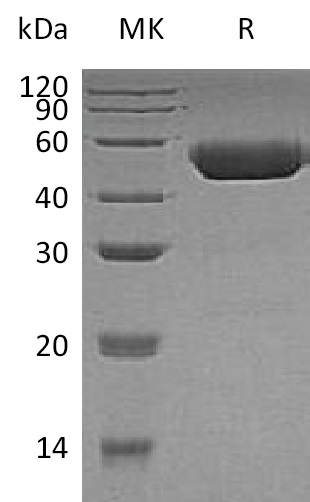 |
Greater than 95% as determined by reducing SDS-PAGE. |
靶点信息 Target Information
| 分子别名Alternative Names | Cathepsin DCTSDCPSD |
|---|---|
| 功能Function | Acid protease active in intracellular protein breakdown. Plays a role in APP processing following cleavage and activation by ADAM30 which leads to APP degradation. Involved in the pathogenesis of several diseases such as breast cancer and possibly Alzheimer disease. |
| 亚细胞定位Subcellular Location | Lysosome. Melanosome. Secreted, extracellular space. |
| 数据库链接Databases |
基因功能参考文献50 条
- CatD plays a major role in intracellular advanced glycation end products (AGEs) degradation. Decreased CatD expression and activity impairs intracellular AGEs degradation in photoaged fibroblasts. PMID: 29501392 : 29501392
- Newly diagnosed type 2 diabetes demonstrated significantly higher circulating cathepsin D concentrations than controls. PMID: 29375176 : 29375176
- This work identifies PGRN as an activator of lysosomal cathepsin D activity, and suggests that decreased cathepsin D activity due to loss of PGRN contributes to both FTD and NCL pathology in a dose-dependent manner. PMID: 29036611 : 29036611
- Study results suggest that the CTSD rs17571 variant may not be associated with risk of Parkinson's disease, amyotrophic lateral sclerosis in Han Chinese. PMID: 28917980 : 28917980
- VPS52 activated the apoptotic pathway through cathepsin D in gastric cancer cells. PMID: 28791438 : 28791438
- Plasma cathepsin D correlates with histological classifications of fatty liver disease in adults. PMID: 27922112 : 27922112
- Study shows that CtsD expression was upregulated in damaged tubular cells in nephrotoxic and ischemia reperfusion induced acute kidney injury (AKI) models. Also, the results provide compelling evidence for CtsD as an important mediator for apoptotic cell death during AKI. PMID: 27271556 : 27271556
- Epithelial ovarian (EOC) cancer secreted Cathepsin D acts as an extracellular ligand and may play an important pro-angiogenic, and thus pro-metastatic, role by activating the omental microvasculature during EOC metastasis to the omentum. PMID: 29024694 : 29024694
- Results show that lowering endogenous cathepsin D abundance induced senescence in HeLa cells, leading to reduced cell proliferation, impaired tumorigenesis in a mouse model, and increased permeability of lysosomal membrane and reactive oxygen species accumulation. These results suggest that CTSD is involved in cancer cells in maintaining lysosomal integrity, redox balance, and Nrf2 activity, thus promoting tumorigenesis. PMID: 26657266 : 26657266
- Data suggest that, compared to control individuals, serum cathepsin-D levels are up-regulated in patients with T2DM-Y (young onset type 2 diabetes) with and without diabetic retinopathy. This study was conducted in India. PMID: 28336215 : 28336215
- The lysosomal enzyme cathepsin D (CTSD) mediates the proteolytic cleavage of PSAP precursor into saposins A-D. Myc-CLN3 colocalized with CTSD and activity of CTSD decreased as myc-CLN3 expression increased, and clearly decreased under hyperosmotic conditions PMID: 28390177 : 28390177
- Study demonstrate that PGRN interacts with the lysosomal protease CTSD and maintains its proper activity in vivo. Therefore, by regulating CTSD activity, PGRN may modulate protein homeostasis. This could potentially explain the TDP-43 aggregation observed in frontotemporal lobar degeneration with GRN mutations. PMID: 28493053 : 28493053
- The S-nitrosation of a non-catalytic cysteine residue in the lysosomal aspartyl protease cathepsin D (CTSD) inhibited proteolytic activation. PMID: 27291402 : 27291402
- Secreted PGRN is incorporated into cells via sortilin or cation-independent mannose 6-phosphate receptor, and facilitated the acidification of lysosomes and degradation of CTSDmat. Moreover, the change of PGRN levels led to a cell-type-specific increase of insoluble TDP-43. In the brain tissue of FTLD-TDP patients with PGRN deficiency, CTSD and phosphorylated TDP-43 accumulated in neurons PMID: 28073925 : 28073925
- CTSD, in need of its catalytic activity, may promote proliferation in advanced glycation end products-treated human umbilical vein endothelial cells independent of the autophagy-lysosome pathway. PMID: 28218663 : 28218663
- Cathepsin D facilitates the TRAIL-induced apoptosis of MDA-MB-231 breast cancer cells in enzymatic activity-dependent manner. Caspase-8 and Bid proteins are the CD targets. The modulatory role of CD in cell response to TRAIL was also confirmed in another breast cancer cell line SKBR3. PMID: 26867770 : 26867770
- Gene expression level of CTSD is significantly higher in AD patients when compared to normal controls. PMID: 26943237 : 26943237
- There was a significant difference between groups with and without endothelial dysfunction in terms of cathepsin D levels, and negative and significant correlations were found between brachial artery FMD% and cathepsin D levels. Cathepsin D, which is known to be associated with atherosclerosis, may play a role in the proce PMID: 25611836 : 25611836
- Fibroblasts from Niemann-Pick type C (NPC) disease patients with low levels of NPC1 protein have high amounts of procathepsin D but reduced quantities of the mature protein, thus showing a diminished cathepsin D activity. PMID: 26507101 : 26507101
- Data indicate that cathepsin D (CD) protein is elevated in the retinas of diabetic mice and serum of human patients with diabetic macular edema (DME). PMID: 26718887 : 26718887
- Data show that co-silencing of tricho-rhino-phalangeal-syndrome (TRPS1) and cathepsin D (Cath-D) in breast cancer cells (BCC) affects the transcription of cell cycle and proliferation. PMID: 26183398 : 26183398
- Transcellular transmission of alpha-synuclein aggregates is increased in CTSD mutated cells. PMID: 26448324 : 26448324
- Serum CatD activity as a marker of healthy endogenous phagocytosis and remodeling was impaired in patients with new-onset cardiac dysfunction. PMID: 25911051 : 25911051
- study provides evidence that hTERT overexpression is responsible for the upregulation of the cysteine protease cathepsin D by regulating EGR-1 to activate invasiveness in cancer progression PMID: 26519755 : 26519755
- A proteomics workflow identified CTSD as an over-expressed protein in osteosarcomas and pulmonary metastases and may thus serve as a new biomarker for individualized treatment regimes for patients with osteosarcomas, even at metastastic stage. PMID: 26203049 : 26203049
- the clues provided by the yeast model unveiled a novel CatD function in the degradation of damaged mitochondria when autophagy is impaired, which protects colorectal cancer cells from acetate-induced apoptosis. PMID: 26086961 : 26086961
- Fenhexamid and cyprodinil can promote ovarian cancer metastasis by increasing the protein expression of cathepsin D via an estrogen receptor dependent pathway. PMID: 26344002 : 26344002
- Variations in CTSD and MnSOD showed no association with the development of Alzheimer's Disease, whereas the presence of the Ala224Val polymorphism in CTSD had a positive association with the development of AD PMID: 26351775 : 26351775
- Human Herpesvirus 8-encoded viral interleukin-6 promotes endoplasmic reticulum-associated degradation of procathepsin D. PMID: 26018151 : 26018151
- NOS-3 overexpression resulted in an increased sensitivity to anti-Fas induced cell death, independently of AR expression and CatD activity. PMID: 25712867 : 25712867
- These results suggest that decreased expression of cathepsin D in the peripheral monocytes is a potential signature of Alzheimer disease,and that this decreased expression is involved in Abeta degradation and Alzheimer disease pathogenesis. PMID: 24898658 : 24898658
- No differences in Cathepsin D were observed in the study when comparing male breast cancer tissues to those of female patients. PMID: 24656773 : 24656773
- T-carrying genotype is associated with a 2.5-fold increased risk for developing Alzheimer disease compared to C/C genotype. There was also a synergistic interaction with APOE epsilon4 leading to a 6.25-fold increased risk of the disease. PMID: 24281128 : 24281128
- CTSD, FKBP10, and SLC2A1 are novel genes that participate in the acquisition and maintenance of the adriamycin-resistant phenotype in leukemia cells. PMID: 24467213 : 24467213
- Knockdown of cathepsin D (CD) expression mediated by siRNA significantly inhibited the in vitro invasion of two hepatocellular carcinoma cell lines, SNU449 and SNU473, which normally secrete high-levels of CD. PMID: 24259486 : 24259486
- In this meta-analysis no association is found betweeen cathepsin D C224T polymorphism and the risk of Alzheimer's disease. PMID: 24423188 : 24423188
- Cathepsin D levels are reduced in patients with preeclampsia in Korean population.Cathepsin D level is an important factor that may contribute to the pathogenesis of preeclampsia. PMID: 23954850 : 23954850
- These data provide a better understanding of Cathepsin D behavior in tumor microenvironment conditions and this knowledge can be used to develop more specific tools for diagnosis and drug delivery. PMID: 23871913 : 23871913
- Determination of cathepsin D status in breast cancer might identify patients at different risk for relapse PMID: 24044567 : 24044567
- These data point to an evident correlation between cathepsins S and D expression and clinical stage of relapsing-remitting multiple sclerosis PMID: 23439581 : 23439581
- Upregulation of cathepsin D may be critically involved in the malignant transformation and progression of melanocytic tumors. PMID: 24511668 : 24511668
- Human herpesvirus 8 IL6 contributes to primary effusion lymphoma cell viability via suppression of cathepsin D interaction with VKORC1v2. PMID: 24198402 : 24198402
- Cathepsin D release from lysosomes and subsequent Bid cleavage is mediated by exposure of cells to an HSP70 inhibitor. PMID: 23868063 : 23868063
- Substrate specificities and proteolytic cleavage characterisitics of human cathepsin D. PMID: 23840360 : 23840360
- A Cathepsin D variant co-segregating with PSEN1 mutation was linked to cerebellar dysfunction and dementia. PMID: 23415546 : 23415546
- Quantification of immunohistochemistry showed that there is no difference in the global expression of CTSD, CTSH and CTSK between asthmatics and non-asthmatics. PMID: 23483898 : 23483898
- The beta-hairpin loop of human pro-cathepsin D, absent in the zebrafish protein, acts as recognition peptide for the enzymes involved in post translational processing. PMID: 23107604 : 23107604
- a model of Aven activation by which its N-terminal inhibitory domain is removed by CathD-mediated proteolysis, thereby unleashing its cytoprotective function. PMID: 22388353 : 22388353
- Cathepsin D activity was decreased in ATP13A2-knockdown cells that displayed lysosome-like bodies characterized by fingerprint-like structures PMID: 23499937 : 23499937
- Data indicate that a serum biomarker panel consisting of CA19-9, cathepsin D, and MMP-7 may provide the most effective screening test currently feasible for Pancreatic ductal adenocarcinoma. PMID: 23065739 : 23065739
蛋白复溶体积计算器缓冲液体积 = 蛋白质量 ÷ 蛋白浓度
输入任意两项,第三项自动计算 |
蛋白浓度稀释计算器初浓度 × 初体积 = 终浓度 × 终体积
输入任意三项,第四项自动计算 |



