


Recombinant Human GLA (C-6His)
Alternative NamesAlpha-Galactosidase A; Alpha-D-Galactosidase A; Alpha-D-Galactoside Galactohydrolase; Melibiase; Agalsidase; GLA
规格参数 Specifications
| 纯度Purity | Greater than 95% as determined by reducing SDS-PAGE |
|---|---|
| 内毒素Endotoxin | <1 EU/µg as determined by LAL test. |
| 蛋白构建Protein Construction |
【Leu32-Leu429】序列区间-6HisC 端标签
|
| Accession | P06280 |
| 表达宿主Expression Host | HEK293 |
| 种属Species | Human |
| 预测分子量Predicted MW | 46.39 kDa |
| 制剂Formulation | Lyophilized From a 0.2 μm filtered solution of 20mM Tris-HCl, 150mM NaCl, pH 8.0. |
| 运输方式Shipping | The product is shipped with ice bag. Upon receipt, store it immediately at the temperature listed below. |
| 稳定性&储存Stability & Storage | 12 months at -20°C to -80°C in lyophilized state.6 months at -20°C to -80°C under sterile conditions after reconstitution.7-10 days at 2°C to 8°C under sterile conditions after reconstitution.Please minimize freeze-thaw cycles. |
!
本司产品仅用于科研,不用于临床诊断和治疗。
产品图片 Product Images点击图片可查看原图
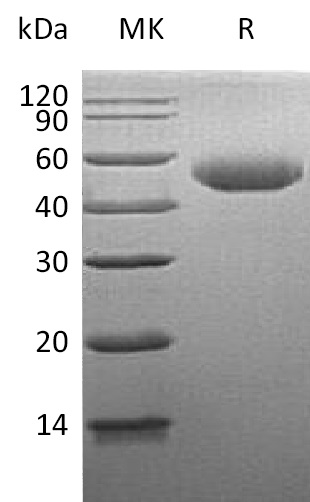 |
Greater than 95% as determined by reducing SDS-PAGE. |
靶点信息 Target Information
| 分子别名Alternative Names | Alpha-Galactosidase AAlpha-D-Galactosidase AAlpha-D-Galactoside GalactohydrolaseMelibiaseAgalsidaseGLA |
|---|---|
| 功能Function | Catalyzes the hydrolysis of glycosphingolipids and participates in their degradation in the lysosome. |
| 亚细胞定位Subcellular Location | Lysosome. |
| 数据库链接Databases |
基因功能参考文献50 条
- GLA variants found included R118C (n = 2), D83N, and D313Y (n = 7); IVS6-22 C>T, IVS4-16 A>G, IVS2+990C>A, 5'UTR-10 C>T (n = 4), IVS1-581 C>T, IVS1-1238 G>A, 5'UTR-30 G>A, IVS2+590C>T, IVS0-12 G>A, IVS4+68A>G, IVS0-10 C>T, IVS2-81-77delCAGCC, IVS2-77delC. We found that patients with common heart disease did not contain a substantial number of patients with undiagnosed Fabry disease. PMID: 29227985 : 29227985
- GLA DNA screening protocols starting from the dialysis population and upstream extended to families of affected individuals may be an effective strategy to maximize the early identification of subjects with Fabry disease. PMID: 30099469 : 30099469
- family study with the classical phenotype of Fabry disease due to the novel nonsense mutation c.607G>T (p.E203X) of the GLA gene; the Fabry disease phenotype is highly variable in heterozygote females, even within the same family PMID: 28152533 : 28152533
- It negatively regulates calcification of human aortic valve interstitial cells. PMID: 29653899 : 29653899
- Results from a study on gene variability markers in early-stage human embryos shows that GLA is a putative variability marker for the 3-day, 8-cell embryo stage. PMID: 26288249 : 26288249
- Presence of isolated heterozygous -10C >T SNP is not associated with clinically relevant symptoms or organ manifestations as seen in Fabry disease. PMID: 29794742 : 29794742
- The D313Y variant in the GLA gene was not Fabry disease causative in 2 Danish families. PMID: 29037082 : 29037082
- The mutation p.D313Y in the GLA gene may lead to organ manifestations and elevation of the Fabry-specific biomarker lyso-globotriaosylsphingosine. PMID: 28276057 : 28276057
- Four novel GLA pathogenic mutations are reported and evidence of pathogenicity of the D313Y mutation is provided. PMID: 28988177 : 28988177
- alpha-Galactosidase A genotype N215S does not lead to the development of a classical Fabry phenotype but induces a specific cardiac variant of Fabry disease mimicking nonobstructive hypertrophic cardiomyopathy. PMID: 29018006 : 29018006
- GLA c.196G>C variant is a genetic risk factor for cerebral small-vessel occlusion and non-cardioembolism in Japanese males but not in females. PMID: 28275245 : 28275245
- we presented the clinical characters of a Chinese FD pedigree mimicking familial episodic pain. Furthermore, our finding suggests that a novel double mutation of GLA (c.273_276del TGAT in cis with c.281G>T) is associated with FD PMID: 27531472 : 27531472
- Results showed that most Fabry disease patients carrying GLA IVS4+919A did not show abnormal cardiac phenotypes. The near-absence of GLA IVS4+919A in heart disease cohort suggested that this variant is not a frequent cause of overt heart diseases in Taiwan. PMID: 28377241 : 28377241
- This longitudinal Fabry Registry study analyzed data from patients with Fabry disease to determine the incidence and type of severe clinical events following initiation of enzyme replacement therapy (ERT) with agalsidase beta, as well as risk factors associated with occurrence of these events PMID: 27510433 : 27510433
- alpha-galactosidase A mutation, IVS4-type Fabry disease has features similar to those of classic Fabry disease and a higher frequency of deep white matter hyperintensities and a higher incidence of infarctions and pulvinar signs than in healthy controls PMID: 26869469 : 26869469
- We demonstrate that the wild-type sequence harbors an hnRNP A1 and hnRNP A2/B1-binding exonic splicing silencer (ESS) overlapping the 5'splice site (5'ss) that prevents pseudoexon inclusion.we demonstrate that splice switching oligonucleotide (SSO) mediated blocking of the pseudoexon 3'ss and 5'ss effectively restores normal GLA splicing PMID: 27595546 : 27595546
- Four patients had non-amenable mutant forms of a-Gal based on the validated cell-based assay conducted after treatment initiation and were excluded from primary efficacy analyses only. PMID: 27834756 : 27834756
- Mesenchymal stem cells with reduced GLA activity are prone to apoptosis and senescence due to impaired autophagy and DNA repair capacity. PMID: 28098348 : 28098348
- we review the various types of GLA variants and recommend that pathogenicity be considered only when associated with elevated globotriaosylceramide in disease-relevant organs and tissues as analyzed by mass spectrometry. PMID: 27195818 : 27195818
- findings revealed the alternative splicing mechanism of GLA (IVS4+919G>A), and a potential treatment for this specific genetic type of Fabry disease by amiloride in the future PMID: 28430823 : 28430823
- Results found a novel heterozygous stop codon mutation in exon 1 of the GLA gene in female patients with Fabry Disease with methylation in the non-mutated allele thought to be associated with the clinical severity of the disease. PMID: 28087245 : 28087245
- Study described the demographic data, wide clinical spectrum of phenotypes, and GLA mutation spectrum of Fabry disease in Korea. Most of the patients had classical Fabry disease, with a 4 times higher incidence than that of late-onset Fabry disease, indicating an underdiagnosis of mild, late-onset Fabry disease. PMID: 28723748 : 28723748
- we reviewed other small molecules that were reported to have a stabilizing effect on some GLA missense mutations in vitro and might be developed to act in synergy or as an alternative to 1-deoxygalactonojirimycin PMID: 27916943 : 27916943
- No pathogenic mutations in the coding regions of the GLA gene were identified in this group of patients and thus no Fabry disease was found in this study. PMID: 26981927 : 26981927
- High desphospho-uncarboxylated matrix Gla protein level, reflecting a poor vitamin K status, seems to be associated with kidney damage and may be also a marker of cardiovascular risk in CKD patients PMID: 27100101 : 27100101
- Similar central nervous system manifestations in patients with the IVS4 mutation or classical Fabry mutations. PMID: 28166746 : 28166746
- Case Report: Kidney transplantation from a mother with unrecognized Fabry disease to her son with low alpha-galactosidase A activity. PMID: 26971403 : 26971403
- p.M187R GLA mutation in Fabry disease causes a severe systemic and ophthalmologic phenotype, in both male and female patients. PMID: 28225726 : 28225726
- The results of the current study suggest that the GLA haplotype D313Y does not lead to severe organ manifestations as seen in genotypes known to be causal for classical Fabry disease. PMID: 27059467 : 27059467
- We report a case of Fabry disease with a p.R301X (c.901 C>T) mutation in a 39-year-old man who was being treated for chronic sclerosing glomerulonephritis for 2 years. Family screening tests showed that the proband's mother, sister, and daughter had the same mutation with different phenotypes. PMID: 27156739 : 27156739
- Case Report: hypertrophic obstructive cardiomyopathy with Fabry disease with the GLA E66Q mutation. PMID: 27160240 : 27160240
- We conclude that a mild GLA variant is typically characterized by high residual enzyme activity and normal biomarker levels. We found evidence that these variants can still be classified as a distinctive, but milder, sub-type of FD. PMID: 26415523 : 26415523
- Fabry disease, an X-linked disorder of glycosphingolipids that is caused by mutations of the GLA gene that codes for alpha-galactosidase A, leads to dysfunction of many cell types and includes a systemic vasculopathy. PMID: 26564084 : 26564084
- Study describes 5 novel mutations found in the GLA gene of patients with clinical diagnosis of Fabry disease. PMID: 26691501 : 26691501
- The present study confirms the heterogeneity of mutations in Fabry disease and the importance of molecular analysis for genetic counseling, female heterozygotes detection as well as therapeutic decisions. PMID: 26297554 : 26297554
- GLA gene variations correlate with globotriaosylceramide and globotriaosylsphingosine analog levels in urine and plasma PMID: 26070511 : 26070511
- results directly implicated the GLA mutation p.E66Q as the genetic etiology of the Chinese renal variant FD pedigree. PMID: 26456105 : 26456105
- This study indicated that the p.E66Q variant of GLA does not affect the progression of chronic kidney disease. PMID: 24718812 : 24718812
- Thus, inheritance of the CIH caused an mRNA deregulation altering the GLA expression pattern, producing a tissue glycolipid storage. PMID: 26334996 : 26334996
- data strongly suggest that the GLA p.(Arg118Cys) variant does not segregate with Fabry disease clinical phenotypes in a Mendelian fashion, but might be a modulator of the multifactorial risk of cerebrovascular disease PMID: 25468652 : 25468652
- In Fabry disease patients, the alpha-galactosidase A-10T allele appears to be causal for neurological manifestations. PMID: 25423912 : 25423912
- Some clinical cases of some members of a Sicilian family to express phenotypical variability of Anderson-Fabry disease in subjects with the same genetic mutation in alpha galactosidase A gene, are reported. PMID: 25281798 : 25281798
- Case Report: immunohistologically detected synaptopodin upregulation in foamy podocytes in Fabry disease due to novel alpha-galactosidase A mutation. PMID: 25295576 : 25295576
- These data confirmed that the specific approach can effectively contribute to the identification of pathological mutations in GLA. PMID: 25382311 : 25382311
- The novel mutation p.M187R/g7219 T>G is associated with a particularly malignant cardiac phenotype in males and females over 40 years. PMID: 24679964 : 24679964
- OC follows a gene duplication strategy while MGP variability was obtained mostly by the use of multiple promoters and alternative splicing, leading to proteins with additional functional characteristics and alternative gene regulatory pathways. [review] PMID: 25068814 : 25068814
- It is clear that a certain intronic haplotype in males with cryptogenic stroke is associated with reduced GLA expression and function. PMID: 25101867 : 25101867
- GLA p.E66Q mutation is a genetic risk factor for cerebral small-vessel occlusion in elderly Japanese PMID: 23724928 : 23724928
- residues important for expression of the GLA activity PMID: 24386359 : 24386359
- A Fabry disease patient and his daughter had the mutation c.493 G > C in the 3d exon of the GLA gene. D165H substitution affects protein folding. This highly conserved AA may be a key amino acid for enzyme functionality. PMID: 24398019 : 24398019
蛋白复溶体积计算器缓冲液体积 = 蛋白质量 ÷ 蛋白浓度
输入任意两项,第三项自动计算 |
蛋白浓度稀释计算器初浓度 × 初体积 = 终浓度 × 终体积
输入任意三项,第四项自动计算 |



