


| 纯度Purity | Greater than 97% as determined by reducing SDS-PAGE. |
|---|---|
| 内毒素Endotoxin | Please contact with the lab for this information |
| 蛋白构建Protein Construction |
【Ala279-Ser390】序列区间
|
| Accession | P07200 |
| 表达宿主Expression Host | E.coli |
| 种属Species | Sus scrofa; Porcine (Pig) |
| 预测分子量Predicted MW | 14.3 kDa |
| 制剂Formulation | Lyophilized from a 0.2 μm filtered solution of PBS, pH7.4, containing 0.01% SKL, 1mM DTT, 5% Trehalose and Proclin300. |
| 运输方式Shipping | The product is shipped with ice bag. Upon receipt, store it immediately at the temperature listed below. |
| 稳定性&储存Stability & Storage | 12 months at -20°C to -80°C in lyophilized state.6 months at -20°C to -80°C under sterile conditions after reconstitution.7-10 days at 2°C to 8°C under sterile conditions after reconstitution.Please minimize freeze-thaw cycles. |
| 复溶Reconstitution | Reconstitute in 10mM PBS (pH7.4) to a concentration of 0.1-1.0 mg/mL. Do not vortex. |
 |
Greater than 97% as determined by reducing SDS-PAGE. |
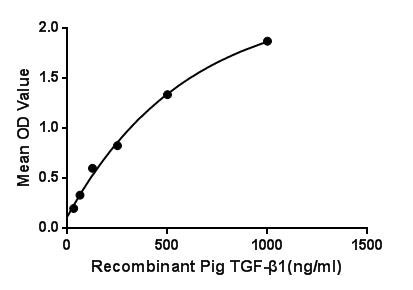 |
Figure. The binding activity of TGF-β1 with LTBP1. Transforming growth factor beta 1 or TGF-β1 is a polypeptide member of the transforming growth factor beta superfamily of cytokines. It is a secreted protein that performs many cellular functions, including the control of cell growth, cell proliferation, cell differentiation and apoptosis. TGF-β1 plays an important role in controlling the immune system, and shows different activities on different types of cell, or cells at different developmental stages. Besides, Latent Transforming Growth Factor Beta Binding Protein 1 (LTBP1) has been identified as an interactor of TGF-β1, thus a binding ELISA assay was conducted to detect the interaction of recombinant pig TGF-β1 and recombinant pig LTBP1. Briefly, TGF-β1 were diluted serially in PBS, with 0.01% BSA (pH 7.4). Duplicate samples of 100μL were then transferred to LTBP1-coated microtiter wells and incubated for 2h at 37℃. Wells were washed with PBST and incubated for 1h with anti-TGF-β1 pAb, then aspirated and washed 3 times. After incubation with HRP labelled secondary antibody, wells were aspirated and washed 3 times. With the addition of substrate solution, wells were incubated 15-25 minutes at 37℃. Finally, add 50µL stop solution to the wells and read at 450nm immediately. The binding activity of TGF-β1 and LTBP1 was shown in Figure 1, and this effect was in a dose dependent manner. |
| 分子别名Alternative Names | TGF-B1CEDDPD1LAPCamurati-Engelmann DiseaseLatency-associated peptide |
|---|---|
| 背景介绍Background | Transforming growth factor beta-1 proprotein: Precursor of the Latency-associated peptide (LAP) and Transforming growth factor beta-1 (TGF-beta-1) chains, which constitute the regulatory and active subunit of TGF-beta-1, respectively.; Required to maintain the Transforming growth factor beta-1 (TGF-beta-1) chain in a latent state during storage in extracellular matrix. Associates non-covalently with TGF-beta-1 and regulates its activation via interaction with 'milieu molecules', such as LTBP1, LRRC32/GARP and LRRC33/NRROS, that control activation of TGF-beta-1. Interaction with LRRC33/NRROS regulates activation of TGF-beta-1 in macrophages and microglia. Interaction with LRRC32/GARP controls activation of TGF-beta-1 on the surface of activated regulatory T-cells (Tregs). Interaction with integrins (ITGAV:ITGB6 or ITGAV:ITGB8) results in distortion of the Latency-associated peptide chain and subsequent release of the active TGF-beta-1.; Multifunctional protein that regulates the growth and differentiation of various cell types and is involved in various processes, such as normal development, immune function, microglia function and responses to neurodegeneration. Activation into mature form follows different steps: following cleavage of the proprotein in the Golgi apparatus, Latency-associated peptide (LAP) and Transforming growth factor beta-1 (TGF-beta-1) chains remain non-covalently linked rendering TGF-beta-1 inactive during storage in extracellular matrix. At the same time, LAP chain interacts with 'milieu molecules', such as LTBP1, LRRC32/GARP and LRRC33/NRROS that control activation of TGF-beta-1 and maintain it in a latent state during storage in extracellular milieus. TGF-beta-1 is released from LAP by integrins (ITGAV:ITGB6 or ITGAV:ITGB8): integrin-binding to LAP stabilizes an alternative conformation of the LAP bowtie tail and results in distortion of the LAP chain and subsequent release of the active TGF-beta-1. Once activated following release of LAP, TGF-beta-1 acts by binding to TGF-beta receptors (TGFBR1 and TGFBR2), which transduce signal. While expressed by many cells types, TGF-beta-1 only has a very localized range of action within cell environment thanks to fine regulation of its activation by Latency-associated peptide chain (LAP) and 'milieu molecules'. Plays an important role in bone remodeling: acts as a potent stimulator of osteoblastic bone formation, causing chemotaxis, proliferation and differentiation in committed osteoblasts. Can promote either T-helper 17 cells (Th17) or regulatory T-cells (Treg) lineage differentiation in a concentration-dependent manner. At high concentrations, leads to FOXP3-mediated suppression of RORC and down-regulation of IL-17 expression, favoring Treg cell development. At low concentrations in concert with IL-6 and IL-21, leads to expression of the IL-17 and IL-23 receptors, favoring differentiation to Th17 cells. Stimulates sustained production of collagen through the activation of CREB3L1 by regulated intramembrane proteolysis (RIP). Mediates SMAD2/3 activation by inducing its phosphorylation and subsequent translocation to the nucleus. Can induce epithelial-to-mesenchymal transition (EMT) and cell migration in various cell types. |
| 功能Function | Transforming growth factor beta-1 proprotein: Precursor of the Latency-associated peptide (LAP) and Transforming growth factor beta-1 (TGF-beta-1) chains, which constitute the regulatory and active subunit of TGF-beta-1, respectively.; Required to maintain the Transforming growth factor beta-1 (TGF-beta-1) chain in a latent state during storage in extracellular matrix. Associates non-covalently with TGF-beta-1 and regulates its activation via interaction with 'milieu molecules', such as LTBP1, LRRC32/GARP and LRRC33/NRROS, that control activation of TGF-beta-1. Interaction with LRRC33/NRROS regulates activation of TGF-beta-1 in macrophages and microglia. Interaction with LRRC32/GARP controls activation of TGF-beta-1 on the surface of activated regulatory T-cells (Tregs). Interaction with integrins (ITGAV:ITGB6 or ITGAV:ITGB8) results in distortion of the Latency-associated peptide chain and subsequent release of the active TGF-beta-1.; Multifunctional protein that regulates the growth and differentiation of various cell types and is involved in various processes, such as normal development, immune function, microglia function and responses to neurodegeneration. Activation into mature form follows different steps: following cleavage of the proprotein in the Golgi apparatus, Latency-associated peptide (LAP) and Transforming growth factor beta-1 (TGF-beta-1) chains remain non-covalently linked rendering TGF-beta-1 inactive during storage in extracellular matrix. At the same time, LAP chain interacts with 'milieu molecules', such as LTBP1, LRRC32/GARP and LRRC33/NRROS that control activation of TGF-beta-1 and maintain it in a latent state during storage in extracellular milieus. TGF-beta-1 is released from LAP by integrins (ITGAV:ITGB6 or ITGAV:ITGB8): integrin-binding to LAP stabilizes an alternative conformation of the LAP bowtie tail and results in distortion of the LAP chain and subsequent release of the active TGF-beta-1. Once activated following release of LAP, TGF-beta-1 acts by binding to TGF-beta receptors (TGFBR1 and TGFBR2), which transduce signal. While expressed by many cells types, TGF-beta-1 only has a very localized range of action within cell environment thanks to fine regulation of its activation by Latency-associated peptide chain (LAP) and 'milieu molecules'. Plays an important role in bone remodeling: acts as a potent stimulator of osteoblastic bone formation, causing chemotaxis, proliferation and differentiation in committed osteoblasts. Can promote either T-helper 17 cells (Th17) or regulatory T-cells (Treg) lineage differentiation in a concentration-dependent manner. At high concentrations, leads to FOXP3-mediated suppression of RORC and down-regulation of IL-17 expression, favoring Treg cell development. At low concentrations in concert with IL-6 and IL-21, leads to expression of the IL-17 and IL-23 receptors, favoring differentiation to Th17 cells. Stimulates sustained production of collagen through the activation of CREB3L1 by regulated intramembrane proteolysis (RIP). Mediates SMAD2/3 activation by inducing its phosphorylation and subsequent translocation to the nucleus. Can induce epithelial-to-mesenchymal transition (EMT) and cell migration in various cell types. |
| 亚细胞定位Subcellular Location | [Latency-associated peptide]: Secreted, extracellular space, extracellular matrix.; [Transforming growth factor beta-1]: Secreted. |
| 数据库链接Databases |
基因功能参考文献34 条
- TGF-beta1 is activated or inactivated by MMP20 or KLK4 and that the amelogenin cleavage product is necessary for the in-solution mobility of TGF-beta1. PMID: 27633089 : 27633089
- Activated TGF-beta signaling rescued miR-143-reduced FSHR and intracellular signaling molecules, and miR-143-induced porcine granulosa cell apoptosis. PMID: 27882941 : 27882941
- TGF-beta1-induced epithelial-myofibroblast plasticity is FAK- dependent, whereas TGF-beta1-induced apoptosis is favored when FAK signaling is inhibited. PMID: 28360109 : 28360109
- this study shows that TGF-beta1 protects intestinal integrity and influences Smad and MAPK signal pathways in intestinal epithelium cells after TNF-alpha challenge PMID: 28142299 : 28142299
- this study shows that anemonin may ameliorate LPS-induced intestinal injury and improve restoration by regulating the TGF-b1 and EGFR signaling pathways PMID: 27189428 : 27189428
- The results indicated that TGF-beta-1 was associated with the restoration of intestinal morphology and barrier function following weaning stress. PMID: 25170924 : 25170924
- Data (including data from in vitro and in vivo experiments) suggest that day 14 elongated conceptus secretes proteins that up-regulate TGFbeta1 mRNA and TGFbeta1 expression in endometrium; TGFbeta1 may be important during pregnancy maintenance. PMID: 24042214 : 24042214
- The effects of semen, spermatozoa in extender, or extender alone on the expression of TGF-beta1, IL-10, and IL-6 in ovarian follicles are reported. PMID: 24020676 : 24020676
- Dietary (1,3/1,6)-beta-D-glucan reduced the mRNA expression of transforming growth factor (TGF) beta2 and tended to reduce the mRNA expression of TGF-beta1 in lung tissue of neonatal piglet. PMID: 23602250 : 23602250
- TGF-beta1, via TGF-beta1 receptor I and p38 MAPK signaling, reduces CFTR expression to impair CFTR-mediated anion secretion, which would likely compound the effects associated with mild CFTR mutations and ultimately would compromise male fertility. PMID: 23903699 : 23903699
- High yield isolation of BMP-2 from bone and in vivo activity of a combination of BMP-2/TGF-beta1. PMID: 22927042 : 22927042
- Boar seminal plasma contained TGF- beta1 and IL-10 but with high individual variation. PMID: 22482797 : 22482797
- The present study was aimed to determine the association between metalloproteinase 3 (MMP3), transforming growth factor beta 1 (TGFbeta1) and collagen type X alpha I (COL10A1) gene polymorphisms with traits related to leg weakness in pigs. PMID: 21739142 : 21739142
- Inhibition of transforming growth factor beta-1 augments liver regeneration after partial portal vein ligation in a porcine experimental model. PMID: 22251543 : 22251543
- TGF-beta prevents excessive heart valve growth under normal physiological conditions while it promotes cell proliferation in the early stages of repair. PMID: 21851806 : 21851806
- Crystals of dimeric porcine proTGF-beta1 reveal a ring-shaped complex, a novel fold for the prodomain, and show how the prodomain shields the growth factor from recognition by receptors and alters its conformation. PMID: 21677751 : 21677751
- The effects of different polymorphisms of TGF-beta1 on litter size in Large white pigs are reported. PMID: 20088852 : 20088852
- TGF-beta disrupts an IGF-II-stimulated autocrine amplification cascade that is necessary for muscle differentiation in vitro. PMID: 21106882 : 21106882
- beta-Catenin plays a critical role in mediating TGF-beta1-induced myofibroblast differentiation in aortic valve interstitial cells. PMID: 21127288 : 21127288
- Results suggest that Rac1 and RhoA are regulated by TGFbeta1 in the process of endothelial tube formation in collagen I gels. PMID: 16978608 : 16978608
- TGFbeta may play a role in the overall process of luteinization, but it appears not to influence steroidogenesis in luteinizing pig follicles. PMID: 20378284 : 20378284
- Elevated circulating TGF-beta(1) causes endothelial dysfunction through NADPH oxidase activation-induced oxidative stress, accelerating atherosclerosis and hypertension in apoE(-/-) mice. PMID: 20511416 : 20511416
- TGFbeta stimulation of ANK expression is dependent upon the influx of phosphate and calcium into ATDC5 cells at all stages of differentiation. PMID: 20432454 : 20432454
- Data suggest that focal adhesion kinase (FAK)-SMAD 2/3 mediate signal crosstalk between type II collagen and TGF-beta1 and regulate glycosaminoglycan secretion in chondrocytic cells. PMID: 19840848 : 19840848
- show that histone deacetylase 4 overexpression promotes TGF-beta1-induced synovium-derived stem cells chondrogenesis but inhibits chondrogenically differentiated stem cell hypertrophy. PMID: 19716643 : 19716643
- multiple effects of TGFbeta at the porcine conceptus-maternal interface, including integrin-mediated conceptus-maternal communication through LAP PMID: 15961561 : 15961561
- Repeated injection of adenovirus expressing porcine TGF-beta1 may be useful model for studying Peyronie's disease. PMID: 17651407 : 17651407
- identification of six quantitative trait loci for diabetes-related traits in F(2)-D Tgf/Tgf and F(2)-C Tgf/Tgf pigs PMID: 18160996 : 18160996
- FGF2 effectively blocks transforming growth factor-beta1 (TGF-beta1)-mediated myofibroblast activation PMID: 18218921 : 18218921
- Using the model of porcine aortic endothelial cells, we demonstrated that TGFbeta stimulates cellular spreading when cells are on collagen I; TGFbeta-stimulated Rac1-GTP accumulation, which was associated with increased MAPK p38 phosphorylation. PMID: 18387002 : 18387002
- Wounding activates valve interstitial cell (VICs), and TGF-beta signaling modulates VIC response to injury. PMID: 18832581 : 18832581
- Altered shear stress stimulates upregulation of endothelial VCAM-1 and ICAM-1 in a BMP-4- and TGF-beta1-dependent pathway. PMID: 19023092 : 19023092
- pTGF-beta1 induces human fibroblast synthesis & secretion of ET-1. TGF-beta1 activation of PI3K/AKT is not dependent on ET-1. ET-1 & TGF-beta1 independently promote fibroblast resistance to apoptosis through p38 MAPK & PI3K/AKT. PMID: 19188658 : 19188658
- transforming growth factor beta has a role in the regulation of thyroid function and growth [review] PMID: 19645615 : 19645615
蛋白复溶体积计算器缓冲液体积 = 蛋白质量 ÷ 蛋白浓度
输入任意两项,第三项自动计算 |
蛋白浓度稀释计算器初浓度 × 初体积 = 终浓度 × 终体积
输入任意三项,第四项自动计算 |



