


| 纯度Purity | Greater than 95% as determined by reducing SDS-PAGE. |
|---|---|
| 内毒素Endotoxin | Please contact with the lab for this information |
| 蛋白构建Protein Construction |
【Ala279-Ser390】序列区间
|
| Accession | P18341 |
| 表达宿主Expression Host | E.coli |
| 种属Species | Bos taurus; Bovine (Cattle) |
| 预测分子量Predicted MW | 42.8 kDa |
| 制剂Formulation | Lyophilized from a 0.2 μm filtered solution of PBS, pH7.4, containing 0.01% SKL, 1mM DTT, 5% Trehalose and Proclin300. |
| 运输方式Shipping | The product is shipped with ice bag. Upon receipt, store it immediately at the temperature listed below. |
| 稳定性&储存Stability & Storage | 12 months at -20°C to -80°C in lyophilized state.6 months at -20°C to -80°C under sterile conditions after reconstitution.7-10 days at 2°C to 8°C under sterile conditions after reconstitution.Please minimize freeze-thaw cycles. |
| 复溶Reconstitution | Reconstitute in 10mM PBS (pH7.4) to a concentration of 0.1-1.0 mg/mL. Do not vortex. |
 |
Greater than 95% as determined by reducing SDS-PAGE. |
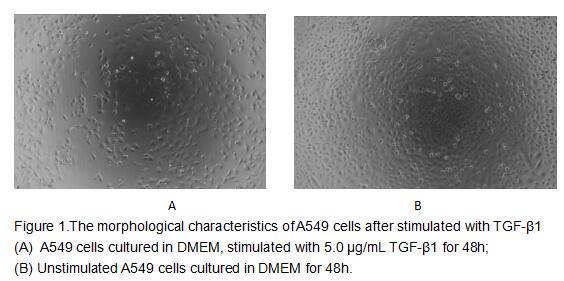 |
Transforming growth factor beta 1 (TGF-β1) is a polypeptide member of the transforming growth factor beta superfamily of cytokines. It is a secreted protein that performs many cellular functions, including the control of cell growth, cell proliferation, cell differentiation, and apoptosis. It is reported that TGF-β1 can stimulate cell transformation by Smad signal transduction .To test the bioactivity of TGF-β1, A549 cells were seeded into 24-well plate at a density of 1x10⁶ cells/mL, and allowed to attach overnight before treated with certain concentrations of TGF-β1. After 48 hours, the morphological changes of A549 were observed by inverted microscope. The results was shown in Figure 1. A549 cells usually have a cobblestone epithelial morphology and corresponding growth pattern. When stimulated with TGF-β1, the cells were similar with fibroblasts, the connections between cells became loose. |
| 分子别名Alternative Names | TGF-B1CEDDPD1LAPCamurati-Engelmann DiseaseLatency-associated peptide |
|---|---|
| 背景介绍Background | Transforming growth factor beta-1 proprotein: Precursor of the Latency-associated peptide (LAP) and Transforming growth factor beta-1 (TGF-beta-1) chains, which constitute the regulatory and active subunit of TGF-beta-1, respectively.; Required to maintain the Transforming growth factor beta-1 (TGF-beta-1) chain in a latent state during storage in extracellular matrix. Associates non-covalently with TGF-beta-1 and regulates its activation via interaction with 'milieu molecules', such as LTBP1, LRRC32/GARP and LRRC33/NRROS, that control activation of TGF-beta-1. Interaction with LRRC33/NRROS regulates activation of TGF-beta-1 in macrophages and microglia. Interaction with LRRC32/GARP controls activation of TGF-beta-1 on the surface of activated regulatory T-cells (Tregs). Interaction with integrins (ITGAV:ITGB6 or ITGAV:ITGB8) results in distortion of the Latency-associated peptide chain and subsequent release of the active TGF-beta-1.; Multifunctional protein that regulates the growth and differentiation of various cell types and is involved in various processes, such as normal development, immune function, microglia function and responses to neurodegeneration. Activation into mature form follows different steps: following cleavage of the proprotein in the Golgi apparatus, Latency-associated peptide (LAP) and Transforming growth factor beta-1 (TGF-beta-1) chains remain non-covalently linked rendering TGF-beta-1 inactive during storage in extracellular matrix. At the same time, LAP chain interacts with 'milieu molecules', such as LTBP1, LRRC32/GARP and LRRC33/NRROS that control activation of TGF-beta-1 and maintain it in a latent state during storage in extracellular milieus. TGF-beta-1 is released from LAP by integrins (ITGAV:ITGB6 or ITGAV:ITGB8): integrin-binding to LAP stabilizes an alternative conformation of the LAP bowtie tail and results in distortion of the LAP chain and subsequent release of the active TGF-beta-1. Once activated following release of LAP, TGF-beta-1 acts by binding to TGF-beta receptors (TGFBR1 and TGFBR2), which transduce signal. While expressed by many cells types, TGF-beta-1 only has a very localized range of action within cell environment thanks to fine regulation of its activation by Latency-associated peptide chain (LAP) and 'milieu molecules'. Plays an important role in bone remodeling: acts as a potent stimulator of osteoblastic bone formation, causing chemotaxis, proliferation and differentiation in committed osteoblasts. Can promote either T-helper 17 cells (Th17) or regulatory T-cells (Treg) lineage differentiation in a concentration-dependent manner. At high concentrations, leads to FOXP3-mediated suppression of RORC and down-regulation of IL-17 expression, favoring Treg cell development. At low concentrations in concert with IL-6 and IL-21, leads to expression of the IL-17 and IL-23 receptors, favoring differentiation to Th17 cells. Stimulates sustained production of collagen through the activation of CREB3L1 by regulated intramembrane proteolysis (RIP). Mediates SMAD2/3 activation by inducing its phosphorylation and subsequent translocation to the nucleus. Can induce epithelial-to-mesenchymal transition (EMT) and cell migration in various cell types. |
| 功能Function | Transforming growth factor beta-1 proprotein: Precursor of the Latency-associated peptide (LAP) and Transforming growth factor beta-1 (TGF-beta-1) chains, which constitute the regulatory and active subunit of TGF-beta-1, respectively.; Required to maintain the Transforming growth factor beta-1 (TGF-beta-1) chain in a latent state during storage in extracellular matrix. Associates non-covalently with TGF-beta-1 and regulates its activation via interaction with 'milieu molecules', such as LTBP1, LRRC32/GARP and LRRC33/NRROS, that control activation of TGF-beta-1. Interaction with LRRC33/NRROS regulates activation of TGF-beta-1 in macrophages and microglia. Interaction with LRRC32/GARP controls activation of TGF-beta-1 on the surface of activated regulatory T-cells (Tregs). Interaction with integrins (ITGAV:ITGB6 or ITGAV:ITGB8) results in distortion of the Latency-associated peptide chain and subsequent release of the active TGF-beta-1.; Multifunctional protein that regulates the growth and differentiation of various cell types and is involved in various processes, such as normal development, immune function, microglia function and responses to neurodegeneration. Activation into mature form follows different steps: following cleavage of the proprotein in the Golgi apparatus, Latency-associated peptide (LAP) and Transforming growth factor beta-1 (TGF-beta-1) chains remain non-covalently linked rendering TGF-beta-1 inactive during storage in extracellular matrix. At the same time, LAP chain interacts with 'milieu molecules', such as LTBP1, LRRC32/GARP and LRRC33/NRROS that control activation of TGF-beta-1 and maintain it in a latent state during storage in extracellular milieus. TGF-beta-1 is released from LAP by integrins (ITGAV:ITGB6 or ITGAV:ITGB8): integrin-binding to LAP stabilizes an alternative conformation of the LAP bowtie tail and results in distortion of the LAP chain and subsequent release of the active TGF-beta-1. Once activated following release of LAP, TGF-beta-1 acts by binding to TGF-beta receptors (TGFBR1 and TGFBR2), which transduce signal. While expressed by many cells types, TGF-beta-1 only has a very localized range of action within cell environment thanks to fine regulation of its activation by Latency-associated peptide chain (LAP) and 'milieu molecules'. Plays an important role in bone remodeling: acts as a potent stimulator of osteoblastic bone formation, causing chemotaxis, proliferation and differentiation in committed osteoblasts. Can promote either T-helper 17 cells (Th17) or regulatory T-cells (Treg) lineage differentiation in a concentration-dependent manner. At high concentrations, leads to FOXP3-mediated suppression of RORC and down-regulation of IL-17 expression, favoring Treg cell development. At low concentrations in concert with IL-6 and IL-21, leads to expression of the IL-17 and IL-23 receptors, favoring differentiation to Th17 cells. Stimulates sustained production of collagen through the activation of CREB3L1 by regulated intramembrane proteolysis (RIP). Mediates SMAD2/3 activation by inducing its phosphorylation and subsequent translocation to the nucleus. Can induce epithelial-to-mesenchymal transition (EMT) and cell migration in various cell types. |
| 亚细胞定位Subcellular Location | [Latency-associated peptide]: Secreted, extracellular space, extracellular matrix.; [Transforming growth factor beta-1]: Secreted. |
| 数据库链接Databases |
基因功能参考文献30 条
- TGF-beta1 stimulated lubricin secretion by superficial zone chondrocytes at all densities with twice-a-week TGF-beta treatment. It is noteworthy that the daily treatment of TGF-beta1 increased lubricin much higher compared with twice-a-week treatment. PMID: 28578597 : 28578597
- hypoxia increased the expression of platelet-derived growth factor (PDGF) and transforming growth factor-beta1 (TGF-beta1) and decreased the expression of neprilysin (NEP), which contributed to the hypoxia-induced Endothelial-to-mesenchymal transition of pulmonary artery endothelial cells. PMID: 27373199 : 27373199
- TGF-beta1 modulates the expression of syndecan-4 in cultured vascular endothelial cells in a biphasic manner. PMID: 28019669 : 28019669
- Taken together, Staphylococcus aureus induces TGF-beta1 and bFGF expression through the activation of AP-1 and NF-kappaB in bovine mammary gland fibroblasts. PMID: 26948281 : 26948281
- localized to maternal septum in the interdigitation area of cotyledonary villi and caruncle PMID: 26382756 : 26382756
- The results identify TGFB1 and ESRRA as likely transcriptional regulators of rumen epithelial development and energy metabolism, respectively, and provide targets for modulation of rumen development and function in the growing calf. PMID: 24767884 : 24767884
- the combined treatment with TGF-beta1 and BMP-7 or treatment first with TGF-beta1 followed by BMP-7 was more effective than other treatment groups in both chondrogenic differentiation and SZP secretion. PMID: 23848497 : 23848497
- Tenascin-X promotes activation of latent TGF-beta1 and subsequent epithelial to mesenchymal transition in mammary epithelial cells. PMID: 24821840 : 24821840
- a detailed computational model for TGF-beta signalling that incorporates elements of previous models together with crosstalking between Smad1/5/8 and Smad2/3 channels through a negative feedback loop dependent on Smad7. PMID: 23804438 : 23804438
- Endogenous TGF-beta1 became more bioactive following activation of the transgene protein product in chondrocytes. PMID: 24105960 : 24105960
- A novel peptide, P2K, regulating TGF-beta1 signaling had an anabolic effect on bovine intervertebral disc cells and rabbit degenerated discs. PMID: 23124260 : 23124260
- Data show that TGF-beta pathways operate during ovarian fetal development, and fibrillin 3 is highly expressed at a critical stage early in developing human and bovine fetal ovaries. PMID: 21411746 : 21411746
- Role of TGF-beta1 and TNF-alpha in IL-1beta mediated activation of proMMP-9 in pulmonary artery smooth muscle cells: involvement of an aprotinin sensitive protease. PMID: 21722622 : 21722622
- Immunohistochemistry in rectus abdominis muscle from foetuses at 180 and 260 days post-conception PMID: 12441094 : 12441094
- vascular endothelial growth factor indirectly stimulates smooth muscle cell proliferation and migration through the modulation of basic fibroblast growth factor and transforming growth factor beta(1) released by endothelial cells PMID: 12591230 : 12591230
- Data show that as antral follicles develop, transforming growth factor (TGF)-beta3 is the most abundant TGF-beta isoform and TGF-beta1 protein levels decline in large follicles. PMID: 14502602 : 14502602
- TGF-beta 1 signaling pathway controls pericyte growth state and contractile phenotype PMID: 14609524 : 14609524
- Reactive oxygen species mediate TGF-beta1-induced TIMP-3 gene expression PMID: 15203191 : 15203191
- MGP plays a role in endothelial cell function, by increasing transforming growth factor-beta1 activity and stimulating VEGF expression PMID: 15456771 : 15456771
- Exogenous TGF-beta1, IGF-I, EGF and GH inhibited fetal bovine serum-deficiency-stimulated TGF-beta1 expression in mammary epithelium. PMID: 15747730 : 15747730
- ALK5 and Smad4 have roles in TGF-beta1-induced pulmonary endothelial permeability PMID: 16004987 : 16004987
- IGF-1 protects against TGF-beta1 mediated apoptosis in mammary gland. PMID: 16077202 : 16077202
- TGF-beta1 which is expressed in airways of asthmatics may contribute to irreversible airway remodeling by enhancing airway smooth muscle proliferation PMID: 16390551 : 16390551
- The roles of TGF-beta1 and somatotropic pathways proteins in control of the switch between survival and death of bovine mammary epithelial cells are reported. PMID: 17388018 : 17388018
- role for TGFbeta signaling in the mechanism of cellular mechanotransduction that is especially significant for joint lubrication PMID: 17968924 : 17968924
- Transforming growth factor-beta1 protects against pulmonary artery endothelial cell apoptosis via ALK5. PMID: 18456797 : 18456797
- the low friction of articular cartilage can be modified by TGF-beta1 and IL-1beta treatment and that the friction coefficient depends on multiple factors, including superficial zone protein localization and surface roughness PMID: 18683879 : 18683879
- Delayed parturition in clone calving may be associated with persistence of elevated TGF-beta-1 expression in late pregnancy. PMID: 19167845 : 19167845
- Sustained restoration of circulating latent TGFB1 to levels approaching the normal physiological range does not rescue the infertility phenotype caused by TGFB1 deficiency. PMID: 19383262 : 19383262
- TGF-beta1 downregulates caveolin-1 of cultured endothelial cells, involving ALK-5 receptor subtype PMID: 19710365 : 19710365
蛋白复溶体积计算器缓冲液体积 = 蛋白质量 ÷ 蛋白浓度
输入任意两项,第三项自动计算 |
蛋白浓度稀释计算器初浓度 × 初体积 = 终浓度 × 终体积
输入任意三项,第四项自动计算 |



