


| 纯度Purity | Greater than 95% as determined by reducing SDS-PAGE. |
|---|---|
| 内毒素Endotoxin | Please contact with the lab for this information |
| 蛋白构建Protein Construction |
【Ile558-Phe675】序列区间
|
| Accession | P23562 |
| 表达宿主Expression Host | E.coli |
| 种属Species | Rattus norvegicus (Rat) |
| 预测分子量Predicted MW | 16.9 kDa |
| 制剂Formulation | Lyophilized from a 0.2 μm filtered solution of PBS, pH7.4, containing 0.01% SKL, 1mM DTT, 5% Trehalose and Proclin300. |
| 运输方式Shipping | The product is shipped with ice bag. Upon receipt, store it immediately at the temperature listed below. |
| 稳定性&储存Stability & Storage | 12 months at -20°C to -80°C in lyophilized state.6 months at -20°C to -80°C under sterile conditions after reconstitution.7-10 days at 2°C to 8°C under sterile conditions after reconstitution.Please minimize freeze-thaw cycles. |
| 复溶Reconstitution | Reconstitute in 10mM PBS (pH7.4) to a concentration of 0.1-1.0 mg/mL. Do not vortex. |
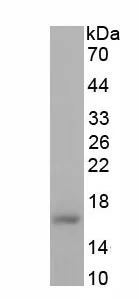 |
Greater than 95% as determined by reducing SDS-PAGE. |
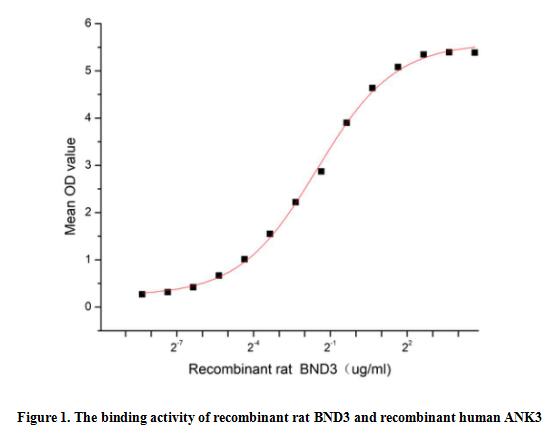 |
Band 3 (BND3), also known as Anion Exchanger 1 and SLC4A1, is a 90-100 kDa polytropic membrane protein that is part of the anion exchanger (AE) family and is expressed in the erythrocyte plasma membrane, where it mediates the exchange of the cellular HCO3- with CI- in plasma. BND3 is required for normal flexibility and stability of the erythrocyte membrane and for normal erythrocyte shape via the interactions of its cytoplasmic domain with cytoskeletal proteins, glycolytic enzymes, and hemoglobin. Scaffold protein Ankyrin 3, Node Of Ranvier (ANK3) can Interacts with BND3, thus a functional binding ELISA assay was conducted to detect the interaction of recombinant rat BND3 and recombinant human ANK3. Briefly, biotin-linked BND3 were diluted serially in PBS, with 0.01% BSA (pH 7.4). Duplicate samples of 100 ul were then transferred to ANK3-coated microtiter wells and incubated for 1h at 37℃. Wells were washed with PBST 3 times and incubation with Streptavidin-HRP for 30min, then wells were aspirated and washed 5 times. With the addition of substrate solution, wells were incubated 15-25 minutes at 37℃. Finally, add 50 µl stop solution to the wells and read at 450 nm immediately. The binding activity of recombinant rat BND3 and recombinant human ANK3 was shown in Figure 1, the EC50 for this effect is 0.35 ug/mL. |
| 分子别名Alternative Names | CD233SLC4A1SLC4-A1WDAE1DIEMPB3EPB3FRRTA1ASWWD1WRAnion Exchange Protein 1Solute Carrier Family 4,Anion Exchanger,Member 1Erythrocyte Membrane Protein Band 3 |
|---|---|
| 背景介绍Background | Functions both as a transporter that mediates electroneutral anion exchange across the cell membrane and as a structural protein. Major integral membrane glycoprotein of the erythrocyte membrane; required for normal flexibility and stability of the erythrocyte membrane and for normal erythrocyte shape via the interactions of its cytoplasmic domain with cytoskeletal proteins, glycolytic enzymes, and hemoglobin. Functions as a transporter that mediates the 1:1 exchange of inorganic anions across the erythrocyte membrane. Mediates chloride-bicarbonate exchange in the kidney, and is required for normal acidification of the urine. |
| 功能Function | Functions both as a transporter that mediates electroneutral anion exchange across the cell membrane and as a structural protein. Major integral membrane glycoprotein of the erythrocyte membrane; required for normal flexibility and stability of the erythrocyte membrane and for normal erythrocyte shape via the interactions of its cytoplasmic domain with cytoskeletal proteins, glycolytic enzymes, and hemoglobin. Functions as a transporter that mediates the 1:1 exchange of inorganic anions across the erythrocyte membrane. Mediates chloride-bicarbonate exchange in the kidney, and is required for normal acidification of the urine. |
| 亚细胞定位Subcellular Location | Cell membrane; Multi-pass membrane protein. Basolateral cell membrane; Multi-pass membrane protein. |
| 数据库链接Databases |
基因功能参考文献1 条
- in the structure and function of erythrocyte band 3. PMID: 24289085 : 24289085
蛋白复溶体积计算器缓冲液体积 = 蛋白质量 ÷ 蛋白浓度
输入任意两项,第三项自动计算 |
蛋白浓度稀释计算器初浓度 × 初体积 = 终浓度 × 终体积
输入任意三项,第四项自动计算 |



