


| 纯度Purity | Greater than 97% as determined by reducing SDS-PAGE. |
|---|---|
| 内毒素Endotoxin | Please contact with the lab for this information |
| 蛋白构建Protein Construction |
【Met1-Lys323】序列区间
|
| Accession | P07824 |
| 表达宿主Expression Host | E.coli |
| 种属Species | Rattus norvegicus (Rat) |
| 预测分子量Predicted MW | 36.2 kDa |
| 制剂Formulation | Lyophilized from a 0.2 μm filtered solution of 20mM Tris, 150mM NaCl, pH8.0, containing 1mM EDTA, 1mM DTT, 0.01% SKL, 5% Trehalose and Proclin300. |
| 运输方式Shipping | The product is shipped with ice bag. Upon receipt, store it immediately at the temperature listed below. |
| 稳定性&储存Stability & Storage | 12 months at -20°C to -80°C in lyophilized state.6 months at -20°C to -80°C under sterile conditions after reconstitution.7-10 days at 2°C to 8°C under sterile conditions after reconstitution.Please minimize freeze-thaw cycles. |
| 复溶Reconstitution | Reconstitute in 20mM Tris, 150mM NaCl (pH8.0) to a concentration of 0.1-1.0 mg/mL. Do not vortex. |
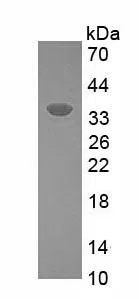 |
Greater than 97% as determined by reducing SDS-PAGE. |
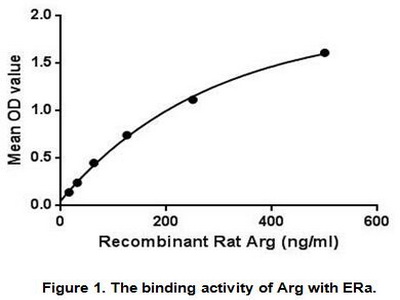 |
Arginase (Arg) is an enzyme that catalyzes the degradation of arginine to produce urea and omithine, which is crucial in the urea cycle. In most mammals, two isozymes of this enzyme exist; the first, Arginase I, functions in the urea cycle, and is located primarily in the cytoplasm of the liver. The second isozyme, Arginase II, has been implicated in the regulation of the arginine/ornithine concentrations in the cell. Besides, Estrogen Receptor Alpha (ERa) has been identified as an interactor of, thus a binding ELISA assay was conducted to detect the interaction of recombinant rat Arginase( Arg) and recombinant rat ERa. Briefly, Arg were diluted serially in PBS, with 0.01% BSA (pH 7.4). Duplicate samples of 100uL were then transferred to ERa-coated microtiter wells and incubated for 2h at 37℃. Wells were washed with PBST and incubated for 1h with anti-Arg pAb, then aspirated and washed 3 times. After incubation with HRP labelled secondary antibody, wells were aspirated and washed 3 times. With the addition of substrate solution, wells were incubated 15-25 minutes at 37℃. Finally, add 50µL stop solution to the wells and read at 450nm immediately. The binding activity of of Arg and ERa was shown in Figure 1, and this effect was in a dose dependent manner. |
| 分子别名Alternative Names | ARG1Arginase ILiver Arginase |
|---|---|
| 背景介绍Background | Key element of the urea cycle converting L-arginine to urea and L-ornithine, which is further metabolized into metabolites proline and polyamides that drive collagen synthesis and bioenergetic pathways critical for cell proliferation, respectively; the urea cycle takes place primarily in the liver and, to a lesser extent, in the kidneys.; Functions in L-arginine homeostasis in nonhepatic tissues characterized by the competition between nitric oxide synthase (NOS) and arginase for the available intracellular substrate arginine. Arginine metabolism is a critical regulator of innate and adaptive immune responses. Involved in an antimicrobial effector pathway in polymorphonuclear granulocytes (PMN). Upon PMN cell death is liberated from the phagolysosome and depletes arginine in the microenvironment leading to suppressed T cell and natural killer (NK) cell proliferation and cytokine secretion. In group 2 innate lymphoid cells (ILC2s) promotes acute type 2 inflammation in the lung and is involved in optimal ILC2 proliferation but not survival. Plays a role in the immune response of alternatively activated or M2 macrophages in processes such as wound healing and tissue regeneration, immune defense against multicellular pathogens and parasites, and immune suppression and allergic inflammation; the regulatory outcome seems to be organ specific. In tumor-infiltrating dendritic cells (DCs) and myeloid-derived suppressor cells (MDSCs) plays a role in suppression of T cell-mediated antitumor immunity. |
| 功能Function | Key element of the urea cycle converting L-arginine to urea and L-ornithine, which is further metabolized into metabolites proline and polyamides that drive collagen synthesis and bioenergetic pathways critical for cell proliferation, respectively; the urea cycle takes place primarily in the liver and, to a lesser extent, in the kidneys.; Functions in L-arginine homeostasis in nonhepatic tissues characterized by the competition between nitric oxide synthase (NOS) and arginase for the available intracellular substrate arginine. Arginine metabolism is a critical regulator of innate and adaptive immune responses. Involved in an antimicrobial effector pathway in polymorphonuclear granulocytes (PMN). Upon PMN cell death is liberated from the phagolysosome and depletes arginine in the microenvironment leading to suppressed T cell and natural killer (NK) cell proliferation and cytokine secretion. In group 2 innate lymphoid cells (ILC2s) promotes acute type 2 inflammation in the lung and is involved in optimal ILC2 proliferation but not survival. Plays a role in the immune response of alternatively activated or M2 macrophages in processes such as wound healing and tissue regeneration, immune defense against multicellular pathogens and parasites, and immune suppression and allergic inflammation; the regulatory outcome seems to be organ specific. In tumor-infiltrating dendritic cells (DCs) and myeloid-derived suppressor cells (MDSCs) plays a role in suppression of T cell-mediated antitumor immunity. |
| 亚细胞定位Subcellular Location | Cytoplasm. Cytoplasmic granule. |
| 数据库链接Databases |
基因功能参考文献25 条
- Arg1 expression, which is abundant in polarized M2 cells, is associated with strain/genotype differences from different pathways. PMID: 25872571 : 25872571
- Arginase promotes endothelial dysfunction and hypertension in obesity by reducing arginine bioavailability. PMID: 25557182 : 25557182
- Lower activity and expression levels of iNOS and higher activity and expression levels of arginase-1 in rat alveolar macrophages were found to be linked to the susceptibility of T. gondii infection in these cells PMID: 23691079 : 23691079
- Diabetes-induced increases in arginase I were involved in the diabetes-induced impairment of retinal blood flow by a mechanism involving vascular endothelial cell dysfunction. PMID: 23232640 : 23232640
- Report utility of arginase-1 for monitoring drug-induced liver injury in rat model. PMID: 22872058 : 22872058
- Arginase and methylated arginine derivatives appear to be essential modulators of the inflammatory response in the acute phase of a multiple sclerosis model. PMID: 22507752 : 22507752
- This study suggested that the increased level of arginase-1 in SCI is associated with an increase in macrophages and reactive astrocytes, possibly contributing to the modulation of inflammation during the course of SCI. PMID: 22325098 : 22325098
- we postulate that the increased level of arginase-1, which is partly from M2 macrophages, contributes to the modulation of neuroinflammation in experimental autoimmune encephalomyelitis lesions PMID: 22483960 : 22483960
- Arginase contributes significantly to L-proline supply for collagen synthesis in rat fibroblasts, in which arginase I is the predominant isoenzyme PMID: 20107769 : 20107769
- These findings reveal the basis for thrombin induction of endothelial arginase I and indicate that arginase inhibition may be an attractive therapeutic alternative in the setting of arterial thrombosis and its associated endothelial dysfunction. PMID: 20032511 : 20032511
- crystal structure: arginase-boronic acid complex highlights a physiological role in erectile function PMID: 10542097 : 10542097
- Regulates low-level NO production by neuronal NOS (nNOS), most likely by competing for L-arginine. PMID: 11829529 : 11829529
- Mechanisms involved in substrate binding and catalysis are elucidated via synthesis and evaluation of alternative substrate. PMID: 12020133 : 12020133
- The upregulation of the arginase expression in wound derived fibroblasts underlines the distinct regulation of l-arginine metabolism in WFBs. PMID: 12069499 : 12069499
- Total arginase activity and arginase I and II protein expression did not differ between the young and aged groups in the prefrontal cortex. PMID: 15013576 : 15013576
- The highest affinity inhibitorsof Arg1 displace the metal-bridging hydroxide ion (and sometimes occupy a Mn(2+)(A) site found vacant in the native enzyme) and maintain a conserved array of hydrogen bonds with their alpha-amino and -carboxylate groups. PMID: 15248756 : 15248756
- Arg I plays a critical role in the pathobiology of age-related endothelial dysfunction. PMID: 16380531 : 16380531
- Arginase I protein was undetectable in the non-pregnant myometrium and up-regulated at term gestation, contributing to enhanced overall arginase activity at term gestation. PMID: 16735458 : 16735458
- Arginase acts as central regulator of trophic factor-deprived motor neuron survival by suppressing nitric oxide production and consequent peroxynitrite toxicity. Resistance of motor neurons to trophic factor deprivation may result from increased arginase. PMID: 16914676 : 16914676
- Thus, in addition to enhancing the expression of Arg I and spermine in repaired spinal cords, our treatment may recruit activated macrophages and create a more favorable environment for axonal regrowth. PMID: 17418108 : 17418108
- diabetes-induced impairment of vasorelaxation to acetylcholine was correlated with increases in reactive oxygen species and arginase activity and arginase I expression in aorta and liver. PMID: 17967788 : 17967788
- Arginase promotes neointima formation in rat injured carotid arteries. PMID: 19164802 : 19164802
- upregulation of Arg I and increased synthesis of polyamines play an important role in the conditioning lesion effect, and spermidine is sufficient to promote optic nerve regeneration in vivo PMID: 19641117 : 19641117
- Data indicate that iNOS-dependent S-nitrosylation of arginase 1 and the increase in arginase activity lead to eNOS uncoupling, contributing to the nitroso-redox imbalance, endothelial dysfunction, and vascular stiffness observed in vascular aging. PMID: 19661445 : 19661445
- Limits iNOS-mediated NO synthese in macrophages, probably by limiting L-arginine availability for iNOS (substrate competition) PMID: 9179379 : 9179379
蛋白复溶体积计算器缓冲液体积 = 蛋白质量 ÷ 蛋白浓度
输入任意两项,第三项自动计算 |
蛋白浓度稀释计算器初浓度 × 初体积 = 终浓度 × 终体积
输入任意三项,第四项自动计算 |



