


| 纯度Purity | Greater than 97% as determined by reducing SDS-PAGE. |
|---|---|
| 内毒素Endotoxin | Please contact with the lab for this information |
| 蛋白构建Protein Construction |
【Met1-Gln210】序列区间
|
| Accession | P04906 |
| 表达宿主Expression Host | E.coli |
| 种属Species | Rattus norvegicus (Rat) |
| 预测分子量Predicted MW | 24.7 kDa |
| 制剂Formulation | Lyophilized from a 0.2 μm filtered solution of 20mM Tris, 150mM NaCl, pH8.0, containing 1mM EDTA, 1mM DTT, 0.01% SKL, 5% Trehalose and Proclin300. |
| 运输方式Shipping | The product is shipped with ice bag. Upon receipt, store it immediately at the temperature listed below. |
| 稳定性&储存Stability & Storage | 12 months at -20°C to -80°C in lyophilized state.6 months at -20°C to -80°C under sterile conditions after reconstitution.7-10 days at 2°C to 8°C under sterile conditions after reconstitution.Please minimize freeze-thaw cycles. |
| 复溶Reconstitution | Reconstitute in 10mM PBS (pH7.4) to a concentration of 0.1-1.0 mg/mL. Do not vortex. |
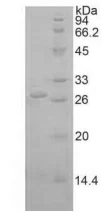 |
Greater than 97% as determined by reducing SDS-PAGE. |
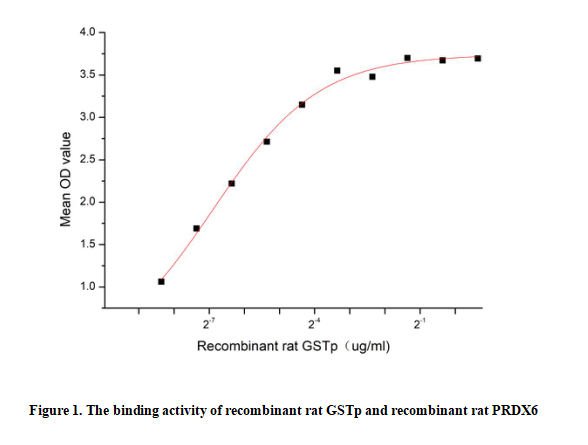 |
Recombinant Glutathione S Transferase Pi (GSTp) is a key enzyme in the body. It conjugates glutathione with electrophilic substances, playing a vital role in detoxification and antioxidant defense. GSTp is involved in protecting cells from harmful substances and oxidative stress by binding with PRDX6 .Thus a functional ELISA assay was conducted to detect the interaction of recombinant rat GSTp and recombinant rat PRDX6. Briefly, GSTp was diluted serially in PBS with 0.01% BSA (pH 7.4). Duplicate samples of 100 μl were then transferred to PRDX6-coated microtiter wells and incubated for 1h at 37℃. Wells were washed with PBST and incubated for 1h with anti-GSTp pAb, then aspirated and washed 3 times. After incubation with HRP labelled secondary antibody for 1h at 37℃, wells were aspirated and washed 5 times. With the addition of substrate solution, wells were incubated 15-25 minutes at 37℃. Finally, add 50 µL stop solution to the wells and read at 450/630nm immediately. The binding activity of recombinant rat GSTp and recombinant rat PRDX6 was shown in Figure 1, the EC50 for this effect is 0.008ug/mL. |
| 分子别名Alternative Names | GSTP1GST-P1DFN7FAEES3GST3 |
|---|---|
| 背景介绍Background | Conjugation of reduced glutathione to a wide number of exogenous and endogenous hydrophobic electrophiles. Involved in the formation of glutathione conjugates of both prostaglandin A2 (PGA2) and prostaglandin J2 (PGJ2). Participates in the formation of novel hepoxilin regioisomers. Regulates negatively CDK5 activity via p25/p35 translocation to prevent neurodegeneration. |
| 功能Function | Conjugation of reduced glutathione to a wide number of exogenous and endogenous hydrophobic electrophiles. Involved in the formation of glutathione conjugates of both prostaglandin A2 (PGA2) and prostaglandin J2 (PGJ2). Participates in the formation of novel hepoxilin regioisomers. Regulates negatively CDK5 activity via p25/p35 translocation to prevent neurodegeneration. |
| 亚细胞定位Subcellular Location | Cytoplasm. Mitochondrion. Nucleus. |
| 数据库链接Databases |
基因功能参考文献20 条
- The cytotoxic action of 2-acetylaminofluorene that give rise to the GST-P(+) single hepatocytes was suggested to be an injury to the excretory pump(s) and the duct of hepatocytes. A new physiological mechanism was hypothesized for the induction of preneoplastic cell populations in the rat liver instead of a genetic mechanism. PMID: 29501922 : 29501922
- Data suggest that expression of Gstp1 can be regulated by dietary factors; here, Gstp1 is induced in hepatocytes by carnosic acid, an anticarcinogenic component of rosemary (Rosmarinus officinalis). PMID: 25974399 : 25974399
- Data show that Valerian extract inhibits hepatocarcinogenesis by suppressing cell proliferation and inducing apoptosis in glutathione S-transferase pi GST-P(+) foci by activating gamma-aminobutyric acid A receptor GABA(A)RA1-mediated signaling. PMID: 25419570 : 25419570
- Cisplatin metabolism in different organs of rats correlated positively with specific GSTP1 activities and this enzyme may be a critical determinant of extent of cellular uptake or retention of cisplatin in renal and liver tissues. PMID: 24474500 : 24474500
- GSTP1 application early after myocardial infarction results in long-term beneficial structural and functional effects that prevent progression to heart faiilure. PMID: 24412522 : 24412522
- GST-P(-) foci induced by promotion with agonists of peroxisome proliferator-activated receptor-alpha. PMID: 20423715 : 20423715
- GSTpi directly associated with signal transducer and activator of transcription 3 (STAT3) to prevent Angiotensin II-triggered binding of Src to STAT3. PMID: 24321768 : 24321768
- The change in expression of GST-pi in peripheral blood showed the same pattern as that in brain tissues, suggesting GST-pi might contribute to drug resistance in epilepsy. PMID: 22038365 : 22038365
- GST-P-positive lesions may involve a mechanism facilitating lipid peroxidation PMID: 20091025 : 20091025
- Exposure to diesel exhaust particles elevated transcription of glutathione-s-transferase gene in rat alveolar macrophages. PMID: 12011483 : 12011483
- GSTpi proteins play an important role in the development of acquired drug resistance to various drugs of prostate cancer cells. PMID: 15809768 : 15809768
- glutathione S-transferase P1 is induced by proteasome inhibitors PMID: 15863507 : 15863507
- Hepaticcgene expression is upregulated by a limited availability of sulfur amino acids PMID: 15867277 : 15867277
- GST-Pi expression was induced by the metabolites of cyclophoshamide. PMID: 16242832 : 16242832
- Expression of GST-P gene is down-regulated by CCAAT enhancer-binding protein alpha in normal liver. PMID: 16407263 : 16407263
- Drug resistant prostate cancer cells displayed significantly increased expression of GSTP1 with other prostate cancer cells. PMID: 16728343 : 16728343
- The upregulation of MIF and GSTpi during the development of acquired drug resistance of hormone independent prostate cancer may modulate the activation of gp-170 PMID: 16728344 : 16728344
- Expression of GST-P is correlated with cellular proliferation and is associated with risk and progression of oral cancer. PMID: 17596925 : 17596925
- These data indicate that expression of GST-P may reflect the carcinogenic effect of cigarette smoke as well as the genetic susceptibility of animals in relation to continuous carcinogens exposure. PMID: 17786572 : 17786572
- development of GST-P-negative foci during the early stage of hepatocarcinogenesis PMID: 18081878 : 18081878
蛋白复溶体积计算器缓冲液体积 = 蛋白质量 ÷ 蛋白浓度
输入任意两项,第三项自动计算 |
蛋白浓度稀释计算器初浓度 × 初体积 = 终浓度 × 终体积
输入任意三项,第四项自动计算 |



