


| 纯度Purity | Greater than 95% as determined by reducing SDS-PAGE. |
|---|---|
| 内毒素Endotoxin | Please contact with the lab for this information |
| 蛋白构建Protein Construction |
【His20-Ser230】序列区间
|
| Accession | P48199 |
| 表达宿主Expression Host | E.coli |
| 种属Species | Rattus norvegicus (Rat) |
| 预测分子量Predicted MW | 27.0 kDa |
| 制剂Formulation | Lyophilized from a 0.2 μm filtered solution of PBS, pH7.4, containing 0.01% SKL, 1mM DTT, 5% Trehalose and Proclin300. |
| 运输方式Shipping | The product is shipped with ice bag. Upon receipt, store it immediately at the temperature listed below. |
| 稳定性&储存Stability & Storage | 12 months at -20°C to -80°C in lyophilized state.6 months at -20°C to -80°C under sterile conditions after reconstitution.7-10 days at 2°C to 8°C under sterile conditions after reconstitution.Please minimize freeze-thaw cycles. |
| 复溶Reconstitution | Reconstitute in 10mM PBS (pH7.4) to a concentration of 0.1-1.0 mg/mL. Do not vortex. |
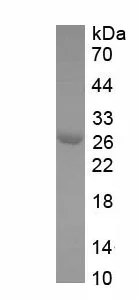 |
Greater than 95% as determined by reducing SDS-PAGE. |
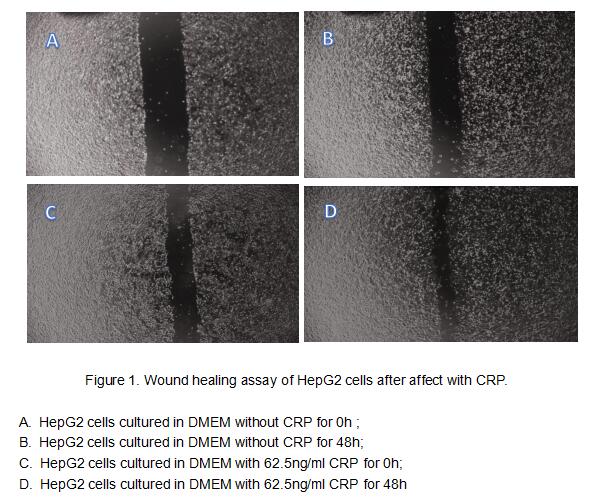 |
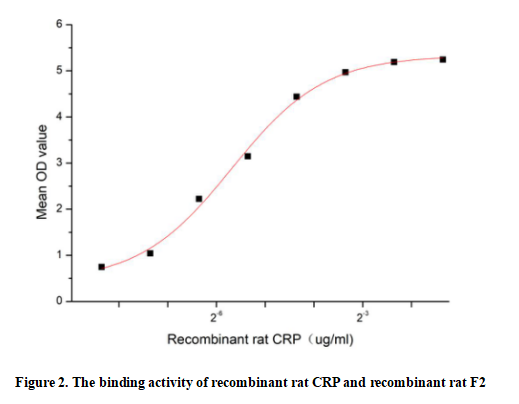
C-reactive protein (CRP) is an annular (ring-shaped), pentameric protein found in blood plasma, whose levels rise in response to inflammation. It is an acute-phase protein of hepatic origin that increases following interleukin-6 secretion by macrophages and T cells. Its physiological role is to bind to lysophosphatidylcholine expressed on the surface of dead or dying cells (and some types of bacteria) in order to activate the complement system via C1q.Besides,CRP have been proved can promote migration of HepG2 cells, 5×10⁴ cells were seeded into 6 well plates. After cell confluent, using a (yellow) pipette tip make a straight scratch, simulating a wound, then washing the wells three times with PBS. Adding 1% serum standard DMEM containing various concentrations of recombinan rat CRP to each well, incubating the plate for 48 hours at 37℃, 5% CO2. Use Image J to measure the area of a scratch, then caculate the cell motility with (0harea -48harea)/0harea ×100%. After affect with 62.5ng/ml CRP for 48h, cell motility is 47%,wiithout affect by CRP, the cell motility is 27%. The results observed by inverted microscope was shown in Figure1. C reactive protein (CRP) is an annular (ring-shaped), pentameric protein found in blood plasma, whose levels rise in response to inflammation. It is an acute-phase protein of hepatic origin that increases following interleukin-6 secretion by macrophages and T cells. Its physiological role is to bind to lysophosphatidylcholine expressed on the surface of dead or dying cells (and some types of bacteria) in order to activate the complement system via C1q. Besides, Coagulation Factor II (F2) has been identified as an interactor of CRP, thus a functional binding ELISA assay was conducted to detect the interaction of recombinant rat CRP and recombinant rat F2. Briefly, CRP was diluted serially in PBS with 0.01% BSA (pH 7.4). Duplicate samples of 100 μl were then transferred to F2-coated microtiter wells and incubated for 1h at 37℃. Wells were washed with PBST and incubated for 1h with anti-CRP pAb, then aspirated and washed 3 times. After incubation with HRP labelled secondary antibody for 1h at 37℃, wells were aspirated and washed 5 times. With the addition of substrate solution, wells were incubated 15-25 minutes at 37℃. Finally, add 50 µL stop solution to the wells and read at 450/630 nm immediately. The binding activity of recombinant rat CRP and recombinant rat F2 was shown in Figure 1, the EC50 for this effect is 0.019 ug/mL. |
 |
| 分子别名Alternative Names | C-RPPTX1Pentraxin-RelatedPentraxin 1 |
|---|---|
| 背景介绍Background | Displays several functions associated with host defense: it promotes agglutination, bacterial capsular swelling, phagocytosis and complement fixation through its calcium-dependent binding to phosphorylcholine. Can interact with DNA and histones and may scavenge nuclear material released from damaged circulating cells. |
| 功能Function | Displays several functions associated with host defense: it promotes agglutination, bacterial capsular swelling, phagocytosis and complement fixation through its calcium-dependent binding to phosphorylcholine. Can interact with DNA and histones and may scavenge nuclear material released from damaged circulating cells. |
| 亚细胞定位Subcellular Location | Secreted. |
| 数据库链接Databases |
基因功能参考文献31 条
- coordinated upregulation of genes encoding CRP, interleukin-6 (IL-6), HNF1alpha, and HNF4alpha in the livers and white adipose tissue (WAT) of chronic renal failure rats, as compared to the pair-fed and control animals. PMID: 29330688 : 29330688
- CRP: varied between DJOS and SHAM groups maintained on HF/HF, CD/CD, and CD/HF. PMID: 29849871 : 29849871
- Fibrinopeptide A induces CRP expression in Vascular Smooth Muscle Cells via Reactive Oxygen Species-ERK1/2/p38-NF-kappaB signal pathway. PMID: 29768263 : 29768263
- Knockdown of ZFAS1 or miR-150 overexpression effectively relieved AMI-induced myocardial infarction in AMI-1 week rats. The ZFAS1/miR-150 axis was involved in the molecular mechanism of AMI induced cardiomyocytes apoptosis via regulating CRP PMID: 28295592 : 28295592
- Epigallocatechin-3-gallate inhibits Ang II-induced CRP generation by interfering with AT1-ROS-ERK1/2 signal pathway in hepatocytes, preventing inflammation. PMID: 27492718 : 27492718
- Salvianolic acid B exerted anti-steatotic and anti-inflammatory effects against alcoholic liver injury by inducing SIRT1-mediated inhibition of CRP and ChREBP expression. PMID: 27989594 : 27989594
- Rosiglitazone inhibits angiotensin II-induced C-reactive protein generation by interfering with AT1-ROS-ERK1/2/JNK signal pathway and up-regulating PPARgamma expression in hepatocytes PMID: 26741265 : 26741265
- These findings provide evidence that, in the presence of high CRP levels, rosuvastatin exhibits significant anti-inflammatory, anti-oxidative, and renoprotective effects. PMID: 25536316 : 25536316
- Data show that palmitic acid significantly stimulated mRNA and protein expression of C-reactive protein, inducible nitric oxide synthase and tumor necrosis factor-alpha in vascular smooth muscle cells in time- and concentration-dependent manners. PMID: 25242580 : 25242580
- No correlation was found between CRP levels and microvascular or macrovascular dysfunction in adjuvant-induced arthritis. PMID: 25708190 : 25708190
- Homocysteine initiates an inflammatory response in VSMCs by stimulating CRP production via the NMDAr-ROS-ERK1/2/p38-NF-kappaB signal pathway. PMID: 25016361 : 25016361
- CRP and IgM depositions demonstrate a parallel time course throughout the reperfusion to hepatocellular damage, inflammatory response and activated complement deposition in an ischemia-reperfusion model. PMID: 24642533 : 24642533
- These demonstrate that aldosterone is able to induce CRP expression via MR-ROS-ERK1/2-NF-kappaB signal pathway in VSMCs, which provides a new evidence for the proinflammatory and proatherosclerotic effects of aldosterone. PMID: 25109280 : 25109280
- Monomeric CRP localized with inflammatory cells in infarcted myocardium. Intravenous pCRP administration significantly enhanced leukocyte rolling, adhesion, and transmigration via localized dissociation to mCRP in inflamed cremaster muscle. PMID: 24982116 : 24982116
- In older animals, there is depressed PAP expression related to a blunted inflammatory response in acute pancreatitis which is associated with worsened bacterial infiltration and higher C-reactive protein level PMID: 22807607 : 22807607
- PDIA3 might be potentially involve into the occurence and development of acute rejection response in renal transplantation and increased plasma IL-2, IL-4, IL-6, and CRP levels play an important role to prevent acute kidney allograft rejection in rats. PMID: 22201020 : 22201020
- C-reactive protein down-regulates endothelial nitric oxide synthase expression and promotes apoptosis in endothelial progenitor cells through receptor for advanced glycation end-products PMID: 22301267 : 22301267
- After attachment of polymeric CRP to the surface of necrotic cardiomyocytes, generation of monomeric CRP was demonstrated over a period of 18 h. PMID: 21856781 : 21856781
- This finding could indicate a possible role for CRP in the progression of small vessel disease in the brain and provide a therapeutic target PMID: 21840509 : 21840509
- C-reactive protein and tumour necrosis factor-alpha are elevated in collagen-induced arthritis in Dark Agouti rats PMID: 21633874 : 21633874
- Increased levels of CRP are an early sign of alcoholic fatty liver in rats. PMID: 21806828 : 21806828
- C-reactive protein exerts a proinflammatory action via Toll-like receptor 4-dependent signaling pathway (AT(1)R-p38 MAPK-TLR4-PKCalpha) in rat vascular smooth muscle cells. PMID: 20332628 : 20332628
- CRP may cause insulin resistance by increasing IRS-1 phosphorylation at Ser(307) and Ser(612) via JNK and ERK1/2, respectively, leading to impaired insulin-stimulated glucose uptake, GLUT4 translocation, and glycogen synthesis PMID: 17279354 : 17279354
- the Ala12 allele of PPARG2 may be an independent factor associated with low serum hs-CRP levels in Japanese females PMID: 17574226 : 17574226
- levels of C-reactive protein and adiponectin are improved after exercise training in diabetic rats PMID: 17660720 : 17660720
- CRP and IgM depositions correlated well with local complement activation, which suggests a role of these molecules in complement activation PMID: 17981193 : 17981193
- CRP levels and cardiovascular disease risk and the long term clinical outcome after acute coronary syndrome but such correlation has yet to be proven regarding CRP and atherosclerosis. PMID: 18254451 : 18254451
- C-reactive protein stimulates superoxide anion release and tissue factor activity in vivo PMID: 18621373 : 18621373
- CRP at clinically relevant concentrations (10 to 20 microg/mL) causes a disruption of the blood-brain barrier PMID: 19246692 : 19246692
- The results suggest that CRP contributes to memory loss and early phase of pathogenesis of Alzheimer disease PMID: 19263040 : 19263040
- The results demonstrate that ET-1 induces CPR production in VSMCs via ET(A) receptor followed by ROS and MAPK signal pathway. PMID: 19748488 : 19748488
蛋白复溶体积计算器缓冲液体积 = 蛋白质量 ÷ 蛋白浓度
输入任意两项,第三项自动计算 |
蛋白浓度稀释计算器初浓度 × 初体积 = 终浓度 × 终体积
输入任意三项,第四项自动计算 |



