


| 纯度Purity | Greater than 95% as determined by reducing SDS-PAGE. |
|---|---|
| 内毒素Endotoxin | Please contact with the lab for this information |
| 蛋白构建Protein Construction |
【Gln24-Val182】序列区间
|
| Accession | P26051 |
| 表达宿主Expression Host | E.coli |
| 种属Species | Rattus norvegicus (Rat) |
| 预测分子量Predicted MW | 21.4 kDa |
| 制剂Formulation | Lyophilized from a 0.2 μm filtered solution of PBS, pH7.4, containing 0.01% SKL, 1mM DTT, 5% Trehalose and Proclin300. |
| 运输方式Shipping | The product is shipped with ice bag. Upon receipt, store it immediately at the temperature listed below. |
| 稳定性&储存Stability & Storage | 12 months at -20°C to -80°C in lyophilized state.6 months at -20°C to -80°C under sterile conditions after reconstitution.7-10 days at 2°C to 8°C under sterile conditions after reconstitution.Please minimize freeze-thaw cycles. |
| 复溶Reconstitution | Reconstitute in 10mM PBS (pH7.4) to a concentration of 0.1-1.0 mg/mL. Do not vortex. |
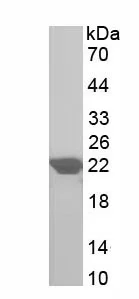 |
Greater than 95% as determined by reducing SDS-PAGE. |
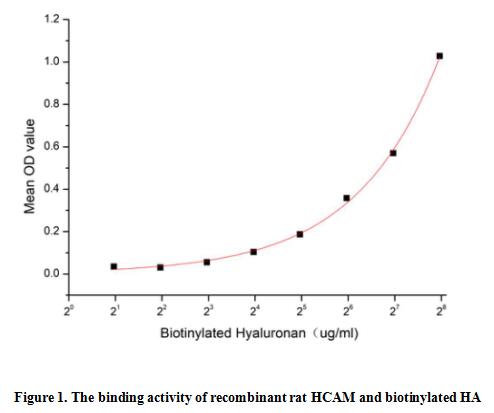 |
Homing Associated Cell Adhesion Molecule (HCAM), also known as CD44, is a ubiquitous multistructural and multifunctional cells surface adhesion molecule involved in cell-cell and cell-matrix interactions. CD44 is broadly expressed, including in the membranes of B cells, granulocytes, monocytes, and erythrocytes as well as on many thymocytes and mature T cells, besides it is highly expressed in many cancers and regulates metastasis via recruitment of CD44 to the cell surface. This protein is a receptor for hyaluronic acid (HA) and can also interact with other ligands, such as osteopontin, collagens, and matrix metalloproteinases (MMPs). Thus a functional binding ELISA assay was conducted to detect the interaction of recombinant rat HCAM and biotinylated hyaluronan (HA). Briefly, biotin-linked HA were diluted serially in PBS, with 0.01% BSA (pH 7.4). Duplicate samples of 100 ul were then transferred to HCAM-coated microtiter wells and incubated for 2h at 37℃. Wells were washed with PBST 3 times and incubation with Streptavidin-HRP for 1 hour, then wells were aspirated and washed 5 times. With the addition of substrate solution, wells were incubated 15-25 minutes at 37℃. Finally, add 50 µl stop solution to the wells and read at 450/630 nm immediately. The binding activity of recombinant rat HCAM and biotinylated HA was shown in Figure 1, and this effect was in a dose dependent manner. |
| 分子别名Alternative Names | CDW44CD44CSPG8ECMR-IIIHCELLINLHRMC56MDU2MDU3MIC4MUTCH-IPgp1Hematopoietic Cell E- And L-Selectin LigandChondroitin Sulfate Proteoglycan 8 |
|---|---|
| 背景介绍Background | Cell-surface receptor that plays a role in cell-cell interactions, cell adhesion and migration, helping them to sense and respond to changes in the tissue microenvironment. Participates thereby in a wide variety of cellular functions including the activation, recirculation and homing of T-lymphocytes, hematopoiesis, inflammation and response to bacterial infection. Engages, through its ectodomain, extracellular matrix components such as hyaluronan/HA, collagen, growth factors, cytokines or proteases and serves as a platform for signal transduction by assembling, via its cytoplasmic domain, protein complexes containing receptor kinases and membrane proteases. Such effectors include PKN2, the RhoGTPases RAC1 and RHOA, Rho-kinases and phospholipase C that coordinate signaling pathways promoting calcium mobilization and actin-mediated cytoskeleton reorganization essential for cell migration and adhesion. |
| 功能Function | Cell-surface receptor that plays a role in cell-cell interactions, cell adhesion and migration, helping them to sense and respond to changes in the tissue microenvironment. Participates thereby in a wide variety of cellular functions including the activation, recirculation and homing of T-lymphocytes, hematopoiesis, inflammation and response to bacterial infection. Engages, through its ectodomain, extracellular matrix components such as hyaluronan/HA, collagen, growth factors, cytokines or proteases and serves as a platform for signal transduction by assembling, via its cytoplasmic domain, protein complexes containing receptor kinases and membrane proteases. Such effectors include PKN2, the RhoGTPases RAC1 and RHOA, Rho-kinases and phospholipase C that coordinate signaling pathways promoting calcium mobilization and actin-mediated cytoskeleton reorganization essential for cell migration and adhesion. |
| 亚细胞定位Subcellular Location | Cell membrane; Single-pass type I membrane protein. Cell projection, microvillus. |
| 数据库链接Databases | UniGeneRn.1120 |
基因功能参考文献35 条
- The findings indicate for the first time that regulation of Rac1 activity is responsible for hyaluronidase and CD44-driven morphological changes of astrocytes. PMID: 27163367 : 27163367
- results suggest that the AT1 receptor is involved in development of hypertension and cardiac fibrosis. Selective activating ACE2/eNOS and inhibiting CD44/HA interaction might be considered as the therapeutic targets for attenuating Ang II induced deleterious cardiovascular effects PMID: 27085217 : 27085217
- Results define a clinically relevant role for signaling by the hyaluronan receptor, CD44, in increased responsiveness to mechanical stimulation PMID: 26996509 : 26996509
- Peptide inhibitors of CD44v6 isoforms block tumor growth and metastasis in several independent models of pancreatic cancer. PMID: 26597578 : 26597578
- Expression of CD44 followed the same temporal pattern as hyaluronic acid deposition in a bladder regeneration model. PMID: 25253654 : 25253654
- Results indicate a novel role for CD44 as an essential regulator of dendritic arbor complexity in both health and disease. PMID: 25300795 : 25300795
- Data show that hyaluronan receptor CD44 undergoes co-internalization with hyaluronan endocytosis. PMID: 25733665 : 25733665
- release of the CD44 intracellular domain into the cytoplasm of cells such as chondrocytes exerts a competitive or dominant-negative effect on the function of full-length CD44. PMID: 23884413 : 23884413
- CD44 is a key molecule in the migration of OPCs toward the focal inflammatory demyelinated lesion induced by zymosan PMID: 23280959 : 23280959
- after experimental TBI, hippocampal neurons grew well on an OPN substrate with growth comparable to that seen on laminin, but showed a higher degree of primary neurites; growth on OPN was mediated through beta1 intregrins and CD44. T PMID: 22692550 : 22692550
- Upregulation of hyaluronan and its binding receptors CD44 and LYVE-1 are involved in interstitial fibrosis in chronic cyclosporine-induced renal injury. PMID: 20470282 : 20470282
- Results describe how CD44 regulates the motility and invasive growth of B35 neuroblastoma cells into a hyaluronan-rich environment. PMID: 20056122 : 20056122
- Data show that Hyal2, through direct interactions with CD44 and possibly some pericellular hyaluronidase activity suppresses the formation or the stability of the glycocalyx, modulates ERM-related cytoskeletal interactions, and diminishes cell motility. PMID: 19783662 : 19783662
- Data show that neither CD44v nor exosomes alone suffice for (pre)metastatic niche formation. PMID: 19794968 : 19794968
- role of colocalization with osteopontin in migration, cell fusion, and resorption in osteoclasts PMID: 12162503 : 12162503
- Data show that CD44 antigen is upregulated on all migrating cells and on newly formed blood vessels at the onset of the foreign body reaction. PMID: 12579564 : 12579564
- Microarray analysis and RNA silencing link fra-1 to the expression of this antigen and c-met expresssion in mesothelioma. PMID: 12839939 : 12839939
- Cd44 variant isoforms associate with tetraspanins and EpCAM. PMID: 15212938 : 15212938
- Cd44 expression identifies astrocyte-restricted precursor cells. PMID: 15531362 : 15531362
- The helper and cytotoxic subsets of T cells, as well as B cells, display the increased expression of CD44, intercellular adhesion molecule 1 and lymphocyte function associated antigen 1 PMID: 15624701 : 15624701
- migration of rat hepatic stellate cells requires hyaluronic acid and CD44v6 PMID: 15691832 : 15691832
- NCoR, GAF, and TR interact with the CD44 negative T(3)-responsive element to enhance basal transactivation, whereas T(3) induces the remodeling of chromatin structure for repression PMID: 15701601 : 15701601
- role of CD44-hyaluronan interaction in mesenchymal stem cell migration in the extracellular matrix PMID: 16306150 : 16306150
- CD44 is a specific marker of small hepatocytes. PMID: 16580085 : 16580085
- CD44 is probably involved in early leukocyte infiltration, in tubular regeneration, and in macrophage activity in the rat kidney after ischemia/reperfusion injury. PMID: 16786159 : 16786159
- The expression pattern of CD44 was studied in the rat testis following ischemia/reperfusion (I/R) injury to elucidate the possible role of the CD44 adhesion molecule in acute experimental testicular torsion. PMID: 16891795 : 16891795
- The association of ezrin, radixin and moesin proteins to the coreceptor is absolutely required to mediate the hepatocyte growth factor-dependent activation of Ras by the guanine nucleotide exchange factor Sos. PMID: 17065554 : 17065554
- CD44 has a pivotal role in the trans-endothelial migration of NPCs across brain endothelial cells PMID: 18450824 : 18450824
- CD44-hyaluronan interaction, by enhancing biliary proliferation, may play a pathogenic role in the development of cholestatic liver diseases. PMID: 18556418 : 18556418
- Data show that the rapid and transient induction of CD44 occurrs in activated microglia/macrophages following transient forebrain ischemia. PMID: 18638458 : 18638458
- CD44 upregulation in neurons is affected by local chondroitin sulfate proteoglycan expression. PMID: 18694596 : 18694596
- CD44 variant isoforms promote metastasis formation by a tumor cell-matrix cross-talk that supports adhesion and apoptosis resistance. PMID: 19208744 : 19208744
- CD44 may play an important role in the development of airway inflammatory in asthma. PMID: 19222954 : 19222954
- Importantly, TSC activation upon ALS-like neurodegeneration results in significant increase in molecular proximity of CD44 and ErbB3, which may have an impact on glial plasticity at the NMJ. PMID: 19385056 : 19385056
- Results suggest that Tra2beta may regulate cellular oxidative response by changing alternative splicing of distinct genes including CD44. PMID: 19439532 : 19439532
蛋白复溶体积计算器缓冲液体积 = 蛋白质量 ÷ 蛋白浓度
输入任意两项,第三项自动计算 |
蛋白浓度稀释计算器初浓度 × 初体积 = 终浓度 × 终体积
输入任意三项,第四项自动计算 |



