


Recombinant Transient Receptor Potential Cation Channel Subfamily M, Member 4 (TRPM4)(N-6His)
Alternative NamesTRPM4B; Melastatin-4; Calcium-activated non-selective cation channel 1; Long transient receptor potential channel 4
规格参数 Specifications
| 纯度Purity | Greater than 90% as determined by reducing SDS-PAGE. |
|---|---|
| 内毒素Endotoxin | <1 EU/µg as determined by LAL test. |
| 蛋白构建Protein Construction |
6HisN 端标签-【Met1-Leu450】序列区间
|
| Accession | Q7TN37 |
| 表达宿主Expression Host | E.coli |
| 种属Species | Mus musculus (Mouse) |
| 预测分子量Predicted MW | 52.7 kDa |
| 制剂Formulation | Lyophilized from a 0.2 μm filtered solution of 20mM Tris, 150mM NaCl, pH8.0, containing 1mM EDTA, 1mM DTT, 0.01% SKL, 5% Trehalose and Proclin300. |
| 运输方式Shipping | The product is shipped with ice bag. Upon receipt, store it immediately at the temperature listed below. |
| 稳定性&储存Stability & Storage | 12 months at -20°C to -80°C in lyophilized state.6 months at -20°C to -80°C under sterile conditions after reconstitution.7-10 days at 2°C to 8°C under sterile conditions after reconstitution.Please minimize freeze-thaw cycles. |
| 复溶Reconstitution | Reconstitute in 20mM Tris, 150mM NaCl (pH8.0) to a concentration of 0.1-1.0 mg/mL. Do not vortex. |
!
本司产品仅用于科研,不用于临床诊断和治疗。
产品图片 Product Images点击图片可查看原图
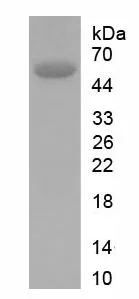 |
Greater than 90% as determined by reducing SDS-PAGE. |
靶点信息 Target Information
| 分子别名Alternative Names | TRPM4BMelastatin-4Calcium-activated non-selective cation channel 1Long transient receptor potential channel 4 |
|---|---|
| 背景介绍Background | Calcium-activated non selective (CAN) cation channel that mediates membrane depolarization. While it is activated by increase in intracellular Ca(2+), it is impermeable to it. Mediates transport of monovalent cations (Na(+) > K(+) > Cs(+) > Li(+)), leading to depolarize the membrane. It thereby plays a central role in cadiomyocytes, neurons from entorhinal cortex, dorsal root and vomeronasal neurons, endocrine pancreas cells, kidney epithelial cells, cochlea hair cells etc. Participates in T-cell activation by modulating Ca(2+) oscillations after T lymphocyte activation, which is required for NFAT-dependent IL2 production. Involved in myogenic constriction of cerebral arteries. Controls insulin secretion in pancreatic beta-cells. May also be involved in pacemaking or could cause irregular electrical activity under conditions of Ca(2+) overload. Affects T-helper 1 (Th1) and T-helper 2 (Th2) cell motility and cytokine production through differential regulation of calcium signaling and NFATC1 localization. Enhances cell proliferation through up-regulation of the beta-catenin signaling pathway. Essential for the migration but not the maturation of dendritic cells. Plays a role in keratinocyte differentiation. |
| 功能Function | Calcium-activated non selective (CAN) cation channel that mediates membrane depolarization. While it is activated by increase in intracellular Ca(2+), it is impermeable to it. Mediates transport of monovalent cations (Na(+) > K(+) > Cs(+) > Li(+)), leading to depolarize the membrane. It thereby plays a central role in cadiomyocytes, neurons from entorhinal cortex, dorsal root and vomeronasal neurons, endocrine pancreas cells, kidney epithelial cells, cochlea hair cells etc. Participates in T-cell activation by modulating Ca(2+) oscillations after T lymphocyte activation, which is required for NFAT-dependent IL2 production. Involved in myogenic constriction of cerebral arteries. Controls insulin secretion in pancreatic beta-cells. May also be involved in pacemaking or could cause irregular electrical activity under conditions of Ca(2+) overload. Affects T-helper 1 (Th1) and T-helper 2 (Th2) cell motility and cytokine production through differential regulation of calcium signaling and NFATC1 localization. Enhances cell proliferation through up-regulation of the beta-catenin signaling pathway. Essential for the migration but not the maturation of dendritic cells. Plays a role in keratinocyte differentiation. |
| 亚细胞定位Subcellular Location | Cell membrane; Multi-pass membrane protein. Endoplasmic reticulum. Golgi apparatus. |
| 数据库链接Databases |
基因功能参考文献36 条
- The activation of TRPM4 during ischemia-reperfusion injury involves the increase in both, intracellular calcium and H2O2, which may act together to produce a sustained activation of the channel. PMID: 28876976 : 28876976
- Both TRPM4 and TRPM5 are required for normal responses to bitter, sweet, and umami stimuli. PMID: 29311301 : 29311301
- The findings of this study demonstrated a novel molecular mechanism involving the SUR1-TRPM4-AQP4 complex to account for bulk water influx during astrocyte swelling. PMID: 28906027 : 28906027
- Calcium studies demonstrated that TRPM4 channel negatively regulates calcium entry providing support for activation of the Cn-NFAT pathway in Trpm4 (-/-) mice. Authors provide evidence for the functional expression of TRPM4 channel in response to endurance training. PMID: 28224334 : 28224334
- Study demonstrates that TRPM4 functions as a limiting factor for antigen evoked calcium rise in connective tissue type mast cells and concurrent translocation of TRPM4 into the plasma membrane is part of this mechanism. PMID: 27624684 : 27624684
- Atrial TRPM4 channel is activated by a physiological range of Ca2+ concentrations and its excessive activity can cause arrhythmic changes. PMID: 28898995 : 28898995
- electron cryo-microscopy structures of the mouse TRPM4 channel with and without ATP PMID: 29211714 : 29211714
- Disrupting the Trpm4 gene in mice specifically eliminates NMDAR-dependent LTP. PMID: 26631168 : 26631168
- observations are consistent with a model in which TRPM4 is a regulator of calcium homeostasis in cardiomyocytes after AngII stimulation PMID: 26043922 : 26043922
- The PKC-dependent effect of GLP-1 on membrane potential and electrical activity was mediated by activation of Na(+)-permeable TRPM4 and TRPM5 channels by mobilization of intracellular Ca(2+) from thapsigargin-sensitive Ca(2+) stores PMID: 26571400 : 26571400
- The function of TRPM4 in renal primary cilia is not yet known, but it is likely to influence the apical Ca(2) dynamics of the cell PMID: 26290373 : 26290373
- Deletion of the Trpm4 gene in mice improved survival and significantly enhanced beta-adrenergic cardiac reserve after inducing ischaemic heart failure. PMID: 25600961 : 25600961
- TRPM4 has pleiotropic roles in the heart, including the regulation of conduction and cellular electrical activity which impact heart development. PMID: 25531103 : 25531103
- The present study demonstrates that robust TRPM4-IR is localized specifically in the soma of Inner Auditory Hair Cells in the organ of Corti. PMID: 24840118 : 24840118
- These results showed that the cell surface expression of TRPM4 channels is mediated by 14-3-3gamma binding. PMID: 25047048 : 25047048
- Adenylyl cyclase-mediated effects contribute to increased isoprenaline-induced cardiac contractility in TRPM4-deficient mice. PMID: 24972051 : 24972051
- Results show that functional TRPM4 proteins are novel determinants of the inotropic effect of beta-adrenergic stimulation on the ventricular heart muscle. PMID: 24226423 : 24226423
- N-Glycosylation is not required for surface expression, but complex N-glycosylation stabilizes Trpm4b surface expression. PMID: 24214984 : 24214984
- The results showed that TRPM4 is implicated in the waveform of the atrial action potential PMID: 23416167 : 23416167
- The results of this study suggested that TRPC4, TRPM4, TRPM8 and TRPV1, showed statistically significant variation in mRNA levels between DRGs from different segments, suggesting ganglion-specific regulation of TRP channel gene expression. PMID: 23410158 : 23410158
- Experiments with FRET and co-immunoprecipitation showed de novo appearance of Sur1-Trpm4 heteromers after spinal cord injury in rats. PMID: 23255597 : 23255597
- The TRPM4 channel contributes to survival in septic peritonitis; monocytes and macrophages (but not neutrophils) confer a survival advantage during sepsis through their expression of Trpm4. PMID: 22933633 : 22933633
- SUR1 controls K(ATP) channel activity but not TRPM4 channels. PMID: 22291026 : 22291026
- cell membrane depolarization by TRPM4 may play an important role in controlling glucagon secretion from alpha-cells and perhaps glucose homeostasis PMID: 21238535 : 21238535
- discussion of data from various lines of investigation on the role of TRPM4 and TRPM5 in glucose-stimulated insulin secretion in pancreatic islets PMID: 21099334 : 21099334
- We therefore conclude that TRPM4 proteins limit catecholamine release from chromaffin cells and that this contributes to increased sympathetic tone and hypertension. PMID: 20679729 : 20679729
- Inhibition of Trpm4 expression increases divalent calcium ion influx and oscillatory calcium signaling levels in T helper (Th)2 cells and decreases influx and oscillations in Th1 cells. PMID: 20656926 : 20656926
- PKCdelta activity causes smooth muscle depolarization and vasoconstriction by increasing the number of TRPM4 channels in the sarcolemma. PMID: 20610768 : 20610768
- Voltage dependence is not due to block by divalent cations or to voltage-dependent binding of intracellular Ca2+ to an activator site, indicating that TRPM4 is a transient receptor potential channel with an intrinsic voltage-sensing mechanism. PMID: 12799367 : 12799367
- Molecular cloning and characterization of TRPM4. PMID: 12893253 : 12893253
- TRPM5 activated at lower Ca2+ concentration than TRPM4 when [Ca2+]i was raised. Different Ca2+ concentrations gave a difference in Ca2+ sensitivity between TRPM4 and TRPM5, with EC50 values of 20.2+/-4.0 microM & 0.70+/-0.1 microM, respectively. PMID: 15670874 : 15670874
- hydrolysis of PI(4,5)P(2) underlies desensitization of TRPM4, and PI(4,5)P(2) is a general regulator for the gating of TRPM ion channels PMID: 16186107 : 16186107
- TRPM4-regulated Ca(2+) homeostasis is crucial for DC mobility but not maturation PMID: 18758465 : 18758465
- TRPM4 is critically involved in migration of bone marrow-derived mast cells by regulation of Ca(2+)-dependent actin cytoskeleton rearrangements. PMID: 19046767 : 19046767
- Depolarizing currents generated by TRPM4 are an important component in the control of intracellular Ca(2+) signals necessary for insulin secretion and perhaps glucagon from alpha-cells. PMID: 19063936 : 19063936
- in vivo gene suppression in rats treated with Trpm4 antisense or in Trpm4(-/-) mice preserved capillary structural integrity, eliminated secondary hemorrhage, yielded a 3x to 5x reduction in lesion volume and produced improvement in neurological function PMID: 19169264 : 19169264
蛋白复溶体积计算器缓冲液体积 = 蛋白质量 ÷ 蛋白浓度
输入任意两项,第三项自动计算 |
蛋白浓度稀释计算器初浓度 × 初体积 = 终浓度 × 终体积
输入任意三项,第四项自动计算 |



