


Recombinant Lysyl Oxidase Like Protein 2 (LOXL2)(N-6His)
Alternative NamesLOR2; WS9-14; Lysyl oxidase homolog 2; Lysyl oxidase-related protein 2; Lysyl oxidase-related protein WS9-14
规格参数 Specifications
| 纯度Purity | Greater than 95% as determined by reducing SDS-PAGE. |
|---|---|
| 内毒素Endotoxin | <1 EU/µg as determined by LAL test. |
| 蛋白构建Protein Construction |
6HisN 端标签-【Pro53-Val160】序列区间
|
| Accession | P58022 |
| 表达宿主Expression Host | E.coli |
| 种属Species | Mus musculus (Mouse) |
| 预测分子量Predicted MW | 13.0 kDa |
| 制剂Formulation | Lyophilized from a 0.2 μm filtered solution of 20mM Tris, 150mM NaCl, pH8.0, containing 1mM EDTA, 1mM DTT, 0.01% SKL, 5% Trehalose and Proclin300. |
| 运输方式Shipping | The product is shipped with ice bag. Upon receipt, store it immediately at the temperature listed below. |
| 稳定性&储存Stability & Storage | 12 months at -20°C to -80°C in lyophilized state.6 months at -20°C to -80°C under sterile conditions after reconstitution.7-10 days at 2°C to 8°C under sterile conditions after reconstitution.Please minimize freeze-thaw cycles. |
| 复溶Reconstitution | Reconstitute in 20mM Tris, 150mM NaCl (pH8.0) to a concentration of 0.1-1.0 mg/mL. Do not vortex. |
!
本司产品仅用于科研,不用于临床诊断和治疗。
产品图片 Product Images点击图片可查看原图
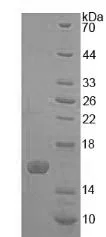 |
Greater than 95% as determined by reducing SDS-PAGE. |
靶点信息 Target Information
| 分子别名Alternative Names | LOR2WS9-14Lysyl oxidase homolog 2Lysyl oxidase-related protein 2Lysyl oxidase-related protein WS9-14 |
|---|---|
| 背景介绍Background | Mediates the post-translational oxidative deamination of lysine residues on target proteins leading to the formation of deaminated lysine (allysine). Acts as a transcription corepressor and specifically mediates deamination of trimethylated 'Lys-4' of histone H3 (H3K4me3), a specific tag for epigenetic transcriptional activation. Shows no activity against histone H3 when it is trimethylated on 'Lys-9' (H3K9me3) or 'Lys-27' (H3K27me3) or when 'Lys-4' is monomethylated (H3K4me1) or dimethylated (H3K4me2). Also mediates deamination of methylated TAF10, a member of the transcription factor IID (TFIID) complex, which induces release of TAF10 from promoters, leading to inhibition of TFIID-dependent transcription. LOXL2-mediated deamination of TAF10 results in transcriptional repression of genes required for embryonic stem cell pluripotency including POU5F1/OCT4, NANOG, KLF4 and SOX2. Involved in epithelial to mesenchymal transition (EMT) via interaction with SNAI1 and participates in repression of E-cadherin, probably by mediating deamination of histone H3. During EMT, involved with SNAI1 in negatively regulating pericentromeric heterochromatin transcription. SNAI1 recruits LOXL2 to pericentromeric regions to oxidize histone H3 and repress transcription which leads to release of heterochromatin component CBX5/HP1A, enabling chromatin reorganization and acquisition of mesenchymal traits. Interacts with the endoplasmic reticulum protein HSPA5 which activates the IRE1-XBP1 pathway of the unfolded protein response, leading to expression of several transcription factors involved in EMT and subsequent EMT induction. When secreted into the extracellular matrix, promotes cross-linking of extracellular matrix proteins by mediating oxidative deamination of peptidyl lysine residues in precursors to fibrous collagen and elastin. Acts as a regulator of sprouting angiogenesis, probably via collagen IV scaffolding. Acts as a regulator of chondrocyte differentiation, probably by regulating expression of factors that control chondrocyte differentiation. |
| 功能Function | Mediates the post-translational oxidative deamination of lysine residues on target proteins leading to the formation of deaminated lysine (allysine). Acts as a transcription corepressor and specifically mediates deamination of trimethylated 'Lys-4' of histone H3 (H3K4me3), a specific tag for epigenetic transcriptional activation. Shows no activity against histone H3 when it is trimethylated on 'Lys-9' (H3K9me3) or 'Lys-27' (H3K27me3) or when 'Lys-4' is monomethylated (H3K4me1) or dimethylated (H3K4me2). Also mediates deamination of methylated TAF10, a member of the transcription factor IID (TFIID) complex, which induces release of TAF10 from promoters, leading to inhibition of TFIID-dependent transcription. LOXL2-mediated deamination of TAF10 results in transcriptional repression of genes required for embryonic stem cell pluripotency including POU5F1/OCT4, NANOG, KLF4 and SOX2. Involved in epithelial to mesenchymal transition (EMT) via interaction with SNAI1 and participates in repression of E-cadherin, probably by mediating deamination of histone H3. During EMT, involved with SNAI1 in negatively regulating pericentromeric heterochromatin transcription. SNAI1 recruits LOXL2 to pericentromeric regions to oxidize histone H3 and repress transcription which leads to release of heterochromatin component CBX5/HP1A, enabling chromatin reorganization and acquisition of mesenchymal traits. Interacts with the endoplasmic reticulum protein HSPA5 which activates the IRE1-XBP1 pathway of the unfolded protein response, leading to expression of several transcription factors involved in EMT and subsequent EMT induction. When secreted into the extracellular matrix, promotes cross-linking of extracellular matrix proteins by mediating oxidative deamination of peptidyl lysine residues in precursors to fibrous collagen and elastin. Acts as a regulator of sprouting angiogenesis, probably via collagen IV scaffolding. Acts as a regulator of chondrocyte differentiation, probably by regulating expression of factors that control chondrocyte differentiation. |
| 亚细胞定位Subcellular Location | Secreted, extracellular space, extracellular matrix, basement membrane. Nucleus. Chromosome. Endoplasmic reticulum. |
| 数据库链接Databases |
基因功能参考文献16 条
- although Loxl2 is expressed in both dermis and epidermis, its function appears largely confined to the epidermis. PMID: 29953488 : 29953488
- LOXL2 controls myofibroblast transformation and migration. PMID: 27966531 : 27966531
- The mRNA and protein expression levels of LOXL2 were higher in a mouse model of tubulointerstitial fibrosis compared with in control mice. PMID: 28677767 : 28677767
- Findings indicate a pathophysiologic role and function for lysyl oxidase-like protein LOXL2 in breast cancer metastasis. PMID: 28720577 : 28720577
- Insulin resistance promotes lysyl oxidase like 2 induction and fibrosis accumulation in non-alcoholic fatty liver disease. PMID: 28468951 : 28468951
- glomerular extracellular matrix. Altogether, we demonstrate that LOXL2 is a novel component of the molecular machinery that forms cross-linked collagen IV networks, which are essential for glomerular basement membrane stability and molecular ultrafiltration function. PMID: 27770022 : 27770022
- LOX and LOXL2 may play an important role in the pathogenesis of AMD. Targeting LOXL2 could have a broader efficacy than targeting LOX, by reducing angiogenesis and inflammation, as well as fibrosis. PMID: 26258612 : 26258612
- Loss and gain of function analyses combined with in vivo studies in syngeneic breast cancer models demonstrate the participation of LOXL2 and E47 in tumor growth and their requirement for lung metastasis. PMID: 24632622 : 24632622
- promoted intrahepatic metastasis by increasing tissue stiffness PMID: 25048396 : 25048396
- Findings reveal new insight into the mechanisms of fibroblast activation, a novel function of LOXL2, and further highlight the importance of generating LOXL2-targeted therapies for the prevention of tumor progression and metastasis. PMID: 24008674 : 24008674
- The Snail1 transcription factor represses mouse pericentromeric transcription, acting through the H3K4 deaminase LOXL2. PMID: 24239292 : 24239292
- The enzymatic activity of lysyl oxidas-like-2 (LOXL2) is not required for LOXL2-induced inhibition of keratinocyte differentiation. PMID: 22157764 : 22157764
- This study provides the first evidence for the role of LOXL2 in regulating angiogenesis through collagen IV scaffolding. PMID: 21835952 : 21835952
- LOXL2 promotes chondrocyte differentiation by mechanisms that are likely to include roles as both a regulator and an effector of chondrocyte differentiation PMID: 21071451 : 21071451
- The efficacy and safety of LOXL2-specific monoclonal antibody represents a new therapeutic approach with broad applicability in oncologic and fibrotic diseases. PMID: 20818376 : 20818376
- LoxL2 is not expressed in MC3T3-E1 cells. PMID: 15652501 : 15652501
蛋白复溶体积计算器缓冲液体积 = 蛋白质量 ÷ 蛋白浓度
输入任意两项,第三项自动计算 |
蛋白浓度稀释计算器初浓度 × 初体积 = 终浓度 × 终体积
输入任意三项,第四项自动计算 |



