


Recombinant Kisspeptin Receptor (KISS1R)(N-6His)
Alternative NamesAXOR12; GPR54; KiSS1-Derived Peptide Receptor; G Protein-Coupled Receptor 54; Hypogonadotropin-1; Kisspeptins receptor; Metastin receptor
规格参数 Specifications
| 纯度Purity | Greater than 90% as determined by reducing SDS-PAGE. |
|---|---|
| 内毒素Endotoxin | <1 EU/µg as determined by LAL test. |
| 蛋白构建Protein Construction |
6HisN 端标签-【Arg331-Leu396】序列区间
|
| Accession | Q91V45 |
| 表达宿主Expression Host | E.coli |
| 种属Species | Mus musculus (Mouse) |
| 预测分子量Predicted MW | 11.0 kDa |
| 制剂Formulation | Lyophilized from a 0.2 μm filtered solution of PBS, pH7.4, containing 0.01% SKL, 1mM DTT, 5% Trehalose and Proclin300. |
| 运输方式Shipping | The product is shipped with ice bag. Upon receipt, store it immediately at the temperature listed below. |
| 稳定性&储存Stability & Storage | 12 months at -20°C to -80°C in lyophilized state.6 months at -20°C to -80°C under sterile conditions after reconstitution.7-10 days at 2°C to 8°C under sterile conditions after reconstitution.Please minimize freeze-thaw cycles. |
| 复溶Reconstitution | Reconstitute in 10mM PBS (pH7.4) to a concentration of 0.1-1.0 mg/mL. Do not vortex. |
!
本司产品仅用于科研,不用于临床诊断和治疗。
产品图片 Product Images点击图片可查看原图
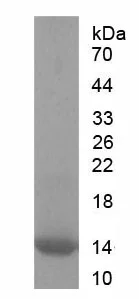 |
Greater than 90% as determined by reducing SDS-PAGE. |
靶点信息 Target Information
| 分子别名Alternative Names | AXOR12GPR54KiSS1-Derived Peptide ReceptorG Protein-Coupled Receptor 54Hypogonadotropin-1Kisspeptins receptorMetastin receptor |
|---|---|
| 背景介绍Background | Receptor for metastin (kisspeptin-52 or kp-52), a C-terminally amidated peptide of KiSS1. KiSS1 is a metastasis suppressor protein. Activation of the receptor inhibits cell proliferation and cell migration, key characteristics of tumor metastasis. The receptor is essential for normal gonadotropin-released hormone physiology and for puberty. The hypothalamic KiSS1/KISS1R system is a pivotal factor in central regulation of the gonadotropic axis at puberty and in adulthood. Analysis of the transduction pathways activated by the receptor identifies coupling to phospholipase C and intracellular calcium release through pertussis toxin-insensitive G(q) proteins. |
| 功能Function | Receptor for metastin (kisspeptin-52 or kp-52), a C-terminally amidated peptide of KiSS1. KiSS1 is a metastasis suppressor protein. Activation of the receptor inhibits cell proliferation and cell migration, key characteristics of tumor metastasis. The receptor is essential for normal gonadotropin-released hormone physiology and for puberty. The hypothalamic KiSS1/KISS1R system is a pivotal factor in central regulation of the gonadotropic axis at puberty and in adulthood. Analysis of the transduction pathways activated by the receptor identifies coupling to phospholipase C and intracellular calcium release through pertussis toxin-insensitive G(q) proteins. |
| 亚细胞定位Subcellular Location | Cell membrane; Multi-pass membrane protein. |
| 数据库链接Databases |
基因功能参考文献45 条
- G-protein coupled receptor 54 (GPR54) deficiency leads to elevated experimental autoimmune encephalomyelitis (EAE) disease severity independent of the reproductive axis. GPR54 deficiency leads to impaired immunotolerance in association with reduced number of Regulatory T-Lymphocytes, increased T-cell activation, and altered thymocyte subsets. PMID: 29931449 : 29931449
- while uterine growth was fully rescued by E2 treatment of Kiss1(-/-) mice and by genetic restoration of kisspeptin signaling in GnRH neurons in Kiss1r(-/-) mice, functional adenogenesis was only marginally restored. Thus, while uterine growth is largely dependent on ovarian E2-output via central kisspeptin signaling, peripheral kisspeptin signaling is indispensable for endometrial adenogenesis and function PMID: 27364226 : 27364226
- Study found unaltered hypothalamic metabolic gene expression in Kiss1 receptor knockout mice despite obesity and reduced energy expenditure. PMID: 27601011 : 27601011
- Nesfatin-1 increased Kiss1R expression in hypothalamic cells. PMID: 28339602 : 28339602
- Kisspeptin-10 may contribute to accelerate the progression and instability of atheromatous plaques, leading to plaque rupture. The GPR54 antagonist may be useful for prevention and treatment of atherosclerosis. PMID: 28411243 : 28411243
- data suggest the utility of the KISS1R as a novel biomarker for multiple myeloma, capable of targeting both tumor cells and host cells of the tumor microenvironment PMID: 27158817 : 27158817
- kiss1 and kiss1r mRNA levels were significantly higher in old compared to reproductive-aged mice, and diet-induced obesity did not alter kiss1 or kiss1r mRNA levels. Compared to young control mice, young MCP-1 knockout mice had significantly lower ovarian kiss1 mRNA PMID: 26879207 : 26879207
- On D4 of pregnancy, the mouse uterus expresses a functional kisspeptin/KISS1R signaling system. PMID: 26384646 : 26384646
- Gnaq was selectively inactivated in GnRH neurons of global Gna11--null mice, but they still responded to kisspeptin, confirming that KISS1R signals via non-Galphaq/11-coupled pathways. PMID: 26377475 : 26377475
- orchestrated onset of kisspeptin and GPR54 expression in the male embryonic brain at embryonic day 13.5 PMID: 26172029 : 26172029
- Results demonstrate defective negative feedback in global Gpr54-null mice that cannot be attributed to a lack of prior exposure of the gonadotropin-releasing hormone neuronal network to cyclical estradiol PMID: 25301053 : 25301053
- Expression of Kiss1 and Gpr54 was confirmed in mouse placenta but no differences in birth weight were found in mice that had been supported by a mutant placenta during fetal development. PMID: 25468546 : 25468546
- Kiss1/GPR54 system is involved in promoting uterine decidualization during early pregnancy in mice PMID: 24830702 : 24830702
- Kiss1r in GnRH neurons is critical for reproductive development and fertility. PMID: 24422632 : 24422632
- kisspeptin-1 and Kiss1r signaling influences BW, energy expenditure, and glucose homeostasis in a sexually dimorphic and partially sex steroid-independent manner PMID: 24937427 : 24937427
- kisspeptin receptor (Kiss1r), a GPCR that is activated by kisspeptin to regulate the onset of puberty and adult reproductive function, is enriched in cilia projecting from mouse PMID: 24982149 : 24982149
- Oocytes fail to respond to gonadotropins with increased trk-B tyrosine kinase (Ntrk)2 expression in the absence of KISS1R PMID: 24877631 : 24877631
- Failure of follicular development and ovulation linked to the absence of Kiss1r cannot be fully rescued by (even extended) gonadotropin replacement. PMID: 24885574 : 24885574
- Most GnRH neurons in the embryonic arcuate nucleus express kisspeptin receptor GPR54 upon circuit formation. PMID: 24599473 : 24599473
- The GnRH neuron is the key site of kisspeptin-Gpr54 signaling for fertility. PMID: 24051579 : 24051579
- kisspeptin regulates gonadotropin gene expression through the activation of Kiss1R signaling through protein kinase C, inducing immediate early genes in vitro. PMID: 23770611 : 23770611
- Gonadal steroids are essential for the induction of kisspeptin expression in the rostral periventricular area of the third ventricle during pubertal development in the male mouse. PMID: 22340076 : 22340076
- It was concluded that elevated testosterone secretion in prenatal and neonatal mice is independent of both kisspeptin and GnRH signaling, and the necessity of kisspeptin-Kiss1r signaling for testicular function is first apparent after d 5. PMID: 22202164 : 22202164
- Data suggest a possible mechanism whereby GPR54 expression levels, and thus GnRH sensitivity to kisspeptin, may change dramatically over the pro-oestrous day. PMID: 21756268 : 21756268
- Kiss1r attenuation was sufficient to delay breast tumor initiation, progression, and metastasis through inhibitory effects on the downstream Galphaq-p63RhoGEF-RhoA signaling pathway. PMID: 21852382 : 21852382
- loss of GPR54 and kisspeptin are not fully equivalent in the mouse hypothalamus PMID: 21527035 : 21527035
- Data show that female mice lacking neurons that express the kisspeptin receptor GPR54 were fertile. PMID: 21516099 : 21516099
- Gpr54-/- mice show more pronounced defects in spermatogenesis than Kiss1-/- mice and improved spermatogenesis with age when exposed to dietary phytoestrogens. PMID: 21156837 : 21156837
- GPR54 regulates ERK1/2 activity and hypothalamic gene expression in a Galpha(q/11) and beta-arrestin-dependent manner. PMID: 20886089 : 20886089
- Gpr54 regulates Bmp7 expression through NFAT2 and Sp1 and plays an important role in embryonic kidney branching morphogenesis and glomerular development PMID: 20375015 : 20375015
- transcription factor SP1 binds directly to the mGPR54 promoter region and activates gene expression. PMID: 20152817 : 20152817
- Kiss1(-/-) and Gpr54(-/-) mice retain some degree of gonadotrophin-releasing hormone activity, which is sufficient to effect vaginal cytology and uterine weights in female mice and on spermatogenesis and testicular weights in male mice. PMID: 19840236 : 19840236
- A complex temporal and spatial pattern of Gpr54 gene expression in developing GnRH neurons. PMID: 19966188 : 19966188
- Mutations in GPR54 cause autosomal recessive idiopathic hypogonadotropic hypogonadism in humans and mice, suggesting that this receptor is essential for normal gonadotropin-releasing hormone physiology and for puberty. PMID: 14573733 : 14573733
- The analysis of the GPR54 mutant mice revealed developmental abnormalities of both male and female genitalia and histopathological changes in tissues which normally contain sexually dimorphic features. PMID: 14652023 : 14652023
- The localization and GnRH release effects of kisspeptin thus define GPR54 as a major control point in the reproductive axis and suggest kisspeptin to be a neurohormonal effector. PMID: 15665093 : 15665093
- Kisspeptin exerts a potent depolarizing effect on the excitability of almost all adult gonadotropin-releasing hormone (GnRH) neurons. Responsiveness of GnRH neurons to kisspeptin increases over postnatal development. PMID: 16339030 : 16339030
- Leptin infusion of ob/ob mice evoked a significant increase in KiSS-1 and GPR54 mRNA levels. PMID: 17595226 : 17595226
- Both Kiss1 and Gpr54 knockout mice have abnormal sexual maturation consistent with hypogonadotropic hypogonadism, although Kiss1 knockout mice appear to be less severely affected than their receptor counterparts. PMID: 17595229 : 17595229
- that GnRH receptor/GnRH and GPR54/kisspeptin autoregulatory systems are integrated by negative feedback to regulate GnRH and kisspeptin secretion from GnRH neurons PMID: 17698953 : 17698953
- GPR54 is necessary for proper male-like development of several sexually dimorphic traits, likely by regulating GnRH-mediated androgen secretion during "critical windows" in perinatal development. PMID: 17699664 : 17699664
- kisspeptin-10 can significantly stimulate gonadotropin-releasing hormone (GnRH) release and GnRH mRNA expression in neurosecretory GT1-7 cells. PMID: 17728535 : 17728535
- in mice, kisspeptin-GPR54 signaling is required for the tonic stimulation of GnRH/LH secretion but is not required for generating the E-induced GnRH/LH surge. PMID: 17978050 : 17978050
- A potent stimulating effect of Kisspeptin at GnRH nerve terminals in the mediobasal hypothalamus of the mouse. PMID: 18450966 : 18450966
- kisspeptin activates G protein-coupled receptor 54 (GPR54) to initiate a PLC-IP3R-calcium cascade that modulates ions channels to initiate depolarization in GnRH neurons. PMID: 18483150 : 18483150
蛋白复溶体积计算器缓冲液体积 = 蛋白质量 ÷ 蛋白浓度
输入任意两项,第三项自动计算 |
蛋白浓度稀释计算器初浓度 × 初体积 = 终浓度 × 终体积
输入任意三项,第四项自动计算 |



