


Recombinant Calsequestrin 2 (CASQ2)(N-6His)
Alternative NamesPDIB2; Cardiac Muscle Calsequestrin; Calsequestrin, cardiac muscle isoform
规格参数 Specifications
| 纯度Purity | Greater than 95% as determined by reducing SDS-PAGE. |
|---|---|
| 内毒素Endotoxin | <1 EU/µg as determined by LAL test. |
| 蛋白构建Protein Construction |
6HisN 端标签-【Glu20-Lys320】序列区间
|
| Accession | O09161 |
| 表达宿主Expression Host | E.coli |
| 种属Species | Mus musculus (Mouse) |
| 预测分子量Predicted MW | 39.0 kDa |
| 制剂Formulation | Lyophilized from a 0.2 μm filtered solution of PBS, pH7.4, containing 0.01% SKL, 1mM DTT, 5% Trehalose and Proclin300. |
| 运输方式Shipping | The product is shipped with ice bag. Upon receipt, store it immediately at the temperature listed below. |
| 稳定性&储存Stability & Storage | 12 months at -20°C to -80°C in lyophilized state.6 months at -20°C to -80°C under sterile conditions after reconstitution.7-10 days at 2°C to 8°C under sterile conditions after reconstitution.Please minimize freeze-thaw cycles. |
| 复溶Reconstitution | Reconstitute in 10mM PBS (pH7.4) to a concentration of 0.1-1.0 mg/mL. Do not vortex. |
!
本司产品仅用于科研,不用于临床诊断和治疗。
产品图片 Product Images点击图片可查看原图
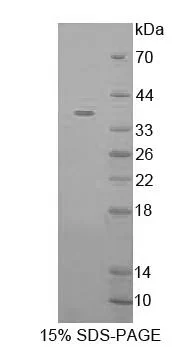 |
Greater than 95% as determined by reducing SDS-PAGE. |
靶点信息 Target Information
| 分子别名Alternative Names | PDIB2Cardiac Muscle CalsequestrinCalsequestrin, cardiac muscle isoform |
|---|---|
| 背景介绍Background | Calsequestrin is a high-capacity, moderate affinity, calcium-binding protein and thus acts as an internal calcium store in muscle. Calcium ions are bound by clusters of acidic residues at the protein surface, especially at the interface between subunits. Can bind around 60 Ca(2+) ions. Regulates the release of lumenal Ca(2+) via the calcium release channel RYR2; this plays an important role in triggering muscle contraction. Plays a role in excitation-contraction coupling in the heart and in regulating the rate of heart beats. |
| 功能Function | Calsequestrin is a high-capacity, moderate affinity, calcium-binding protein and thus acts as an internal calcium store in muscle. Calcium ions are bound by clusters of acidic residues at the protein surface, especially at the interface between subunits. Can bind around 60 Ca(2+) ions. Regulates the release of lumenal Ca(2+) via the calcium release channel RYR2; this plays an important role in triggering muscle contraction. Plays a role in excitation-contraction coupling in the heart and in regulating the rate of heart beats. |
| 亚细胞定位Subcellular Location | Sarcoplasmic reticulum lumen. |
| 数据库链接Databases |
基因功能参考文献24 条
- CASQ2-/- causes increase in calsequestrin 1 (CASQ1) expression. PMID: 28130614 : 28130614
- These data suggest a functional role of CSQ2 not only in the ventricle but also in the atrium of mammalian hearts PMID: 27484853 : 27484853
- The minimal KEKE motif of TRN involved in the interactions with CSQ2, HRC and RyR2 within the Ca2+ release units of cardiac sarcoplasmic reticulum has been defined. PMID: 26674963 : 26674963
- While CASQ2 stabilizes RyR2 rendering it refractory in the diastolic phase, HRC enhances RyR2 activity facilitating RyR2 recovery from refractoriness. PMID: 26410369 : 26410369
- Results show that CASQ2 deletion causes abnormal sarcoplasmic reticulum Ca(2+) release and selective interstitial fibrosis in the atrial pacemaker complex, which disrupt SAN pacemaking and increase susceptibility to atrial fibrillation PMID: 24216388 : 24216388
- Viral gene transfer of wild-type CASQ2 into the heart of R33Q mice prevents and reverts severe manifestations of catecholaminergic polymorphic ventricular tachycardia. PMID: 24888331 : 24888331
- Cardiac hypertrophy and calcium waves in CASQ2-null cardiac muscle are governed by the ryanodine receptor (Ryr)2 Ca2+ sensor. PMID: 24758151 : 24758151
- Expression of CASQ2-R33Q influences molecular and ultra-structural heart development; post-natal, adaptive changes appear capable of ensuring until adulthood a new pathophysiological equilibrium. PMID: 24370574 : 24370574
- Mutant CASQ2(D307H) protein retains some of its physiological function. Its expression decreases with age and is inversely related to arrhythmia severity. PMID: 24070655 : 24070655
- Qualitatively similar results were obtained in a hybrid strain created by crossing CASQ2 knockout mice with mice deficient in phospholamban. PMID: 23135969 : 23135969
- Aberrant disordered calcium release events can become synchronized in the intact myocardium, leading to triggered activity and the resultant diastolic contractions in the settings of a cardiac rhythm disorder. PMID: 23733959 : 23733959
- The triadin-to-calsequestrin ratio is a critical modulator of the sarcoplasmic reticulum Ca(2+) signaling in ventricular myocytes. PMID: 22427521 : 22427521
- The results presented in this paper support the idea of Casq2 acting both as a buffer and a direct regulator of the Ca(2+) release process. PMID: 21983287 : 21983287
- Ca(2+) and JNT-dependent disassembly of the CSQ2 polymer PMID: 22123818 : 22123818
- Suggest that CASQ2(D307H) point mutation may affect Ca(2+) buffering capacity and Ca(2+) release in cardiac myocytes. PMID: 21984545 : 21984545
- Report prevention of ventricular arrhythmia and calcium dysregulation in a catecholaminergic polymorphic ventricular tachycardia mouse model carrying calsequestrin-2 mutation. PMID: 20807279 : 20807279
- calsequestrin mutation CASQ2D307H does not affect protein stability and targeting to the junctional sarcoplasmic reticulum but compromises its dynamic regulation of calcium buffering PMID: 19920148 : 19920148
- gene structure, developmental and tissue specific expression of the murine, cardiac isoform of calsequestrin. PMID: 11770083 : 11770083
- Lack of Casq2 causes increased diastolic sarcoplasmic reticulum Ca2+ leak, rendering Casq2-null mice susceptible to catecholaminergic ventricular arrhythmias. PMID: 16932808 : 16932808
- central role of RyR2 dysfunction in CASQ2 deficiency unifies the pathophysiologic mechanism underlying Catecholamine-induced polymorphic ventricular tachycardia due to RyR2 or CASQ2 mutations PMID: 17607358 : 17607358
- Reductions in Casq2 increase sarcoplasmic recticulum Ca2+ leak and cause ventricular tachycardia susceptibility under stress. Casq2 likely regulates sarcoplasmic reticulum calcium channels. PMID: 17656677 : 17656677
- abnormalities in the CASQ2(R33Q/R33Q) CPVT mouse model include (1) reduced CASQ2 content, (2) reduction of SR calcium content, (3) dilatation of junctional SR, and (4) impaired clustering of mutant CASQ2. PMID: 18583715 : 18583715
- REVIEW of Casq2 mutations that cause catecholaminergic polymorphic ventricular tachycardia and their effects on Casq2 function and Ca handling PMID: 18669926 : 18669926
- Egr-1 negatively regulates calsequestrin expression and calcium dynamics in ventricular cells. PMID: 19103607 : 19103607
蛋白复溶体积计算器缓冲液体积 = 蛋白质量 ÷ 蛋白浓度
输入任意两项,第三项自动计算 |
蛋白浓度稀释计算器初浓度 × 初体积 = 终浓度 × 终体积
输入任意三项,第四项自动计算 |



