


Recombinant Eukaryotic Elongation Factor 2 Kinase (EEF2K)(N-GST-6His)
Alternative NameseEF-2K; Calcium/calmodulin-dependent eukaryotic elongation factor 2 kinase
规格参数 Specifications
| 纯度Purity | Greater than 90% as determined by reducing SDS-PAGE. |
|---|---|
| 内毒素Endotoxin | <1 EU/µg as determined by LAL test. |
| 蛋白构建Protein Construction |
6HisN 端标签-GSTN 端标签-【Asp30-Leu327】序列区间
|
| Accession | O08796 |
| 表达宿主Expression Host | E.coli |
| 种属Species | Mus musculus (Mouse) |
| 预测分子量Predicted MW | 64 kDa |
| 制剂Formulation | Lyophilized from a 0.2 μm filtered solution of PBS, pH7.4, containing 0.01% SKL, 1mM DTT, 5% Trehalose and Proclin300. |
| 运输方式Shipping | The product is shipped with ice bag. Upon receipt, store it immediately at the temperature listed below. |
| 稳定性&储存Stability & Storage | 12 months at -20°C to -80°C in lyophilized state.6 months at -20°C to -80°C under sterile conditions after reconstitution.7-10 days at 2°C to 8°C under sterile conditions after reconstitution.Please minimize freeze-thaw cycles. |
| 复溶Reconstitution | Reconstitute in 10mM PBS (pH7.4) to a concentration of 0.1-1.0 mg/mL. Do not vortex. |
!
本司产品仅用于科研,不用于临床诊断和治疗。
产品图片 Product Images点击图片可查看原图
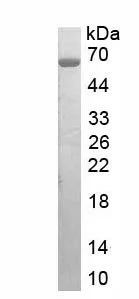 |
Greater than 90% as determined by reducing SDS-PAGE. |
靶点信息 Target Information
| 分子别名Alternative Names | eEF-2KCalcium/calmodulin-dependent eukaryotic elongation factor 2 kinase |
|---|---|
| 背景介绍Background | Threonine kinase that regulates protein synthesis by controlling the rate of peptide chain elongation. Upon activation by a variety of upstream kinases including AMPK or TRPM7, phosphorylates the elongation factor EEF2 at a single site, renders it unable to bind ribosomes and thus inactive. In turn, the rate of protein synthesis is reduced. |
| 功能Function | Threonine kinase that regulates protein synthesis by controlling the rate of peptide chain elongation. Upon activation by a variety of upstream kinases including AMPK or TRPM7, phosphorylates the elongation factor EEF2 at a single site, renders it unable to bind ribosomes and thus inactive. In turn, the rate of protein synthesis is reduced. |
| 数据库链接Databases |
基因功能参考文献16 条
- This study provides new insights into the control of eEF2K by AMPK. PMID: 28502587 : 28502587
- eEF2K activity is increased in postmortem Alzheimer's disease (AD) patient cortex and hippocampus, and in the hippocampus of aged transgenic AD mice. eEF2K inhibition using pharmacological or genetic approaches prevented the toxic effects of Abeta42 oligomers on neuronal viability and dendrite formation in vitro. Findings highlight the potential utility of eEF2K inhibition to reduce Abeta-mediated oxidative stress in AD. PMID: 27752775 : 27752775
- results suggest that protective versus pro-apoptotic roles of eEF2K depend on the type of cells: eEF2K is protective in highly proliferative cells, such as small intestinal stem cells and cancer cells, which are more susceptible to mitotic catastrophe. PMID: 27466362 : 27466362
- Using an eEF2K gain-of-function design in vitro as well as eEF2K-KO mice, we show that eEF2K activity regulates the excitation/inhibition balance by downregulating vesicle release at inhibitory synapses and tonic inhibition. This translates into a reduced susceptibility of eEF2K-KO mice for seizures without major behavioral alterations with the exception of impaired contextual and trace fear memory PMID: 27005990 : 27005990
- eEF2K protects cancer cells against nutrient starvation by inhibiting protein synthesis rather than by activating autophagy. PMID: 26795954 : 26795954
- The findings of this study suggested that eEF2K likely contributes to neuronal function by regulating the synthesis of microtubule-related proteins. PMID: 26485687 : 26485687
- eEF2K mediates PDGF-BB-induced SMCs proliferation and migration through activating ERK, Akt, p38 and HSP27 signals in a calmodulin-dependent manner PMID: 25069823 : 25069823
- Results show that eEF2K is rapidly activated in response to acidosis in cells, an effect that is followed by its downregulation. PMID: 25776553 : 25776553
- Data show that eEF2K is activated during hypoxia or upon inhibition of prolyl hydroxylases and inhibited by its hydroxylation on a highly conserved proline residue, restricting its activity during normoxia. PMID: 25755286 : 25755286
- data suggest that achieving an active conformation, rather than eEF2K activity per se, is required for its susceptibility to degradation. PMID: 25670349 : 25670349
- Because eEF2K activity in cells of the hematopoietic compartment contributes to atherosclerosis development, drugs inhibiting eEF2K might have a beneficial effect in treatment of atherosclerosis. PMID: 25475470 : 25475470
- Loss of eEF2K leads to increase in abnormal antral follicles and unhealthy oocytes. PMID: 24582807 : 24582807
- Data highlight a conserved role for eEF2K in protecting cells from nutrient deprivation and in conferring tumor cell adaptation to metabolic stress. PMID: 23706743 : 23706743
- Adequate levels of eEF2K phosphorylation are essential for cortical-dependent associative learning; malfunction of memory processing at the systems level can lead to associative memory impairment. PMID: 22366775 : 22366775
- Resveratrol inhibits the proliferation and migration of vascular endothelial cells by activating eukaryotic elongation factor-2 kinase. PMID: 20472894 : 20472894
- During late embryonic and early postnatal stages, elongation factor 2 kinase is up-regulated in the cerebral cortex and hippocampal pyramidal cell layer. PMID: 12213630 : 12213630
蛋白复溶体积计算器缓冲液体积 = 蛋白质量 ÷ 蛋白浓度
输入任意两项,第三项自动计算 |
蛋白浓度稀释计算器初浓度 × 初体积 = 终浓度 × 终体积
输入任意三项,第四项自动计算 |



