


Recombinant A Kinase Anchor Protein 5 (AKAP5)(N-GST-6His)
Alternative NamesAKAP75; AKAP79; H21; A-kinase anchor protein 79 kDa; cAMP-dependent protein kinase regulatory subunit II high affinity-binding protein
规格参数 Specifications
| 纯度Purity | Greater than 97% as determined by reducing SDS-PAGE. |
|---|---|
| 内毒素Endotoxin | <1 EU/µg as determined by LAL test. |
| 蛋白构建Protein Construction |
6HisN 端标签-GSTN 端标签-【Met1-Gln161】序列区间
|
| Accession | D3YVF0 |
| 表达宿主Expression Host | E.coli |
| 种属Species | Mus musculus (Mouse) |
| 预测分子量Predicted MW | 47.9 kDa |
| 制剂Formulation | Lyophilized from a 0.2 μm filtered solution of PBS, pH7.4, containing 0.01% SKL, 1mM DTT, 5% Trehalose and Proclin300. |
| 运输方式Shipping | The product is shipped with ice bag. Upon receipt, store it immediately at the temperature listed below. |
| 稳定性&储存Stability & Storage | 12 months at -20°C to -80°C in lyophilized state.6 months at -20°C to -80°C under sterile conditions after reconstitution.7-10 days at 2°C to 8°C under sterile conditions after reconstitution.Please minimize freeze-thaw cycles. |
| 复溶Reconstitution | Reconstitute in 10mM PBS (pH7.4) to a concentration of 0.1-1.0 mg/mL. Do not vortex. |
!
本司产品仅用于科研,不用于临床诊断和治疗。
产品图片 Product Images点击图片可查看原图
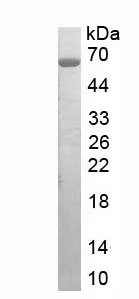 |
Greater than 97% as determined by reducing SDS-PAGE. |
靶点信息 Target Information
| 分子别名Alternative Names | AKAP75AKAP79H21A-kinase anchor protein 79 kDacAMP-dependent protein kinase regulatory subunit II high affinity-binding protein |
|---|---|
| 背景介绍Background | Multivalent scaffold protein that anchors the cAMP-dependent protein kinase/PKA to cytoskeletal and/or organelle-associated proteins, targeting the signal carried by cAMP to specific intracellular effectors. Association with the beta2-adrenergic receptor (beta2-AR) not only regulates beta2-AR signaling pathway, but also the activation by PKA by switching off the beta2-AR signaling cascade. Plays a role in long term synaptic potentiation by regulating protein trafficking from the dendritic recycling endosomes to the plasma membrane and controlling both structural and functional plasticity at excitatory synapses. |
| 功能Function | Multivalent scaffold protein that anchors the cAMP-dependent protein kinase/PKA to cytoskeletal and/or organelle-associated proteins, targeting the signal carried by cAMP to specific intracellular effectors. Association with the beta2-adrenergic receptor (beta2-AR) not only regulates beta2-AR signaling pathway, but also the activation by PKA by switching off the beta2-AR signaling cascade. Plays a role in long term synaptic potentiation by regulating protein trafficking from the dendritic recycling endosomes to the plasma membrane and controlling both structural and functional plasticity at excitatory synapses. |
| 亚细胞定位Subcellular Location | Postsynaptic recycling endosome membrane; Lipid-anchor. |
| 数据库链接Databases |
基因功能参考文献26 条
- AKAP150 regulates Ca(2+ )cycling and myocardial ionotropy following pathological stress, promoting pathological remodelling and heart failure propensity. PMID: 27856611 : 27856611
- AKAP150-calcineurin signaling dyad is essential for the activation of the phosphatase and the subsequent down-regulation of Kv channel currents following myocardial infarction. PMID: 26724383 : 26724383
- This study demonstrated that the AKAP150 oordinates metabotropic glutamate receptor sensitization of peripheral sensory neurons. PMID: 26172554 : 26172554
- Thus, our present study revealed that AKAP5 plays a significant role in the regulation of sympathetic nerve activities. PMID: 26713362 : 26713362
- Identify a novel cardioprotective role for AKAP5 that is mediated by regulating the activities of cardiac CaN and CaMKII and highlight a significant role for cardiac beta-ARs in this phenomenon. PMID: 25225170 : 25225170
- endothelial-dependent dilation of resistance arteries is enabled by MEP-localized AKAP150, which ensures the proximity of PKC to TRPV4 channels and the coupled channel gating necessary for efficient communication from endothelial to smooth muscle cells PMID: 25005230 : 25005230
- Our results support a model whereby subcellular anchoring of CaN by AKAP150 is a key molecular determinant of vascular BKCa channel remodeling, which contributes to vasoconstriction during diabetes mellitus. PMID: 24323672 : 24323672
- a significant role for the AKAP5 scaffold in signaling and trafficking of the beta1-AR in cardiac myocytes and mammalian cells. PMID: 24121510 : 24121510
- Anchoring of protein kinase A and adenylyl cyclase by AKAP5 is important for regulation of postsynaptic functions and specifically AMPA receptor activity. PMID: 23649627 : 23649627
- AKAP150 null mice secrete less insulin yet have better glucose handling due to increased insulin sensitivity in target tissues. Tethering of phosphatases to a seven-residue sequence of Akap5 is the main molecular event for this. PMID: 22940692 : 22940692
- This study demonistrated taht AKAP79/150-anchored CaN in regulation of Ca2+-permeable GluA1 homomers that our results here now clearly establish as a key mechanism that maintains bidirectional synaptic plasticity in the hippocampus. PMID: 23100425 : 23100425
- A kinase anchor protein 150 (AKAP150)-associated protein kinase A limits dendritic spine density PMID: 21652711 : 21652711
- We propose that AKAP150-dependent changes in Ca(V)1.2-LQT8 channel gating may constitute a novel general mechanism for Ca(V)1.2-driven arrhythmias. PMID: 21700933 : 21700933
- other neural AKAPs cannot compensate for the loss of PKA binding to AKAP5 PMID: 20428246 : 20428246
- In knockout AKAP5 cardiomyocytes, beta-adrenergic regulation of calcium transients is disrupted. PMID: 20671242 : 20671242
- Study reveals that non-neurotransmitter Abeta has a binding capacity to beta(2)AR and induces PKA-dependent hyperactivity in AMPA receptors. PMID: 20395454 : 20395454
- These data suggest that isoproterenol-stimulated amylase secretion occurs via both an AKAP5/AC6/PKA complex and a PKA-independent, Epac pathway in mouse parotid acini. PMID: 20164376 : 20164376
- An important role of AKAP150 in coordinating signaling events regulating the frequency of intrinsic pulsatile GnRH secretion. PMID: 19887564 : 19887564
- CaMKIIalpha targets a specific SAP97 splice variant to disengage AKAP79/150 from regulating GluR1 AMPARs PMID: 19858198 : 19858198
- The association of AKAP150 with TREK channels integrates them into a postsynaptic scaffold where both G-protein-coupled membrane receptors and TREK-1 dock simultaneously. PMID: 17110924 : 17110924
- AKAP150 protein levels were increased upon exposing mice to the novel context independent of the training protocol. After habituation, only mice that learned to associate the context with the footshock showed an upregulation of AKAP150. PMID: 17270471 : 17270471
- AKAP150-anchored PKA might critically contribute to LTP in adult hippocampus in part by phosphorylating GluR1 to foster postsynaptic accumulation of homomeric GluR1 AMPA receptors during initial LTP in 8-week-old mice PMID: 17972919 : 17972919
- local control of L-type Ca2+ channel function is regulated by AKAP150-targeted protein kinase C signaling, which controls stuttering persistent Ca2+ influx, vascular tone, and blood pressure and underlies angiotensin II-dependent hypertension. PMID: 18174462 : 18174462
- temporal and spatial compartmentalization of hippocampal PKA signaling pathways, as achieved by anchoring of PKA to AKAPs, is specifically instrumental in long-term contextual fear memory consolidation and extinction, but not in acquisition and retrieval PMID: 18442935 : 18442935
- data indicate that AKAP150-anchored protein kinase A activity is required to induce long-term depression and not merely to maintain a tonically heightened activity level of AMPA receptors as proposed earlier PMID: 18617570 : 18617570
- distinct AKAP150-enzyme complexes regulate context-dependent neuronal signaling events PMID: 18711127 : 18711127
蛋白复溶体积计算器缓冲液体积 = 蛋白质量 ÷ 蛋白浓度
输入任意两项,第三项自动计算 |
蛋白浓度稀释计算器初浓度 × 初体积 = 终浓度 × 终体积
输入任意三项,第四项自动计算 |



