


Recombinant Diacylglycerol Kinase Zeta (DGKz)(N-6His)
Alternative NamesDAGK5; DAGK6; DGK-ZETA; hDGKzeta; Diglyceride kinase zeta
规格参数 Specifications
| 纯度Purity | Greater than 90% as determined by reducing SDS-PAGE. |
|---|---|
| 内毒素Endotoxin | <1 EU/µg as determined by LAL test. |
| 蛋白构建Protein Construction |
6HisN 端标签-【Tyr657-Val879】序列区间
|
| Accession | Q80UP3 |
| 表达宿主Expression Host | E.coli |
| 种属Species | Mus musculus (Mouse) |
| 预测分子量Predicted MW | 28.3 kDa |
| 制剂Formulation | Lyophilized from a 0.2 μm filtered solution of PBS, pH7.4, containing 0.01% SKL, 1mM DTT, 5% Trehalose and Proclin300. |
| 运输方式Shipping | The product is shipped with ice bag. Upon receipt, store it immediately at the temperature listed below. |
| 稳定性&储存Stability & Storage | 12 months at -20°C to -80°C in lyophilized state.6 months at -20°C to -80°C under sterile conditions after reconstitution.7-10 days at 2°C to 8°C under sterile conditions after reconstitution.Please minimize freeze-thaw cycles. |
| 复溶Reconstitution | Reconstitute in 10mM PBS (pH7.4) to a concentration of 0.1-1.0 mg/mL. Do not vortex. |
!
本司产品仅用于科研,不用于临床诊断和治疗。
产品图片 Product Images点击图片可查看原图
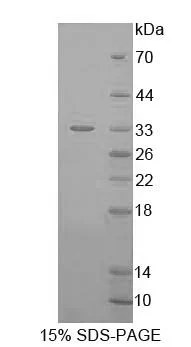 |
Greater than 90% as determined by reducing SDS-PAGE. |
靶点信息 Target Information
| 分子别名Alternative Names | DAGK5DAGK6DGK-ZETAhDGKzetaDiglyceride kinase zeta |
|---|---|
| 背景介绍Background | Diacylglycerol kinase that converts diacylglycerol/DAG into phosphatidic acid/phosphatidate/PA and regulates the respective levels of these two bioactive lipids. Thereby, acts as a central switch between the signaling pathways activated by these second messengers with different cellular targets and opposite effects in numerous biological processes. Also plays an important role in the biosynthesis of complex lipids. Does not exhibit an acyl chain-dependent substrate specificity among diacylglycerol species. Can also phosphorylate 1-alkyl-2-acylglycerol in vitro but less efficiently and with a preference for alkylacylglycerols containing an arachidonoyl group. The biological processes it is involved in include T cell activation since it negatively regulates T-cell receptor signaling which is in part mediated by diacylglycerol. By generating phosphatidic acid, stimulates PIP5KIA activity which regulates actin polymerization. Through the same mechanism could also positively regulate insulin-induced translocation of SLC2A4 to the cell membrane. Regulates RASGRP1 activity. |
| 功能Function | Diacylglycerol kinase that converts diacylglycerol/DAG into phosphatidic acid/phosphatidate/PA and regulates the respective levels of these two bioactive lipids. Thereby, acts as a central switch between the signaling pathways activated by these second messengers with different cellular targets and opposite effects in numerous biological processes. Also plays an important role in the biosynthesis of complex lipids. Does not exhibit an acyl chain-dependent substrate specificity among diacylglycerol species. Can also phosphorylate 1-alkyl-2-acylglycerol in vitro but less efficiently and with a preference for alkylacylglycerols containing an arachidonoyl group. The biological processes it is involved in include T cell activation since it negatively regulates T-cell receptor signaling which is in part mediated by diacylglycerol. By generating phosphatidic acid, stimulates PIP5KIA activity which regulates actin polymerization. Through the same mechanism could also positively regulate insulin-induced translocation of SLC2A4 to the cell membrane. Regulates RASGRP1 activity. |
| 亚细胞定位Subcellular Location | Nucleus. Cytoplasm, cytosol. Cell membrane. Cell projection, lamellipodium. |
| 数据库链接Databases |
基因功能参考文献43 条
- DGKzeta deficiency protects against peripheral insulin resistance and improves energy metabolism. PMID: 29066466 : 29066466
- DGKzeta prevents GLUT4 translocation in the absence of insulin. DGKzeta dissociated from IRS-1 by insulin stimulation enhances GLUT4 translocation through PIP5K1alpha activity PMID: 27739494 : 27739494
- Our studies identify a previously unrecognized DGKzeta contribution as a negative regulator of the crosstalk between phospholipase C-gamma- and phosphoinositide 3-kinase-regulated pathways. PMID: 28163304 : 28163304
- Our results demonstrate that, in addition to its known role in limiting canonical antigen-mediated activation of cytotoxic function, DGKzeta negatively regulates IL-2/IL-15-dependent expansion of innate-like cytotoxic CD8+ T cells. These studies add to the growing evidence that targeting DAG metabolism through pharmacological manipulation of DGKzeta could be an important, yet-unexplored area for cancer immunotherapy. PMID: 28438506 : 28438506
- these data suggest that the activation of DGKzeta downstream of antigen recognition provides a mechanism that ensures the activation of PA-dependent signaling as a direct result of the strength of TCR-dependent DAG mobilization. PMID: 27999176 : 27999176
- Diacylglycerol kinases alpha and zeta are up-regulated in cancer in cancer, and contribute towards tumor immune evasion and T cells clonal anergy. (Review) PMID: 27697466 : 27697466
- We propose that enzymes that negatively regulate distal activating receptor signaling pathways such as DGKzeta represent novel targets for augmenting the therapeutic potential of NK cells. PMID: 27342844 : 27342844
- Downregulation of DGKzeta might be one factor predisposing a person to osteolytic bone destruction in pathological conditions. PMID: 27312515 : 27312515
- this is the first report implicating M-CSF/DGKzeta/DAG axis as a critical regulator of bone homeostasis via its actions on OC differentiation and c-Fos expression. PMID: 25891971 : 25891971
- another possible involvement of DGKzeta in the regulation of secretion of the terminal tubule cells, as well as its functional significance of its nuclear localization in the submandibular ganglion cells is discussed PMID: 25952157 : 25952157
- This study demonstrated that Diacylglycerol Kinase zeta with Protein Kinase Calpha Is Required for Cerebellar Long-Term Depression PMID: 26586831 : 26586831
- The results suggest that DGKzeta cytoplasmic translocation in neurons under hypoxic stress is regulated by some mechanism which differs from that mediated by NAP1-like proteins. PMID: 24893663 : 24893663
- This study shows that DGKzeta knockdown facilitates degradation of IkappaB, followed by nuclear translocation of NF-kappaB p65 subunit. PMID: 25450975 : 25450975
- It plays a role in pathogenesis of various disorders in the central nervous system. PMID: 24599142 : 24599142
- DGKzeta regulates the development of natural Treg cells by limiting the extent of activation of the ERK and c-Rel signaling pathways. PMID: 24280042 : 24280042
- The zeta isoform of diacylglycerol kinase plays a predominant role in regulatory T cell development and TCR-mediated ras signaling. PMID: 24280043 : 24280043
- Data demonstrate that miR-34a is a negative regulator for DGKzeta and may play an important role in regulating T cell activation. PMID: 24147106 : 24147106
- Data indicate that in the absence of DGKzeta, the threshold for B cell antigen receptor (BCR) signaling, measured as activation of the Ras-extracellular signal-regulated kinase (ERK) pathway, was markedly reduced in mature follicular B cells. PMID: 24129701 : 24129701
- DGKzeta, but not PLD, plays an important role in mechanically induced increases in PA and mTOR signaling. PMID: 24302719 : 24302719
- The DGKzeta-deficient neurons do not succumb directly to apoptosis, although they are more vulnerable to excitotoxicity because of aberrant cell cycle reentry. PMID: 22516102 : 22516102
- Diacylglycerol kinase zeta serves as a sentinel to control p53 function both during normal homeostasis and in stress responses. PMID: 23606744 : 23606744
- Data indicate that combined deletion of dgkzeta and dgkalpha markedly enhances T-cell responses. PMID: 23576561 : 23576561
- As a regulator of Rac1 and RhoA activity, DGKzeta is a critical factor linking changes in lipid signaling to actin reorganization. PMID: 22918940 : 22918940
- DGK zeta is a crucial regulator of CXCL4-triggered T-cell arrest of surfaces presenting ICAM-1. PMID: 22546945 : 22546945
- These results suggest that DGKzeta regulates hippocampal long-term potentiation (LTP) and long-term depression (LTD) by promoting DAG-to-PA conversion, and establish that phospholipase C and protein kinase C lie upstream and downstream, respectively, of DGKzeta-dependent regulation of hippocampal LTP and LTD. PMID: 21069783 : 21069783
- DGKzeta inhibited ventricular tachyarrhythmias in a mouse model of heart failure and transient receptor potential channels participated in ventricular tachyarrhythmia induction in failing hearts. PMID: 21778596 : 21778596
- DAG kinases (DGKs) alpha and zeta, which terminate DAG-mediated signaling, synergistically inhibit TCR-induced mTOR activation by inhibiting the Ras-Mek1/2-Erk/12 pathway PMID: 21310925 : 21310925
- DGK-zeta export from nucleus to cytoplasm is regulated by a leucine-rich nuclear export signals through the exportin 1. PMID: 20023381 : 20023381
- Diacylglycerol kinase zeta functions as a physiological negative regulator of tcr signaling and t-cell activation PMID: 12883552 : 12883552
- DGK-zeta, syntrophin, and Rac1 form a regulated signaling complex that controls polarized outgrowth in neuronal cells PMID: 16055737 : 16055737
- DGKzeta may act in vivo as a downstream effector of pRB to regulate nuclear levels of diacylglycerol and phosphatidic acid PMID: 16286473 : 16286473
- Nuclear DGK-zeta might play some fundamental role during myogenic differentiation of C2C12 cells. PMID: 16897754 : 16897754
- These results are the first in vivo evidence that DGKzeta suppresses cardiac hypertrophy and fibrosis and prevents impaired left ventricular systolic function caused by pressure overload. PMID: 17251681 : 17251681
- DGKzeta promotes Toll-like receptors responses via a pathway involving inhibition of phosphatidylinositol 3-kinase PMID: 17371930 : 17371930
- Results suggest DGK-zeta and syntrophins play a role at multiple stages of the fusion process. PMID: 17410543 : 17410543
- DGK zeta blocks cardiac dysfunction and progression to lethal HF by activated G alpha q protein without detectable adverse effects in the in-vivo heart and suggest that DGK zeta is a novel therapeutic target for HF. PMID: 18219172 : 18219172
- Data show that ET-1-induced effects on Ca(2+) transients and cell shortening were abolished in diacylglycerol (DAG) kinase zeta-overexpressing mouse ventricular myocytes. PMID: 18275971 : 18275971
- DGKzeta localizes to the nucleus during interphase including G1, S, and G2 phases and is associated with chromatin although it dissociates from condensed chromatin during mitotic phase in NIH3T3 cells PMID: 18680142 : 18680142
- DGKs not only terminate diacylglycerol signaling but also initiate PA signaling in thymocytes to promote positive selection PMID: 18689679 : 18689679
- In DGKzeta-deficient fibroblasts PAK1 phosphorylation and Rac1-RhoGDI dissociation were attenuated, leading to reduced Rac1 activation after platelet-derived growth factor stimulation. PMID: 19211846 : 19211846
- Results show that diacylglycerol kinase zeta is targeted to excitatory synapses through its direct interaction with the postsynaptic PDZ scaffold PSD-95. PMID: 19229292 : 19229292
- Nuclear diacylglycerol kinase -zeta downregulated the expression of cyclin D1 and increased the expression of Btg2 protein, a transcriptional regulator of cyclin D1 with a strong anti-proliferative function. PMID: 19263516 : 19263516
- DGKz differentially regulates mast cell degranulation and cytokine production following FceRI stimulation PMID: 16717114 : 16717114
蛋白复溶体积计算器缓冲液体积 = 蛋白质量 ÷ 蛋白浓度
输入任意两项,第三项自动计算 |
蛋白浓度稀释计算器初浓度 × 初体积 = 终浓度 × 终体积
输入任意三项,第四项自动计算 |



