


Recombinant Pannexin 1 (PANX1)(N-6His)
Alternative NamesMRS1; PX1; Innexin
规格参数 Specifications
| 纯度Purity | Greater than 90% as determined by reducing SDS-PAGE. |
|---|---|
| 内毒素Endotoxin | <1 EU/µg as determined by LAL test. |
| 蛋白构建Protein Construction |
6HisN 端标签-【Ala77-Asp260】序列区间
|
| Accession | Q9JIP4 |
| 表达宿主Expression Host | E.coli |
| 种属Species | Mus musculus (Mouse) |
| 预测分子量Predicted MW | 22.2 kDa |
| 制剂Formulation | Lyophilized from a 0.2 μm filtered solution of PBS, pH7.4, containing 0.01% SKL, 1mM DTT, 5% Trehalose and Proclin300. |
| 运输方式Shipping | The product is shipped with ice bag. Upon receipt, store it immediately at the temperature listed below. |
| 稳定性&储存Stability & Storage | 12 months at -20°C to -80°C in lyophilized state.6 months at -20°C to -80°C under sterile conditions after reconstitution.7-10 days at 2°C to 8°C under sterile conditions after reconstitution.Please minimize freeze-thaw cycles. |
| 复溶Reconstitution | Reconstitute in 10mM PBS (pH7.4) to a concentration of 0.1-1.0 mg/mL. Do not vortex. |
!
本司产品仅用于科研,不用于临床诊断和治疗。
产品图片 Product Images点击图片可查看原图
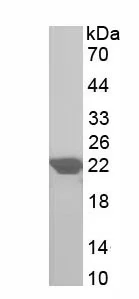 |
Greater than 90% as determined by reducing SDS-PAGE. |
靶点信息 Target Information
| 分子别名Alternative Names | MRS1PX1Innexin |
|---|---|
| 背景介绍Background | Structural component of the gap junctions and the hemichannels. May play a role as a Ca(2+)-leak channel to regulate ER Ca(2+) homeostasis.; Structural component of the gap junctions and the hemichannels involved in the ATP release and nucleotide permeation. May play a role as a Ca(2+)-leak channel to regulate ER Ca(2+) homeostasis. Plays a critical role in oogenesis. |
| 功能Function | Structural component of the gap junctions and the hemichannels. May play a role as a Ca(2+)-leak channel to regulate ER Ca(2+) homeostasis.; Structural component of the gap junctions and the hemichannels involved in the ATP release and nucleotide permeation. May play a role as a Ca(2+)-leak channel to regulate ER Ca(2+) homeostasis. Plays a critical role in oogenesis. |
| 亚细胞定位Subcellular Location | Cell membrane; Multi-pass membrane protein. Cell junction, gap junction. Endoplasmic reticulum membrane; Multi-pass membrane protein. |
| 数据库链接Databases |
基因功能参考文献50 条
- Panx1 expressed in immune cells is critical for pain-like effects following nerve injury in mice, perhaps via a GPCR-mediated activation mechanism, and suggest that inhibition of Panx1 may be useful in treating neuropathic pain. PMID: 28195232 : 28195232
- Auditory brainstem response thresholds in the Gen-Panx1 KO mouse were significantly increased. Distortion product otoacoustic emission and cochlear microphonics were significantly reduced. PMID: 29710868 : 29710868
- These novel findings reveal unique roles for GFAP-positive glial and neuronal Panx1 and describe new chronic pain targets for cell-type specific intervention in this often intractable disease. PMID: 27910899 : 27910899
- Panx-1 modulation may be interesting to amplify the clinical effect of cisplatin (DDP) and reverse the resistance of testicular cancer cells to DDP. PMID: 28780469 : 28780469
- Pannexin1 may play a role in the pathogenesis of liver disease. PMID: 29246445 : 29246445
- Findings indicate a deleterious role for membrane channel Pannexin 1 (Panx1) in response to permanent permanent middle cerebral artery (MCA) occlusion, that is unique to females. PMID: 28445139 : 28445139
- ATP release from red blood cells is not mediated by the cAMP-mediated Panx1 pathway. PMID: 28855161 : 28855161
- blocking Panx1 and/or Casp4 activities is a beneficial strategy to enhance donor cell engraftment and LG regeneration through the reduction of inflammation. PMID: 29098296 : 29098296
- found a significant increase in waking and a correspondent decrease in slow wave sleep percentages in the Panx1-/- animals. PMID: 27769744 : 27769744
- Diabetic C57BL/6J-Ins2Akita mice were used to evaluate in vivo effects of high glucose on P2R and Panx1 PMID: 27159053 : 27159053
- Pharmacological blockade or genetic deletion of Panx1 channels inhibits CD4+ T lymphocyte polarization and migration induced by the chemokine SDF-1alpha/CXCL12. Panx1 deficiency delayed experimental autoimmune encephalomyelitis symptoms because of the decreased infiltration of CD4+ T lymphocytes into the CNS. PMID: 27076682 : 27076682
- data suggest that Panx1 and Panx3 are not essential for baseline hearing in mice tested, but the therapeutic targeting of Panx3 may prove protective against mid-high-frequency hearing loss caused by loud NE. PMID: 27784763 : 27784763
- Pannexin1 (Panx1) is dynamically regulated throughout mammary gland development. PMID: 27099931 : 27099931
- Panx1 is expressed in the central and peripheral nervous system during early developmental stages. PMID: 26453396 : 26453396
- this study provides the first demonstration of Panx1 channel morphology and assembly in intact cells. PMID: 26386583 : 26386583
- Panx1 in the heart influences different electrophysiological parameters involving depolarization, repolarization and atrial vulnerability causing atrial fibrillation. PMID: 26828725 : 26828725
- ATP released by myocardial cells through Pannexin-1 channel during ischemia could evoke calcium responses in cardiac sympathetic nerve fibers. PMID: 26596404 : 26596404
- Platelets of Panx1-/- mice showed reduced collagen-induced aggregation as compared to those of WT mice. PMID: 25947940 : 25947940
- The observations of this study reveal a new role for Panx1 in NPC maintenance in the VZ and suggesting that targeting peri-infarct Panx1 (in combination with other interventions) could improve outcomes after stroke. PMID: 26818508 : 26818508
- The role of Pannexin 1 is analyzed at the systems level, it is not required for normal taste perception. Further studies are needed to determine the role of this hemichannel in taste cells. PMID: 26126730 : 26126730
- Panx1 channels promote leukocyte adhesion and emigration through the venous wall during acute systemic inflammation. PMID: 26242575 : 26242575
- The PANX1 is unnecessary for taste detection and consequently that ATP release from Type 2 taste cells does not require PANX1. PMID: 25987548 : 25987548
- Pannexin1 channels dominate ATP release in the cochlea ensuring endocochlear potential and auditory receptor potential generation and hearing PMID: 26035172 : 26035172
- But not in Casp11(-/-), Panx1(-/-), or P2x7(-/-) mice. PMID: 26572062 : 26572062
- Px1 channels releasing ATP have any role in the constrictor actions of alpha1-adrenoceptor activation PMID: 25637780 : 25637780
- A molecular signature in the pannexin1 intracellular loop confers channel activation by the alpha1 adrenoreceptor in smooth muscle cells. PMID: 25690012 : 25690012
- Hydrolysable ATP is the most potent stimulator of Panx1 internalization. Two possible mechanisms for Panx1 internalization include activation of P2X receptors and involvement of a putative ATP-sensitive residue in the first extracellular loop of Panx1. PMID: 26195825 : 26195825
- These findings indicate that Panx1 participates in urothelial mechanotransduction and signaling by providing a direct pathway for mechanically-induced ATP release and by functionally interacting with P2X7Rs PMID: 25170954 : 25170954
- Deletion of Panx1 in the cochlea could produce a progressive hearing loss. The auditory brainstem response (ABR) recording showed that hearing loss was moderate to severe and severe at high-frequencies. PMID: 26002464 : 26002464
- activation of Panx1/P2X7 purinoceptors appears to play a significant role in the neuroprotective mechanism of ischemic postconditioning. PMID: 25796110 : 25796110
- Application of P1-receptor antagonist and apyrase significantly reduced this component in WT, but not in KO mice, indicating participation of ATP released via Panx1 in the EDH-like relaxation. PMID: 25819435 : 25819435
- These results show that P2X7 receptors and pannexin-1 channels are major mediators of postanoxic depolarization in neurons and of brain damage after ischemia PMID: 25605289 : 25605289
- The two channel states were associated with different reactivities of the terminal cysteine of Panx1 to thiol reagents, suggesting different conformations. PMID: 25056878 : 25056878
- Study found that astrocytes released ATP in response to mechanical strain, with pannexin 1 the predominant efflux pathway PMID: 24839011 : 24839011
- The cytoplasmic domains of pannexin 1 is transmembrane domains uncovered a potential membrane interacting region (I360-G370) located upstream of the caspase cleavage site (D375-D378) within the pannexin 1 CT domain. PMID: 24751934 : 24751934
- Panx1 channels serves as the main cell membrane pathway for ATP-induced uptake of small molecules and mediates the ATP-induced T-cell death. PMID: 24590064 : 24590064
- The Panx1 C-terminus plays an important role in channel trafficking and highlight the complexity of molecular signals involved. PMID: 23659289 : 23659289
- 5-Lipoxygenase inhibitor activation of Panx1 channels involves activation of the thromboxane receptor via the cAMP/PKA pathway. PMID: 25080488 : 25080488
- This study's findings suggest a new function of Pannexin1 as an important player in normal endothelium-dependent regulation of arterial tone, where it facilitates vessel dilation and attenuates constriction. PMID: 24885326 : 24885326
- These findings suggest that nonmetal hapten reactivity to thiol residues causes membrane disruption of keratinocytes and reactive oxygen species production that leads to ATP release through opening of Panx hemichannels. PMID: 24531690 : 24531690
- We conclude that Panx1 controls cellular properties of keratinocytes and dermal fibroblasts during early stages of skin development and modulates wound repair upon injury. PMID: 24522432 : 24522432
- This report provides immunocytological and functional evidence for a role of Panx1 HCs in adult skeletal muscles. PMID: 23583931 : 23583931
- data identify a novel linkage between an antibiotic, pannexin channels and cellular integrity, and suggest that re-engineering certain quinolones might help develop newer antibacterials PMID: 24646995 : 24646995
- shows that a Panx1 dependent mechanism (ATP release and/or inflammasome activation) contributes to disease progression, and that inhibition of Panx1 using pharmacology or gene disruption delays and attenuates clinical signs of EAE PMID: 23885286 : 23885286
- Panx1 regulates neural stem and progenitor cell behaviours associated with cytoskeletal dynamics and interacts with multiple cytoskeletal elements. PMID: 23964896 : 23964896
- propose that Panx1 signaling provides a positive feedback loop for inflammatory responses involved in bladder dysfunction in MS PMID: 23827947 : 23827947
- Panx1-/- mice carried much more F4/80lowGr1-Ly6C- cells in the peritoneal cavity, indicating that this population is neither inflammatory monocytes nor classical macrophages. PMID: 23549611 : 23549611
- The results of this study suggested that Panx1 channels serve as sinks for extracellular current flow making them possible candidates for the mediation of feedback from horizontal cells to photoreceptors. PMID: 22965528 : 22965528
- ). Pannexin double-knockout mice (Px1(-/-) Px2(-/-)) were less impaired in parameters such as exploration, anxiety, sensorimotor function and behavioral symmetry. PMID: 23111424 : 23111424
- Panx1 alone forms a channel that has insufficient permeability to ATP. PMID: 22956545 : 22956545
蛋白复溶体积计算器缓冲液体积 = 蛋白质量 ÷ 蛋白浓度
输入任意两项,第三项自动计算 |
蛋白浓度稀释计算器初浓度 × 初体积 = 终浓度 × 终体积
输入任意三项,第四项自动计算 |



