


Recombinant Sphingosine 1 Phosphate Lyase 1 (SGPL1)(N-6His)
Alternative NamesSPL; S1PL; Sphingosine-1-phosphate aldolase
规格参数 Specifications
| 纯度Purity | Greater than 97% as determined by reducing SDS-PAGE. |
|---|---|
| 内毒素Endotoxin | <1 EU/µg as determined by LAL test. |
| 蛋白构建Protein Construction |
6HisN 端标签-【Trp382-Arg568】序列区间
|
| Accession | Q8R0X7 |
| 表达宿主Expression Host | E.coli |
| 种属Species | Mus musculus (Mouse) |
| 预测分子量Predicted MW | 24.5 kDa |
| 制剂Formulation | Lyophilized from a 0.2 μm filtered solution of PBS, pH7.4, containing 0.01% SKL, 1mM DTT, 5% Trehalose and Proclin300. |
| 运输方式Shipping | The product is shipped with ice bag. Upon receipt, store it immediately at the temperature listed below. |
| 稳定性&储存Stability & Storage | 12 months at -20°C to -80°C in lyophilized state.6 months at -20°C to -80°C under sterile conditions after reconstitution.7-10 days at 2°C to 8°C under sterile conditions after reconstitution.Please minimize freeze-thaw cycles. |
| 复溶Reconstitution | Reconstitute in 10mM PBS (pH7.4) to a concentration of 0.1-1.0 mg/mL. Do not vortex. |
!
本司产品仅用于科研,不用于临床诊断和治疗。
产品图片 Product Images点击图片可查看原图
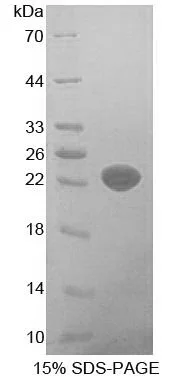 |
Greater than 97% as determined by reducing SDS-PAGE. |
靶点信息 Target Information
| 分子别名Alternative Names | SPLS1PLSphingosine-1-phosphate aldolase |
|---|---|
| 背景介绍Background | Cleaves phosphorylated sphingoid bases (PSBs), such as sphingosine-1-phosphate, into fatty aldehydes and phosphoethanolamine. Elevates stress-induced ceramide production and apoptosis. Required for global lipid homeostasis in liver and cholesterol homeostasis in fibroblasts. Involved in the regulation of pro-inflammatory response and neutrophil trafficking. Modulates neuronal autophagy via phosphoethanolamine production which regulates accumulation of aggregate-prone proteins such as APP. Seems to play a role in establishing neuronal contact sites and axonal maintenance. |
| 功能Function | Cleaves phosphorylated sphingoid bases (PSBs), such as sphingosine-1-phosphate, into fatty aldehydes and phosphoethanolamine. Elevates stress-induced ceramide production and apoptosis. Required for global lipid homeostasis in liver and cholesterol homeostasis in fibroblasts. Involved in the regulation of pro-inflammatory response and neutrophil trafficking. Modulates neuronal autophagy via phosphoethanolamine production which regulates accumulation of aggregate-prone proteins such as APP. Seems to play a role in establishing neuronal contact sites and axonal maintenance. |
| 亚细胞定位Subcellular Location | Endoplasmic reticulum membrane; Single-pass type III membrane protein; Cytoplasmic side. |
| 数据库链接Databases |
基因功能参考文献36 条
- These results show that both a primary defect in cholesterol trafficking and S1P lyase deficiency cause overlapping phenotypic alterations, and challenge the present view on the role of sphingosine in lysosomal Ca(2+) homeostasis. PMID: 28262793 : 28262793
- Partial genetic deletion of Sgpl1 protected mice against ventilator induced lung injury. PMID: 29301259 : 29301259
- Study identifies sphingosine 1-phosphate metabolism as a novel player in modulating synaptic architecture and plasticity. PMID: 27883090 : 27883090
- SGPL1 modulates neuronal autophagy via phosphatidylethanolamine production PMID: 28521611 : 28521611
- Study verifies the role of a high-ranked gene in dysregulation of sphingolipid metabolism in the disease and demonstrate that inhibiting the enzyme, sphingosine-1-phosphate lyase 1 (SPL), has neuroprotective effects in Huntington's disease models. PMID: 28931805 : 28931805
- Epigenetic regulation of pro-inflammatory cytokine secretion by sphingosine 1-phosphate (S1P) in acute lung injury, and the role in this process of S1P lyase has been described. (Review) PMID: 27720306 : 27720306
- Mutations in sphingosine-1-phosphate lyase cause nephrosis with ichthyosis and adrenal insufficiency PMID: 28165339 : 28165339
- Sphingosine-1-phosphate lyase mutations cause primary adrenal insufficiency and steroid-resistant nephrotic syndrome. PMID: 28165343 : 28165343
- deleting SPL in CD11c(+) dendritic cells (DCs), rather than thymic epithelial cells or other stromal cells, disrupts the sphingosine-1-phosphate gradient, preventing egress. PMID: 27810923 : 27810923
- The sphingosine-1-phosphate lyase contributes to the restriction of Legionella pneumophila in murine macrophages. PMID: 26741365 : 26741365
- Studies suggest that S1PL is a novel endogenous suppressor of pulmonary fibrosis in human idiopathic pulmonary fibrosis and animal models. PMID: 26286721 : 26286721
- Although the observed inhibitory effect was not as strong as that of 4-deoxypyridoxine (a VB6 analog SPL inhibitor), these findings may be useful for further understanding the mechanism of action of THI. PMID: 25381637 : 25381637
- upregulation of multidrug resistance transporters contributes to the chemoresistance of S1P lyase-deficient MEFs PMID: 25385827 : 25385827
- Sphingosine-1-phosphate lyase downregulation promotes colon carcinogenesis through STAT3-activated microRNAs. PMID: 25347472 : 25347472
- Findings suggest that sphingosine phosphate lyase (S1P lyase) expressed in the thymic medullary perivascular spaces keeps the tissue sphingosine 1-phosphate low around the vessels and promotes thymic egress via up-regulation of S1P receptor 1 (S1P1). PMID: 24343820 : 24343820
- Data indicate that SGPL1 sphingosine 1-phosphate lyase (aldolase) mRNA is significantly increased in the periinfarct cortex. PMID: 23936150 : 23936150
- Leukocyte Sgpl1 as critical factor in monocyte macrophage differentiation and function. PMID: 23700419 : 23700419
- Inducible Sgpl1 knockout mice are protected in experimental autoimmune encephalomyelitis (EAE). PMID: 23544080 : 23544080
- Sphingosine-1-phosphate lyase has many undiscovered physiological functions apart from its role in immunity PMID: 22781001 : 22781001
- S1PL deficiency increases sphingolipid formation via recycling at the expense of de novo biosynthesis in neurons. PMID: 22291021 : 22291021
- Data show that S1P lyase knockout mice with reduced S1P lyase activity (resulting in increased bio-available S1P) had improved survival compared with wild-type littermates. PMID: 21556483 : 21556483
- S1P lyase regulates DNA damage responses through a sphingolipid feedback mechanism. PMID: 21368890 : 21368890
- Sphingosine-1-phosphate lyase (SPL) contributes to oxidative stress by depleting sphingosine-1-phosphate pools available for cardioprotective signaling. SPL inhibition as a strategy for reducing cardiac ischemia-reperfusion (I/R) injury. PMID: 21335477 : 21335477
- a genetic block in S1P degradation elicits a pro-inflammatory response but impairs neutrophil migration from blood into tissues PMID: 21173151 : 21173151
- Sphingosine 1-phosphate lyase deficiency disrupts lipid homeostasis in liver. PMID: 20097939 : 20097939
- S1P lyase-deficient cells show that S1P metabolism contributes to long-term regulation of cellular Ca2+ storage. PMID: 19913094 : 19913094
- SPL may be involved in the regulation of intracellular S1P levels during this differentiation PMID: 12584204 : 12584204
- Data report the characterization of the expression, localization, and topology of sphingosine-1-phosphate lyase. PMID: 15522238 : 15522238
- These results provide evidence of the existence of an alternative S1P lyase. PMID: 15737611 : 15737611
- Products of the Spl pathway stimulate mitogenesis. PMID: 15938718 : 15938718
- it was concluded that lymphocyte egress is mediated by sphingosine 1-phosphate (S1P) gradients that are established by S1P lyase activity and that the lyase may represent a novel immunosuppressant drug target PMID: 16151014 : 16151014
- genetic or epigenetic changes affecting intestinal sphingosine-1-phosphate metabolism may correlate with and potentially contribute to carcinogenesis PMID: 17090686 : 17090686
- extracellular S1P is dephosphorylated and subsequently converted by cells, which appears to be important for clearance of the signaling molecule S1P in the local tissue environment after infections or injuries PMID: 18172856 : 18172856
- Data suggest that lymphocyte trafficking is particularly sensitive to variations in sphingosine 1-phosphate lyase (S1PL) activity and suggest that there is a window in which partial inhibition of S1PL could produce therapeutic levels of immunosuppression. PMID: 19119317 : 19119317
- sphingosine 1-phosphate subcellular origin is essential for its toxic effect in lyase-deficient neurons PMID: 19251691 : 19251691
- SGPL1-deficient mice exhibit postnatal discontinuation of early thymocytopoiesis starting at age 2 weeks and leading to accumulation of sphingosine 1-phosphate in lymphoid tissues, which blocks lymphocyte egress and induces thymus atrophy. PMID: 19748984 : 19748984
蛋白复溶体积计算器缓冲液体积 = 蛋白质量 ÷ 蛋白浓度
输入任意两项,第三项自动计算 |
蛋白浓度稀释计算器初浓度 × 初体积 = 终浓度 × 终体积
输入任意三项,第四项自动计算 |



