


Recombinant FK506 Binding Protein 5 (FKBP5)(N-6His)
Alternative NamesP54; FKBP51; FKBP54; Ptg-10; Rotamase; 51 kDa FK506-binding protein; 54 kDa progesterone receptor-associated; Androgen-regulated protein 6; HSP90-binding immunophilin
规格参数 Specifications
| 纯度Purity | Greater than 90% as determined by reducing SDS-PAGE. |
|---|---|
| 内毒素Endotoxin | <1 EU/µg as determined by LAL test. |
| 蛋白构建Protein Construction |
6HisN 端标签-【Thr2-Val456】序列区间
|
| Accession | Q64378 |
| 表达宿主Expression Host | E.coli |
| 种属Species | Mus musculus (Mouse) |
| 预测分子量Predicted MW | 52.1 kDa |
| 制剂Formulation | Lyophilized from a 0.2 μm filtered solution of PBS, pH7.4, containing 0.01% SKL, 1mM DTT, 5% Trehalose and Proclin300. |
| 运输方式Shipping | The product is shipped with ice bag. Upon receipt, store it immediately at the temperature listed below. |
| 稳定性&储存Stability & Storage | 12 months at -20°C to -80°C in lyophilized state.6 months at -20°C to -80°C under sterile conditions after reconstitution.7-10 days at 2°C to 8°C under sterile conditions after reconstitution.Please minimize freeze-thaw cycles. |
| 复溶Reconstitution | Reconstitute in ddH₂O to a concentration of 0.1-1.0 mg/mL. Do not vortex. |
!
本司产品仅用于科研,不用于临床诊断和治疗。
产品图片 Product Images点击图片可查看原图
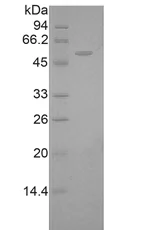 |
Greater than 90% as determined by reducing SDS-PAGE. |
靶点信息 Target Information
| 分子别名Alternative Names | P54FKBP51FKBP54Ptg-10Rotamase51 kDa FK506-binding protein54 kDa progesterone receptor-associatedAndrogen-regulated protein 6HSP90-binding immunophilin |
|---|---|
| 背景介绍Background | Immunophilin protein with PPIase and co-chaperone activities. Component of unligated steroid receptors heterocomplexes through interaction with heat-shock protein 90 (HSP90). Plays a role in the intracellular trafficking of heterooligomeric forms of steroid hormone receptors maintaining the complex into the cytoplasm when unliganded. Acts as a regulator of Akt/AKT1 activity by promoting the interaction between Akt/AKT1 and PHLPP1, thereby enhancing dephosphorylation and subsequent activation of Akt/AKT1. |
| 功能Function | Immunophilin protein with PPIase and co-chaperone activities. Component of unligated steroid receptors heterocomplexes through interaction with heat-shock protein 90 (HSP90). Plays a role in the intracellular trafficking of heterooligomeric forms of steroid hormone receptors maintaining the complex into the cytoplasm when unliganded. Acts as a regulator of Akt/AKT1 activity by promoting the interaction between Akt/AKT1 and PHLPP1, thereby enhancing dephosphorylation and subsequent activation of Akt/AKT1. |
| 亚细胞定位Subcellular Location | Cytoplasm. Nucleus. |
| 数据库链接Databases |
基因功能参考文献40 条
- Fkbp5 knockouts are protected from high-fat diet-induced weight gain, show improved glucose tolerance and increased insulin signaling in skeletal muscle. We identify a novel association between FKBP51 and AS160, a substrate of AKT2 that is involved in glucose uptake. FKBP51 antagonism increases the phosphorylation of AS160. PMID: 29170369 : 29170369
- High FKBP5 expression is associated with anxiety/depression. PMID: 27502757 : 27502757
- In mice, dexamethasone 300 mug/kg was associated with increased amygdala Fkbp5 mRNA following fear extinction and robust extinction learning while lower doses were not associated with amygdala Fkbp5 mRNA or differences in extinction learning. Further, mice that extinguished on dexamethasone 300 mug/kg maintained low levels of freezing behavior during recall training while mRNA levels were no longer elevated. PMID: 28025095 : 28025095
- These data establish SUMO conjugation as a novel regulatory mechanism in the Hsp90 cochaperone activity of FKBP51 with a functional impact on GR signaling in a neuronal context. PMID: 27177020 : 27177020
- Findings indicate a role of FK506 binding protein 5 (FKBP5) in hypoxia-regulated adipogenesis. PMID: 28254433 : 28254433
- important regulator of PPARgamma in white adipose tissue PMID: 27442117 : 27442117
- FKBP5 might increase muscle mass through the enhancements of muscle protein synthesis and myotube differentiation as well as an inhibition of muscle protein degradation in mice PMID: 27680313 : 27680313
- findings show that miR-511 is a functional regulator of FKBP5 and can contribute to neuronal differentiation. PMID: 27334923 : 27334923
- These results suggest that the association between FKBP5 and alcohol consumption is conserved in both mice and humans. PMID: 27527158 : 27527158
- We discovered that the suggested psychiatric risk factor FK506 binding protein 51 (FKBP51) increases phosphorylation of GSK3beta at serine 9 (pGSK3beta(S9)). PMID: 25849320 : 25849320
- Results suggest that regulation of Fkbp5 mRNA expression via DNA methylation, and its subsequent regulation of glucocorticoid receptor sensitivity may be implicated in the molecular mechanisms of fear retention and extinciton PMID: 26174596 : 26174596
- FKBP5 associates with BECN1, changes its phosphorylation and protein levels and enhances markers of autophagy and autophagic flux PMID: 25714272 : 25714272
- Aged animals display elevated FKBP51 levels, which contribute to impaired resiliency to depressive-like behaviors through impaired glucocorticoid signaling, a phenotype that is abrogated in FKBP5-/- mice. PMID: 25191701 : 25191701
- Overexpression of FKBP51 in the amygdala resulted in increased anxiety-related behavior. PMID: 26085626 : 26085626
- the stress response, as well as the effects of antidepressants on behavior and autophagic markers, depends on FKBP51. PMID: 25386878 : 25386878
- FKBP51 is a key regulator of adipogenesis via the Akt-p38 pathway. PMID: 24933247 : 24933247
- FKBP51 loss reciprocally regulates glucocorticoid receptor alpha and PPARgamma via 2 complementary mechanisms. PMID: 24933248 : 24933248
- In mice, the absence of the Fkbp5 gene enhances sensitivity to alcohol withdrawal. PMID: 24603855 : 24603855
- Higher levels of hypothalamic Fkbp5 expression were related to increased body weight gain. Fkbp5 may represent a novel target in metabolic regulation. PMID: 24781256 : 24781256
- The dynamic mitochondrial-nuclear shuttling of FKBP51 regulated by PKA may be key in fine-tuning the transcriptional control of glucocorticoid receptor target genes required for the acquisition of adipocyte phenotype. PMID: 24101724 : 24101724
- These results indicate that FKBP5 promotes osteoclast differentiation by a mechanism distinct from NF-kappaB activation. FKBP5 might play a role in bone destruction and development of osteoporosis in RA as well as in glucocorticoid-induced osteoporosis. PMID: 23263277 : 23263277
- Results indicate that an FKBP51 deletion yields a pro-resilience sleep phenotype. FKBP51 could therefore be a therapeutic target for stress-induced mood and sleep disorders. PMID: 24354785 : 24354785
- The guinea pig GR-specific mutations within the H1-H3 loop confer global changes within the GR-Hsp90 complex that favor FKBP51 repression over FKBP52 potentiation. PMID: 23686112 : 23686112
- The overexpression of FKBP5 did not change glyoxylase-1 mRNA and also not alter protein levels of glyoxylase-1. PMID: 23733890 : 23733890
- FKBP51 ezpression is significantly increased directly after the stress period and correlates with behavioral and neuroendocrine parameters. PMID: 22871917 : 22871917
- The genetic programs of cancer stemness and invasiveness overlap in melanoma, and that FKBP51 plays a pivotal role in sustaining such a program. PMID: 23559012 : 23559012
- This study demonstrated that animals with a conventional FKBP5 deletion are less responsive to the adverse effects of chronic stress with regards to physiological and neuroendocrine parameters. PMID: 21839098 : 21839098
- FKBP51 contributes to the regulation of the suppressive function of MDSCs by increasing inducible NO synthase, arginase-1, and reactive oxygen species levels and enhancing NF-kappaB activity. PMID: 22474024 : 22474024
- Data suggest that a 48-h fast induces Fkbp51 in ventromedial, paraventricular, and arcuate hypothalamic nuclei; mice overexpressing Fkbp51 exhibit elevated body weight relative to control mice. PMID: 22318949 : 22318949
- Quantitative real-time RT-PCR demonstrated significant increases of Fkbp5 expression levels in cochleae of dexamethasone-treated mice as compared with controls at 12 h after application PMID: 22026503 : 22026503
- basal expression of fkbp5 mRNA PMID: 21347384 : 21347384
- FKBP5-/- mice showed antidepressant behavior without affecting cognition and other basic motor functions. PMID: 21935478 : 21935478
- This study in mice and humans presents FKBP5 as a decisive factor for the physiological stress response, shaping neuroendocrine reactivity as well as coping behavior. PMID: 21907973 : 21907973
- FKBP51 is a major mitochondrial factor that undergoes nuclear-mitochondrial shuttling, an observation that may be related to antiapoptotic mechanisms triggered during the stress response. PMID: 21730050 : 21730050
- Tacrolimus binding protein 5 appears to act through activation of NF-kappaB p65 protein, suggesting a pathway for neuroprotection. PMID: 21617754 : 21617754
- These observations suggest that recognition memory impairment in aged mice is associated with decreased FKBP51 expression PMID: 20422297 : 20422297
- FKBP5:rs1360780 allele T and genotype TT were overrepresented in depression for men. PMID: 20226536 : 20226536
- FKBP51 binding/switching is a step in glucocorticoid receptor activation in L929 cells. PMID: 11751894 : 11751894
- These data suggest that distal intronic elements significantly contribute to transcriptional regulation of FKBP5 by glucocorticoids and progestins. PMID: 15544162 : 15544162
- The distal enhancer complex and basal transcription apparatus communicate indirectly with one another, implicating a regulatory mechanism that has not been previously appreciated for androgen receptor target genes. PMID: 16210365 : 16210365
蛋白复溶体积计算器缓冲液体积 = 蛋白质量 ÷ 蛋白浓度
输入任意两项,第三项自动计算 |
蛋白浓度稀释计算器初浓度 × 初体积 = 终浓度 × 终体积
输入任意三项,第四项自动计算 |



