


Recombinant Receptor Interacting Serine Threonine Kinase 3 (RIPK3)(N-6His)
Alternative NamesRIP3; RIP-like protein kinase 3; Receptor-interacting protein 3
规格参数 Specifications
| 纯度Purity | Greater than 95% as determined by reducing SDS-PAGE. |
|---|---|
| 内毒素Endotoxin | <1 EU/µg as determined by LAL test. |
| 蛋白构建Protein Construction |
6HisN 端标签-【Leu16-Cys239】序列区间
|
| Accession | Q9QZL0 |
| 表达宿主Expression Host | E.coli |
| 种属Species | Mus musculus (Mouse) |
| 预测分子量Predicted MW | 28.4 kDa |
| 制剂Formulation | Lyophilized from a 0.2 μm filtered solution of 20mM Tris, 150mM NaCl, pH8.0, containing 1mM EDTA, 1mM DTT, 0.01% SKL, 5% Trehalose and Proclin300. |
| 运输方式Shipping | The product is shipped with ice bag. Upon receipt, store it immediately at the temperature listed below. |
| 稳定性&储存Stability & Storage | 12 months at -20°C to -80°C in lyophilized state.6 months at -20°C to -80°C under sterile conditions after reconstitution.7-10 days at 2°C to 8°C under sterile conditions after reconstitution.Please minimize freeze-thaw cycles. |
| 复溶Reconstitution | Reconstitute in 20mM Tris, 150mM NaCl (pH8.0) to a concentration of 0.1-1.0 mg/mL. Do not vortex. |
!
本司产品仅用于科研,不用于临床诊断和治疗。
产品图片 Product Images点击图片可查看原图
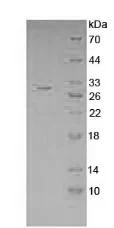 |
Greater than 95% as determined by reducing SDS-PAGE. |
靶点信息 Target Information
| 分子别名Alternative Names | RIP3RIP-like protein kinase 3Receptor-interacting protein 3 |
|---|---|
| 背景介绍Background | Serine/threonine-protein kinase that activates necroptosis and apoptosis, two parallel forms of cell death. Necroptosis, a programmed cell death process in response to death-inducing TNF-alpha family members, is triggered by RIPK3 following activation by ZBP1. Activated RIPK3 forms a necrosis-inducing complex and mediates phosphorylation of MLKL, promoting MLKL localization to the plasma membrane and execution of programmed necrosis characterized by calcium influx and plasma membrane damage. In addition to TNF-induced necroptosis, necroptosis can also take place in the nucleus in response to orthomyxoviruses infection: following ZBP1 activation, which senses double-stranded Z-RNA structures, nuclear RIPK3 catalyzes phosphorylation and activation of MLKL, promoting disruption of the nuclear envelope and leakage of cellular DNA into the cytosol. Also regulates apoptosis: apoptosis depends on RIPK1, FADD and CASP8, and is independent of MLKL and RIPK3 kinase activity. Phosphorylates RIPK1: RIPK1 and RIPK3 undergo reciprocal auto- and trans-phosphorylation. In some cell types, also able to restrict viral replication by promoting cell death-independent responses. In response to flavivirus infection in neurons, promotes a cell death-independent pathway that restricts viral replication: together with ZBP1, promotes a death-independent transcriptional program that modifies the cellular metabolism via up-regulation expression of the enzyme ACOD1/IRG1 and production of the metabolite itaconate. Itaconate inhibits the activity of succinate dehydrogenase, generating a metabolic state in neurons that suppresses replication of viral genomes. RIPK3 binds to and enhances the activity of three metabolic enzymes: GLUL, GLUD1, and PYGL. These metabolic enzymes may eventually stimulate the tricarboxylic acid cycle and oxidative phosphorylation, which could result in enhanced ROS production. |
| 功能Function | Serine/threonine-protein kinase that activates necroptosis and apoptosis, two parallel forms of cell death. Necroptosis, a programmed cell death process in response to death-inducing TNF-alpha family members, is triggered by RIPK3 following activation by ZBP1. Activated RIPK3 forms a necrosis-inducing complex and mediates phosphorylation of MLKL, promoting MLKL localization to the plasma membrane and execution of programmed necrosis characterized by calcium influx and plasma membrane damage. In addition to TNF-induced necroptosis, necroptosis can also take place in the nucleus in response to orthomyxoviruses infection: following ZBP1 activation, which senses double-stranded Z-RNA structures, nuclear RIPK3 catalyzes phosphorylation and activation of MLKL, promoting disruption of the nuclear envelope and leakage of cellular DNA into the cytosol. Also regulates apoptosis: apoptosis depends on RIPK1, FADD and CASP8, and is independent of MLKL and RIPK3 kinase activity. Phosphorylates RIPK1: RIPK1 and RIPK3 undergo reciprocal auto- and trans-phosphorylation. In some cell types, also able to restrict viral replication by promoting cell death-independent responses. In response to flavivirus infection in neurons, promotes a cell death-independent pathway that restricts viral replication: together with ZBP1, promotes a death-independent transcriptional program that modifies the cellular metabolism via up-regulation expression of the enzyme ACOD1/IRG1 and production of the metabolite itaconate. Itaconate inhibits the activity of succinate dehydrogenase, generating a metabolic state in neurons that suppresses replication of viral genomes. RIPK3 binds to and enhances the activity of three metabolic enzymes: GLUL, GLUD1, and PYGL. These metabolic enzymes may eventually stimulate the tricarboxylic acid cycle and oxidative phosphorylation, which could result in enhanced ROS production. |
| 亚细胞定位Subcellular Location | Cytoplasm, cytosol. Nucleus. |
| 数据库链接Databases |
基因功能参考文献50 条
- key player in the degenerative process in dystrophin-deficient muscles PMID: 30194302 : 30194302
- melatonin treatment inhibited the Ripk3-PGAM5-CypD-mPTP cascade and thus reduced cellular necroptosis, conferring a protective advantage to the endothelial system in IR stress. PMID: 29770487 : 29770487
- Aldehyde dehydrogenase 2 deficiency negates chronic low-to-moderate alcohol consumption-induced cardioprotecion possibly via ROS-dependent apoptosis and RIP1/RIP3/MLKL-mediated necroptosis. PMID: 27840306 : 27840306
- The major function of RIP1 kinase activity in TNF-induced necroptosis is to autophosphorylate serine 161. This specific phosphorylation then enables RIP1 to recruit RIP3 and form a functional necrosome, a central controller of necroptosis. PMID: 28176780 : 28176780
- Deficiency in RIPK3 attenuated serum and lung cytokines, lung injury and neutrophil infiltration and lung and gut apoptosis. These data suggest that RIPK3, in part, is responsible for the systemic inflammatory response in neonatal sepsis. PMID: 29248164 : 29248164
- RIP3-ablation attenuated oxidative stress, inflammation and apoptosis in astrocytes, which was dependent on AMPKalpha activation. PMID: 29470982 : 29470982
- The necroptosis-inducing kinase RIPK3 reduces adipose tissue inflammation and glucose intolerance. PMID: 27323669 : 27323669
- RIP3-mediated signaling is not a critical driver of acute radiation syndrome PMID: 29634408 : 29634408
- RIPK3 promotes adenovirus type 5 oncolytic activity. PMID: 29238045 : 29238045
- in Mycobacterium tuberculosis-infected macrophages, mitochondria are an essential platform for induction of necrosis by activating RIPK3 function and preventing caspase 8-activation. PMID: 28401933 : 28401933
- Ripk3 promotes mitochondrial apoptosis via inhibition of FUNDC1 mitophagy in cardiac ischemia reperfusion injury. PMID: 28732308 : 28732308
- The authors report here that male reproductive organs of both Ripk3- and Mlkl-knockout mice retain 'youthful' morphology and function into advanced age, while those of age-matched wild-type mice deteriorate. Feeding of wild-type mice with an RIPK1 inhibitor prior to the normal onset of age-related changes in their reproductive organs blocked the appearance of signs of aging. PMID: 28807105 : 28807105
- These data demonstrate a role for RIP3 in promoting in vivo thrombosis and hemostasis by amplifying platelet activation. RIP3 may represent a novel promising therapeutic target for thrombotic diseases. PMID: 28242694 : 28242694
- Pull down experiments with biotinylated Sorafenib show that it binds independently RIPK1, RIPK3 and MLKL. Moreover, it inhibits RIPK1 and RIPK3 kinase activity. In vivo Sorafenib protects against TNF-induced systemic inflammatory response syndrome (SIRS) and renal ischemia-reperfusion injury (IRI). PMID: 28661484 : 28661484
- RIP3-mediated activation of caspase-1 rather than necroptosis-dependent inflammation was responsible for aggressive inflammation in influenza A (H7N9) virus-infected mice. PMID: 28423682 : 28423682
- we assessed the role of RIP3 in synergy with Caspase-1 in the induction of IL-1beta production in BMDM after either LPS/ATP or Chlamydia muridarum stimulation. The possibility of pyroptosis and necroptosis interplays and the role of RIP3 in IL-1beta production during Chlamydia muridarum infection in BMDM was investigated as well. PMID: 28660207 : 28660207
- 2-hydroxyglutarate bound to DNMT1 and stimulated its association with the RIP3 promoter, inducing hypermethylation that reduces RIP3 protein and consequently impaired RIP3-dependent necroptosis. PMID: 28564603 : 28564603
- Knock-out mice deficient in MLKL or RIP3 had increased survival and reduced pulmonary injury during Serratia marcescens pneumonia. PMID: 28387756 : 28387756
- our results reveal that the necroptosis adaptor RIPK3 has key anti-inflammatory and anti-tumoral functions in the intestine, and define RIPK3 as a novel colon tumor suppressor PMID: 27344176 : 27344176
- Ablation of Ripk3 rescues Fadd-deficient mice through two processes: inhibiting necroptosis during embryonic development and restricting massive inflammation during postnatal development, which were segregated by the RIPK3 mutation. PMID: 28445730 : 28445730
- Impaired Nrf2-dependent redox homeostasis is an important mechanism that promotes cell death downstream of IFN-I and RIP3 signaling in S. Typhimurium-infected macrophages. PMID: 29055012 : 29055012
- a key physiological function of RIPK3 is to promote reparative cytokine expression through intestinal CD11c(+) mononuclear phagocytes in a kinase- and necroptosis-independent manner. PMID: 28273458 : 28273458
- An alternative function for RIPK1/RIPK3 in vascular permeability. PMID: 28151480 : 28151480
- study identifies a novel role for RIPK1 and RIPK3, a pair of homologous serine/threonine kinases previously implicated in the regulation of necroptosis and pathologic tissue injury, in directing IFN-beta production in macrophages PMID: 28461567 : 28461567
- this study shows that RIPK1 and RIPK3 account for acute inflammatory responses induced by lipopolysaccharide in vivo; notably, this regulation does not require exogenous manipulation of caspases PMID: 27396959 : 27396959
- RIPK3 and/or MLKL may exert functions independently of necroptosis. PMID: 27523270 : 27523270
- These results identify DAI as a link between influenza A virus replication and RIPK3 activation and implicate DAI as a sensor of RNA viruses. PMID: 27746097 : 27746097
- results reveal a pathway for MLKL-dependent programmed necrosis that is executed in the absence of RIPK3 and potentially drives the pathogenesis of severe liver diseases. PMID: 27756058 : 27756058
- Mice deficient in RIPK3 or doubly deficient in MLKL and FADD, but not MLKL alone, are more susceptible to influenza A virus than their wild-type counterparts, revealing an important role for RIPK3-mediated apoptosis in antiviral immunity. PMID: 27321907 : 27321907
- These data suggest that Rip3 plays a role in neurodegeneration and mitochondrial morphology in the absence of mitochondrial division. PMID: 27640145 : 27640145
- RIPK3 regulates type I IFN both transcriptionally, by interacting with MAVS and limiting RIPK1 interaction with MAVS, and post-transcriptionally. PMID: 28410401 : 28410401
- Using a mouse model of West Nile virus encephalitis, study shows that RIPK3 restricts WNV pathogenesis independently of cell death. Ripk3(-/-) mice exhibited enhanced mortality compared to wild-type controls. PMID: 28366204 : 28366204
- Low RIP3 expression is associated with inflammation in dextran sodium sulfate-induced ulcerative colitis . PMID: 28256024 : 28256024
- The findings reported here indicate that palmitate induces RIP1/RIP3-dependent necrosis via MLKL-mediated pore formation of RAW 264.7 cells in the plasma membrane, which could provide a new mechanism to explain the link between elevated levels of free fatty acids (FFAs), palmitate in particular, and macrophage death. PMID: 27856241 : 27856241
- Results demonstrate that RIPK3 restricts malignant myeloproliferation by activating the inflammasome, which promotes differentiation and cell death, and that loss of RIPK3 increases leukemic burden in mice. Reduced RIPK3 expression is observed across several human acute myeloid leukemia subtypes. PMID: 27411587 : 27411587
- Data identify RIPK3 and the inflammasome as key tumor suppressors in acute myeloid leukemia (AML). PMID: 27411587 : 27411587
- Results suggest that impaired hepatic proteasome function by alcohol exposure may contribute to hepatic accumulation of RIP3 resulting in necroptosis and steatosis while RIP1 kinase activity is important for alcohol-induced inflammation. PMID: 26769846 : 26769846
- Study shows that Rip3 mRNA expression is at the highest level in the spleen and duodenum, but lowest level in brain. Protein detection results revealed its localization in different type cells in different tissues that can be either nuclear or cytoplasmic. PMID: 26969469 : 26969469
- we demonstrate that the phosphorylation of Ser345 is not required for the interaction between RIPK3 and MLKL in the necrosome, but is essential for MLKL translocation, accumulation in the plasma membrane, and consequent necroptosis. PMID: 26024392 : 26024392
- CHIP is a bona fide negative regulator of the RIPK1-RIPK3 necrosome formation leading to desensitization of TNF-mediated necroptosis PMID: 26900751 : 26900751
- Data indicate that receptor-interacting serine-threonine kinase 3 (RIPK3) deletion prevents inflammatory phenotypes in CreLysM (lysozyme M) Casp8fl/fl (caspase 8) mice. PMID: 26471282 : 26471282
- RIP3-induced activation of CaMKII, via phosphorylation or oxidation or both, triggers opening of the mitochondrial permeability transition pore and myocardial necroptosis. PMID: 26726877 : 26726877
- RIPK3 is an essential molecule to maintain the temporal manner of the normal progression of wound closure PMID: 26451737 : 26451737
- deficiency of RIPK3 or MLKL prevents oxalate crystal-induced acute kidney injury. PMID: 26817517 : 26817517
- Results identify a crucial role for RIPK3-PGAM5-Drp1/NFAT signalling in NKT cell activation, and further suggest that RIPK3-PGAM5 signalling may mediate crosstalk between mitochondrial function and immune signalling. PMID: 26381214 : 26381214
- RIPK3 can promote NLRP3 inflammasome and IL-1beta inflammatory responses independent of MLKL and necroptotic cell death PMID: 25693118 : 25693118
- Data implicate the infiltrating macrophages as a source of damaging inflammasomes after photoreceptor detachment in a RIP3-dependent manner and suggest a novel therapeutic target for treatment of retinal diseases. PMID: 25906154 : 25906154
- Cisplatin stimulates RIP1/RP3/MLKL-dependent necrotic cell death in renal tubules, which finally causes renal dysfunction PMID: 25788533 : 25788533
- diverse modes of acute liver injury have differing requirements for RIP1 and RIP3; moreover, within a single injury model, RIP1 and RIP3 blockade can have diametrically opposite effects on tissue damage PMID: 25950489 : 25950489
- Human herpesvirus 1 ICP6 interacts with mouse RIP1/RIP3 through its RHIM domain and forms dimers/oliogmers by its C-terminal R1 domain. PMID: 25674982 : 25674982
蛋白复溶体积计算器缓冲液体积 = 蛋白质量 ÷ 蛋白浓度
输入任意两项,第三项自动计算 |
蛋白浓度稀释计算器初浓度 × 初体积 = 终浓度 × 终体积
输入任意三项,第四项自动计算 |



