


| 纯度Purity | Greater than 90% as determined by reducing SDS-PAGE. |
|---|---|
| 内毒素Endotoxin | Please contact with the lab for this information |
| 蛋白构建Protein Construction |
【Glu41-His210】序列区间
|
| Accession | P16301 |
| 表达宿主Expression Host | E.coli |
| 种属Species | Mus musculus (Mouse) |
| 预测分子量Predicted MW | 20.7 kDa |
| 制剂Formulation | Lyophilized from a 0.2 μm filtered solution of PBS, pH7.4, containing 0.01% SKL, 1mM DTT, 5% Trehalose and Proclin300. |
| 运输方式Shipping | The product is shipped with ice bag. Upon receipt, store it immediately at the temperature listed below. |
| 稳定性&储存Stability & Storage | 12 months at -20°C to -80°C in lyophilized state.6 months at -20°C to -80°C under sterile conditions after reconstitution.7-10 days at 2°C to 8°C under sterile conditions after reconstitution.Please minimize freeze-thaw cycles. |
| 复溶Reconstitution | Reconstitute in 20mM Tris, 150mM NaCl (pH8.0) to a concentration of 0.1-1.0 mg/mL. Do not vortex. |
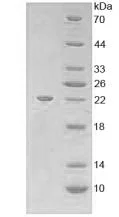 |
Greater than 90% as determined by reducing SDS-PAGE. |
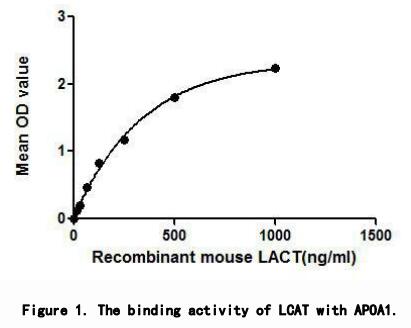 |
LCAT (Phosphatidylcholine-sterol acyltransferase) is an enzyme in the extracellular metabolism of plasma lipoproteins, which converts cholesterol and phosphatidylcholines (lecithins) to cholesteryl esters and lysophosphatidylcholines. It is reported that APOA1 (Apolipoprotein A-I) acts as a cofactor for the LCAT. Thus, a binding ELISA assay was conducted to detect the association of LCAT with APOA1. Briefly, recombinant rat LCAT were diluted serially in PBS with 0.01% BSA (pH 7.4). Duplicate samples of 100uL were then transferred to APOA1-coated microtiter wells and incubated for 2h at 37°C. Wells were washed with PBST and incubated for 1h with anti-LCAT pAb, then aspirated and washed 3 times. After incubation with HRP labelled secondary antibody, wells were aspirated and washed 3 times. With the addition of substrate solution, wells were incubated 15-25 minutes at 37°C. Finally, add 50µL stop solution to the wells and read at 450nm immediately. The binding activity of LCAT with APOA1 was shown in Figure 1 and this effect was in a dose dependent manner. |
| 分子别名Alternative Names | phosphatidylcholine-sterol O-acyltransferasePhospholipid-cholesterol acyltransferase |
|---|---|
| 背景介绍Background | Central enzyme in the extracellular metabolism of plasma lipoproteins. Synthesized mainly in the liver and secreted into plasma where it converts cholesterol and phosphatidylcholines (lecithins) to cholesteryl esters and lysophosphatidylcholines on the surface of high and low density lipoproteins (HDLs and LDLs). The cholesterol ester is then transported back to the liver. Also produced in the brain by primary astrocytes, and esterifies free cholesterol on nascent APOE-containing lipoproteins secreted from glia and influences cerebral spinal fluid (CSF) APOE- and APOA1 levels. Together with APOE and the cholesterol transporter ABCA1, plays a key role in the maturation of glial-derived, nascent lipoproteins. Required for remodeling high-density lipoprotein particles into their spherical forms. Has a preference for plasma 16:0-18:2 or 18:O-18:2 phosphatidylcholines. Catalyzes the hydrolysis of 1-O-alkyl-2-acetyl-sn-glycero-3-phosphocholine (platelet-activating factor or PAF) to 1-O-alkyl-sn-glycero-3-phosphocholine (lyso-PAF). Also catalyzes the transfer of the acetate group from PAF to 1-hexadecanoyl-sn-glycero-3-phosphocholine forming lyso-PAF. Catalyzes the esterification of (24S)-hydroxycholesterol (24(S)OH-C), also known as cerebrosterol to produce 24(S)OH-C monoesters. |
| 功能Function | Central enzyme in the extracellular metabolism of plasma lipoproteins. Synthesized mainly in the liver and secreted into plasma where it converts cholesterol and phosphatidylcholines (lecithins) to cholesteryl esters and lysophosphatidylcholines on the surface of high and low density lipoproteins (HDLs and LDLs). The cholesterol ester is then transported back to the liver. Also produced in the brain by primary astrocytes, and esterifies free cholesterol on nascent APOE-containing lipoproteins secreted from glia and influences cerebral spinal fluid (CSF) APOE- and APOA1 levels. Together with APOE and the cholesterol transporter ABCA1, plays a key role in the maturation of glial-derived, nascent lipoproteins. Required for remodeling high-density lipoprotein particles into their spherical forms. Has a preference for plasma 16:0-18:2 or 18:O-18:2 phosphatidylcholines. Catalyzes the hydrolysis of 1-O-alkyl-2-acetyl-sn-glycero-3-phosphocholine (platelet-activating factor or PAF) to 1-O-alkyl-sn-glycero-3-phosphocholine (lyso-PAF). Also catalyzes the transfer of the acetate group from PAF to 1-hexadecanoyl-sn-glycero-3-phosphocholine forming lyso-PAF. Catalyzes the esterification of (24S)-hydroxycholesterol (24(S)OH-C), also known as cerebrosterol to produce 24(S)OH-C monoesters. |
| 亚细胞定位Subcellular Location | Secreted. |
| 数据库链接Databases |
基因功能参考文献21 条
- Taken together, these results suggest that apoE-containing discoidal HDLs do not require LCAT-dependent maturation to mediate efficient Abeta clearance PMID: 24950691 : 24950691
- increased cholesterol esterification by LCAT is atheroprotective PMID: 25964513 : 25964513
- Gene transfer of WT LCAT in LCAT(-/-) mice increased 11.8-fold the plasma cholesterol, whereas the LCAT[T147I] and LCAT[P274S] mutants caused a 5.2- and 2.9-fold increase, respectively. PMID: 25948084 : 25948084
- DYRK1A overexpression decreases plasma lecithin:cholesterol acyltransferase activity and apolipoprotein A-I levels. PMID: 23920041 : 23920041
- adrenal glucocorticoid function in LCAT knockout (KO) mice PMID: 23178225 : 23178225
- a novel function of apoA-IV in the biogenesis of discrete HDL-A-IV particles with the participation of ABCA1 and LCAT PMID: 23132909 : 23132909
- Studies suggest that absence of lecithin cholesterol acyltransferase (LCAT) may protect against insulin resistance, diabetes and obesity. PMID: 22326749 : 22326749
- Data show that LCAT activity was significantly higher in long chain base biosynthesis protein 2 (Sptlc2)+/- and sphingomyelin synthase 2 (Sms2)-/- mice, but markedly lower in ApoE-/- and Ldlr-/- mice. PMID: 22370449 : 22370449
- Lecithin:cholesterol acyltransferase deficiency protects against cholesterol-induced hepatic endoplasmic reticulum stress in mice. PMID: 22500017 : 22500017
- LCAT deficiency confers gender-specific protection against diet-induced obesity and insulin resistance at least in part through regulation in UPR, white adipose tissue adipogenesis, and brown adipocyte partitioning PMID: 21454561 : 21454561
- Oxidative stress is markedly elevated in lecithin:cholesterol acyltransferase-deficient mice and is paradoxically reversed in the apolipoprotein E knockout background in association with a reduction in atherosclerosis PMID: 11809774 : 11809774
- LCAT contributes significantly to the cholesteryl ester (CE) fatty acid pool of apoB lipoprotein and is the only source of plasma long chain polyunsaturated CE in LDL receptor and apoE knockout mice. PMID: 11893779 : 11893779
- hypertriglyceridemia and the improved fasting glucose phenotype seen in the lecithin-cholesterol acyltransferase and ldl receptor double knockout mice are in part attributable to up-regulation of hepatic sterol regulatory element binding factor-1c gene PMID: 14668345 : 14668345
- LCAT has a role in regulating plasma HDL cholesterol levels and biliary cholesterol excretion PMID: 15251433 : 15251433
- apoE is a more significant activator of LCAT than apoA-I on mouse apoB lipoproteins PMID: 15654758 : 15654758
- ACAT2 provides core CE of newly secreted VLDL, whereas LCAT adds CE during LDL particle formation PMID: 15805543 : 15805543
- In LCAT deficient mice, alterations in hepatic expression of the gene for fads2, soat2, and dgat2, results in changes in total hepatic and cholesterol ester-associated polyunsaturated fatty acids. PMID: 16105858 : 16105858
- LCAT deficiency induces complex alterations in hepatic signal transduction cascades. PMID: 17551001 : 17551001
- These data show that brain LCAT esterifies cholesterol on glial-derived apoE-lipoproteins, and influences CSF apoE and apoA-I levels. PMID: 19065001 : 19065001
- LCAT overexpression does not promote an increased rate of macrophage reverse cholesterol transport. PMID: 19564558 : 19564558
- Cholesterol homeostasis was examined in mice with the two major cholesterol transport pathways for catabolism interrupted by disrupting abca1, lcat, or both. PMID: 19729076 : 19729076
蛋白复溶体积计算器缓冲液体积 = 蛋白质量 ÷ 蛋白浓度
输入任意两项,第三项自动计算 |
蛋白浓度稀释计算器初浓度 × 初体积 = 终浓度 × 终体积
输入任意三项,第四项自动计算 |



