


| 纯度Purity | Greater than 95% as determined by reducing SDS-PAGE. |
|---|---|
| 内毒素Endotoxin | Please contact with the lab for this information |
| 蛋白构建Protein Construction |
【Glu23-Ala245】序列区间
|
| Accession | P98086 |
| 表达宿主Expression Host | E.coli |
| 种属Species | Mus musculus (Mouse) |
| 预测分子量Predicted MW | 27.2 kDa |
| 制剂Formulation | Lyophilized from a 0.2 μm filtered solution of PBS, pH7.4, containing 0.01% SKL, 1mM DTT, 5% Trehalose and Proclin300. |
| 运输方式Shipping | The product is shipped with ice bag. Upon receipt, store it immediately at the temperature listed below. |
| 稳定性&储存Stability & Storage | 12 months at -20°C to -80°C in lyophilized state.6 months at -20°C to -80°C under sterile conditions after reconstitution.7-10 days at 2°C to 8°C under sterile conditions after reconstitution.Please minimize freeze-thaw cycles. |
| 复溶Reconstitution | Reconstitute in 10mM PBS (pH7.4) to a concentration of 0.1-1.0 mg/mL. Do not vortex. |
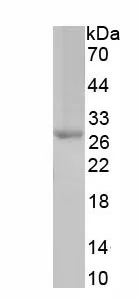 |
Greater than 95% as determined by reducing SDS-PAGE. |
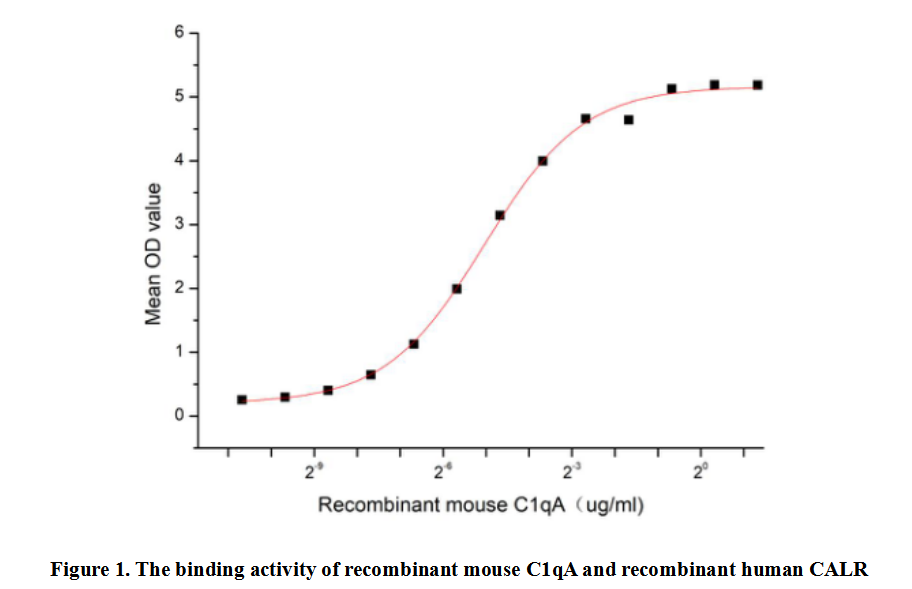 |
Complement Component 1, Q Subcomponent A (C1qA) is a protein that plays a crucial role in the innate immune system. It is part of the C1 complex, which is the first component of the classical complement pathway. The C1 complex is composed of one molecule each of C1q, C1r, and C1s. C1q is the recognition subcomponent of the complex and and initiating the complement cascade. C1qA plays a key role in eliminating pathogens, regulating inflammatory response and maintaining immune tolerance. It is reported that C1qA can bind to the C-terminal of CALR through its gelatin-as-region, and this interaction may play an important role in regulating complement activation and cell signaling. Thus a functional binding ELISA assay was conducted to detect the interaction of recombinant mouse C1qA and recombinant human CALR. Briefly, C1qA was diluted serially in PBS with 0.01% BSA (pH 7.4). Duplicate samples of 100 μl were then transferred to CALR-coated microtiter wells and incubated for 1h at 37℃. Wells were washed with PBST and incubated for 1h with anti-C1qA pAb, then aspirated and washed 3 times. After incubation with HRP labelled secondary antibody for 1h at 37℃, wells were aspirated and washed 5 times. With the addition of substrate solution, wells were incubated 15-25 minutes at 37℃. Finally, add 50 µL stop solution to the wells and read at 450/630 nm immediately. The binding activity of recombinant mouse C1qA and recombinant human CALR was shown in Figure 1, the EC50 for this effect is 0.03 ug/mL. |
| 分子别名Alternative Names | Complement Component 1,q Subcomponent,Alpha Polypeptide |
|---|---|
| 背景介绍Background | C1q associates with the proenzymes C1r and C1s to yield C1, the first component of the serum complement system. The collagen-like regions of C1q interact with the Ca(2+)-dependent C1r(2)C1s(2) proenzyme complex, and efficient activation of C1 takes place on interaction of the globular heads of C1q with the Fc regions of IgG or IgM antibody present in immune complexes. |
| 功能Function | C1q associates with the proenzymes C1r and C1s to yield C1, the first component of the serum complement system. The collagen-like regions of C1q interact with the Ca(2+)-dependent C1r(2)C1s(2) proenzyme complex, and efficient activation of C1 takes place on interaction of the globular heads of C1q with the Fc regions of IgG or IgM antibody present in immune complexes. |
| 亚细胞定位Subcellular Location | Secreted. |
| 数据库链接Databases |
基因功能参考文献49 条
- C1qa(-/-) mice did not show any differences in photoreceptor loss or inflammation at 7 days compared to wild-type PMID: 30126455 : 30126455
- The results presented here demonstrate that the C1q expression in aged females experience a distinct difference in brain aging when compared to age-matched males, suggesting females undergo a higher level of microglial activation with age. PMID: 28732515 : 28732515
- this study shows that regulatory dendritic cells can mediate a potent direct anti-inflammatory activity via the expression and/or secretion of molecules such as C1q, independently of their capacity to expand the pool of regulatory T cells PMID: 27731323 : 27731323
- Data preliminarily suggest that complement C1q activity may aid in the clearance of the Toxoplasma gondii parasite from the central nervous system and in so doing, have consequences for the connectivity of neighboring cells and synapses PMID: 27109609 : 27109609
- analysis of molecular signaling and inflammatory responses during ingestion of atherogenic lipoproteins modulated by complement protein C1q PMID: 27573737 : 27573737
- C1q-/- mice manifest increased frequency of fetal resorption, reduced fetal weight, and smaller litter size when compared to their wild-type counterparts PMID: 27687635 : 27687635
- This study demonstrated that microglia, but not neurons or peripheral sources, are the dominant source of C1q in the brain. PMID: 28264694 : 28264694
- findings show that C1q rather than FcgammaRs controls the Ab-mediated Ag uptake and its presentation by spleen APC subsets to T cells PMID: 28432146 : 28432146
- Demonstrate local synthesis of complement proteins by both PDGFRbeta-positive pericytes and CD45-positive cells in kidney fibrosis. PMID: 28052876 : 28052876
- Deleting C1qa gene significantly reduces synaptic pruning by Grn(-/-) microglia and mitigates neurodegeneration, behavioral phenotypes, and premature mortality in Grn(-/-) mice; results uncover a previously unrecognized role of progranulin in suppressing aberrant microglia activation during aging. PMID: 27114033 : 27114033
- C1q level may be a surrogate of prediction marker representing neurodegenerative disease progress before developing behavioral impairment. PMID: 26728245 : 26728245
- developmental mechanisms of C1qa may be re-engaged during injury response PMID: 27008854 : 27008854
- that inhibition of C1 is sufficient to preserve dendritic and synaptic architecture PMID: 27048300 : 27048300
- These findings support a role for locally synthesized C1q in promoting tumor growth. PMID: 26831747 : 26831747
- C1q is involved in the pristane-mediated enhanced inflammatory response to TLR7 stimulation. PMID: 26773156 : 26773156
- C1q has a role in pulmonary vascular homeostasis and preventing injury to lung endothelium PMID: 26487714 : 26487714
- Data (including data from studies in mutant mice) suggest exercise prevents age-related neurovascular decline, up-regulation of C1qa, and down-regulation of astrocytic Apoe; this preventive effect of exercise does not occur in Apoe-deficient mice. PMID: 26512759 : 26512759
- critical role in activation of beta-catenin signalling in hypertensive arterial remodelling PMID: 25716000 : 25716000
- G allele in rs172378 risk factor for lupus nephritis in a homozygous status PMID: 25326229 : 25326229
- Data (including data on knockout mice) suggest, in absence of Trem2 (triggering receptor expressed on myeloid cells 2), pulmonary macrophages selectively produce elevated levels of C1q resulting in enhanced phagocytosis during pneumococcal pneumonia. PMID: 24945405 : 24945405
- Complement protein C1q promotes macrophage anti-inflammatory M2-like polarization during the clearance of atherogenic lipoproteins PMID: 25091012 : 25091012
- C1q was significantly reduced in newly diagnosed schizophrenic patients or schizophrenic patients on medication compared with the controls. PMID: 23235303 : 23235303
- C1q induction and global complement pathway activation do not contribute to ALS toxicity in mutant SOD1 mice. PMID: 24170856 : 24170856
- The structural abnormalities, together with increased numbers of excitatory synapses, likely contribute to epileptogenesis in C1q KO mice. PMID: 23621154 : 23621154
- C1q-induced LRP1B and GPR6 proteins expressed early in Alzheimer disease mouse models, are essential for the C1q-mediated protection against amyloid-beta neurotoxicity PMID: 23150673 : 23150673
- These findings suggest that C1q recognizes an alternative binding partner expressed by stressed retinal ganglion cells. PMID: 22918632 : 22918632
- Findings suggest the unexpected role of complement C1q in Wnt signal transduction and modulation of mammalian aging. PMID: 22682250 : 22682250
- Our data indicate that C1q could have a role in regulating platelet activation and associated leukocyte recruitment during vessel wall injury. PMID: 22142906 : 22142906
- Levels of C1q rise substantially in retinal tissues over the course of degeneration. in the absence of C1q, cone photoreceptor function and viability are significantly compromised. PMID: 21863053 : 21863053
- analysis of the molecular mechanisms for synchronized transcription of three complement C1q subunit genes (A, B and C) in dendritic cells and macrophages PMID: 21862594 : 21862594
- Leukocyte recruitment and C1q-hemolytic activity was restored to wild type levels when CD93 was expressed on either hematopoietic cells or nonhematopoietic cells in bone marrow chimeric mice PMID: 21849679 : 21849679
- C1q, a marker of microglial activation, is upregulated in the nigrostriatal system following subchronic 1-methyl-4-phenyl-1,2,3,6-tetrahydropyridine (MPTP); nigrostriatal dopaminergic injury is not affected by C1q in this model of Parkinson disease. PMID: 21640391 : 21640391
- Mice with a mutation in complement component 1a (C1qa) were protected from glaucoma. PMID: 21383504 : 21383504
- Complement 1q (C1q)-deficient mice lacking the classical complement pathway show significantly reduced survival and increased organ dysfunction, following cecal ligation and puncture when compared with control mice. PMID: 21263075 : 21263075
- C1q directly promotes neuronal survival, thereby demonstrating new interactions between immune proteins and neuronal cells that may facilitate neuroprotection. PMID: 21368058 : 21368058
- Ethanol activates the classical complement pathway via C1q binding to apoptotic cells in the liver and that C1q contributes to the pathogenesis of ethanol-induced liver injury. PMID: 20416309 : 20416309
- Complement protein C1q forms a complex with cytotoxic prion protein oligomers PMID: 20410306 : 20410306
- These results suggest that C1q and C3 facilitate the induction of intranasal tolerance. PMID: 20213737 : 20213737
- Bacterial titers of both Streptococcus pneumoniae serotype 6A and 14 in the middle ear lavage fluid samples from Bf/C2(-/)(-), Bf(-)(/)(-), and C1qa(-/)(-) mice were significantly higher than in samples from wild-type mice. PMID: 20065024 : 20065024
- C1q contributes to apoptotic cell clearance in vitro, but its genetic deletion has no effect on pulmonary apoptotic cell clearance in vivo. PMID: 12244199 : 12244199
- Elevated expression of splenic prion protein (PrP) may be dependent on C1q, since PrP up-regulation does not occur in spleens of C1q-deficient mice following treatment with preformed immune complexes or vesicular stomatitis virus. PMID: 12794132 : 12794132
- Evaluation using C1q-deficient mice shows that lung injury following gastrointestinal ischemia-reperfusion injury is independent of C1q and classical complement activation. PMID: 15879138 : 15879138
- alpha2beta1 integrin is a novel receptor for multiple collectins and the C1q complement protein PMID: 16166590 : 16166590
- The transmembrane lectin SIGN-R1 therefore contributes to innate resistance by an unusual C3 activation pathway. PMID: 16615889 : 16615889
- bacterial titers in the CNS were almost 12- and 20-fold higher in C1q- and C3-deficient-mice, respectively. Mean CSF leukocyte counts were reduced by 47 and 73% in C1q- and C3-deficient-mice, respectively PMID: 17237437 : 17237437
- The in vitro binding and activation of the human and mouse complement systems was analysed and the susceptibility to infection in complement-deficient mouse strains, was tested. PMID: 18501966 : 18501966
- C1q participates in scrapie prion protein PrP(Sc) uptake by conventional dendritic cells (cDCs), revealing a critical role for cDCs in initial prion capture, an event that takes place before the PrP(Sc) accumulation within the follicular DC network. PMID: 19155476 : 19155476
- IgM antibodies play a central role in protection against atherosclerosis; the mechanism appears to be at least partly independent of classical pathway complement activation by C1q PMID: 19620499 : 19620499
- ARRB2 acts to limit JNK/ERK activation and survival in macrophages. PMID: 19783052 : 19783052
蛋白复溶体积计算器缓冲液体积 = 蛋白质量 ÷ 蛋白浓度
输入任意两项,第三项自动计算 |
蛋白浓度稀释计算器初浓度 × 初体积 = 终浓度 × 终体积
输入任意三项,第四项自动计算 |



