


| 纯度Purity | Greater than 95% as determined by reducing SDS-PAGE. |
|---|---|
| 内毒素Endotoxin | Please contact with the lab for this information |
| 蛋白构建Protein Construction |
【Met20-Lys190】序列区间
|
| Accession | Q9Z1R3 |
| 表达宿主Expression Host | E.coli |
| 种属Species | Mus musculus (Mouse) |
| 预测分子量Predicted MW | 25.8 kDa |
| 制剂Formulation | Lyophilized from a 0.2 μm filtered solution of PBS, pH7.4, containing 0.01% SKL, 1mM DTT, 5% Trehalose and Proclin300. |
| 运输方式Shipping | The product is shipped with ice bag. Upon receipt, store it immediately at the temperature listed below. |
| 稳定性&储存Stability & Storage | 12 months at -20°C to -80°C in lyophilized state.6 months at -20°C to -80°C under sterile conditions after reconstitution.7-10 days at 2°C to 8°C under sterile conditions after reconstitution.Please minimize freeze-thaw cycles. |
| 复溶Reconstitution | Reconstitute in 10mM PBS (pH7.4) to a concentration of 0.1-1.0 mg/mL. Do not vortex. |
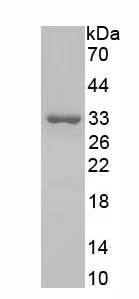 |
Greater than 95% as determined by reducing SDS-PAGE. |
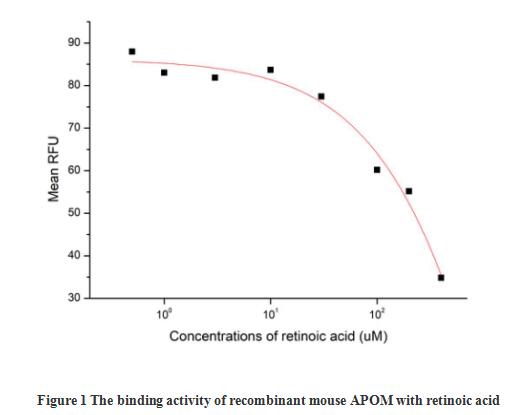 |
Apolipoprotein M (APOM) is an approximately 25 kDa variably glycosylated protein that adopts a beta-barrel structure characteristic of lipocalin family proteins. It functions as a component of lipoprotein particles which play essential roles in fatty acid and cholesterol transport and metabolism. Alternative splicing generates a short isoform that lacks the N-terminal 72 amino acids. APOM is produced primarily by hepatocytes but also by renal tubule epithelial cells. The signal peptide is not cleaved and is required for APOM association with lipoprotein particles as well as Megalin mediated reabsorption by the kidney. The activity of recombinant mouse APOM was measured by its ability to bind all-trans retinoic acid. The binding of retinoic acid results in the quenching of Trp fluorescence in APOM. APOM was diluted to 50 ug/ml in 50 mM Tris, 10 mM CaCl2, 150 mM NaCl, pH 7.5 (assay buffer) and the retinoic acid was diluted to 400, 200, 100, 30, 10, 3, 1 and 0.5 µM in 95% ethanol. Mixing 112.5 µL of 50 µg/mL rmAPOM and 12.5 µL of retinoic acid serial dilutions in microtubes and a blank containing 112.5 µL of 50 µg/mL rmAPOM and 12.5 µL of 95% ethanol, then incubate at room temperature for 30 minutes. Loading 100 ul of the reaction mixtures and blank and read at excitation and emission wavelengths of 280 nm and 340 nm (top read), respectively, in endpoint mode. The result was shown in figure 1, the 50% binding concentration (BC50) is >300 µM. |
| 分子别名Alternative Names | Apo-MG3aNG20Protein G3a |
|---|---|
| 背景介绍Background | Probably involved in lipid transport. Can bind sphingosine-1-phosphate, myristic acid, palmitic acid and stearic acid, retinol, all-trans-retinoic acid and 9-cis-retinoic acid. |
| 功能Function | Probably involved in lipid transport. Can bind sphingosine-1-phosphate, myristic acid, palmitic acid and stearic acid, retinol, all-trans-retinoic acid and 9-cis-retinoic acid. |
| 亚细胞定位Subcellular Location | Secreted. |
| 数据库链接Databases |
基因功能参考文献23 条
- apoM-S1P-S1PR1 signaling might underlie the pathogenesis of ALI and apoM could have physiological benefits to alleviate LPS-induced ALI. PMID: 29260347 : 29260347
- These S1P-induced enhancements in growth factors and chemotactic cytokines in retinal pigment epithelium cells were significantly inhibited by ApoM treatment. Additionally, in vivo experiments using a laser-induced choroidal neovascularization (CNV) murine model demonstrated that intravitreal ApoM injection significantly reduced the progression of CNV formation. PMID: 29301231 : 29301231
- This study highlights the complexity of Apom/S1P in atherosclerosis and challenges the notion that the Apom/S1P complex is anti-atherogenic, at least in Apoe-deficient mice. PMID: 28866363 : 28866363
- This suggests that the autophagy dysfunction caused by the deficiency of ApoM is an important factor in hepatic steatosis (triglyceride accumulation). ApoM plays a key role in normal autophagy activity in the liver and thereby further regulates the metabolism of liver lipids, particularly triglycerides. PMID: 29288662 : 29288662
- HDL facilitates S1P efflux from erythrocytes by both apoM-dependent and apoM-independent mechanisms. Moreover, apoM facilitates tubular reabsorption of S1P from the urine, however, with no impact on S1P plasma concentrations. PMID: 24950692 : 24950692
- The study suggests that vascular leakage of albumin-sized particles in ApoM deficiency is S1P- and S1P1-dependent and this dependency exacerbates the response to inflammatory stimuli. PMID: 26956418 : 26956418
- apoM might facilitate the maintenance of CD4(+) T-lymphocytes or could modify the T-lymphocytes subgroups in murine spleen PMID: 26543853 : 26543853
- Upon immune stimulation, Apom(-/-) mice developed more severe experimental autoimmune encephalomyelitis, characterized by increased lymphocytes in the central nervous system and breakdown of the blood-brain barrier PMID: 26053123 : 26053123
- LDL receptor and ApoE have roles in the clearance of ApoM-associated sphingosine 1-phosphate PMID: 25505264 : 25505264
- ApoM augmented insulin secretion by maintaining the S1P concentration under both in vivo and in vitro conditions. PMID: 24814049 : 24814049
- The present data indicate that the plasma apo-M levels modulate the ability of plasma to mobilize cellular cholesterol, whereas apo-M has no major effect on the excretion of cholesterol into feces. PMID: 24046869 : 24046869
- ApoM can bind oxidized phospholipids, increasing the antioxidant effect of HDL. PMID: 22204862 : 22204862
- Results show that apoM, by delivering S1P to the S1P(1) receptor on endothelial cells, is a vasculoprotective constituent of HDL. PMID: 21606363 : 21606363
- After refolding from inclusion bodies, the crystal structure of apoM (reported here at 2.5 A resolution) displays a novel yet unprecedented seven-stranded beta-barrel structure. PMID: 20932978 : 20932978
- apoM mainly associates with HDL in normal mice but also with the pathologically increased lipoprotein fraction in genetically modified mice; decreased apoM levels in apoA-I-deficient mice suggest a connection between apoM and apoA-I metabolism. PMID: 15102887 : 15102887
- ApoM transcripts were detectable in mouse embryos from day 7.5 to day 18.5 PMID: 15147633 : 15147633
- in both liver and kidney, expression of apoM was significantly lower in leptin deficient ob/ob mice and in leptin-receptor deficient db/db mice than in control mice PMID: 15358114 : 15358114
- Overexpression of apoM in Ldlr(-/-) mice protected against atherosclerosis when the mice were challenged with a cholesterol-enriched diet. PMID: 15793583 : 15793583
- Megalin-mediated endocytosis in kidney proximal tubules prevents apoM excretion in the urine. PMID: 16099815 : 16099815
- Based on these results, we suggest that insulin regulates apoM synthesis in vivo and, therefore, that the reduction of apoM expression is a general phenomenon in diabetes models. PMID: 16516154 : 16516154
- In the setting of low density lipoprotein receptor deficiency, apoM-Tg mice with approximately 2-fold increased plasma apoM concentrations developed smaller atherosclerotic lesions than controls. PMID: 18006500 : 18006500
- Apolipoprotein M is a negative acute response protein that decreases during infection and inflammation PMID: 18054359 : 18054359
- Foxa2 activity increases plasma high density lipoprotein levels by regulating apolipoprotein M PMID: 18381283 : 18381283
蛋白复溶体积计算器缓冲液体积 = 蛋白质量 ÷ 蛋白浓度
输入任意两项,第三项自动计算 |
蛋白浓度稀释计算器初浓度 × 初体积 = 终浓度 × 终体积
输入任意三项,第四项自动计算 |



