


| 纯度Purity | Greater than 90% as determined by reducing SDS-PAGE. |
|---|---|
| 内毒素Endotoxin | Please contact with the lab for this information |
| 蛋白构建Protein Construction |
【Leu123-Glu339】序列区间
|
| Accession | O70370 |
| 表达宿主Expression Host | E.coli |
| 种属Species | Mus musculus (Mouse) |
| 预测分子量Predicted MW | 30.3 kDa |
| 制剂Formulation | Lyophilized from a 0.2 μm filtered solution of PBS, pH7.4, containing 0.01% SKL, 1mM DTT, 5% Trehalose and Proclin300. |
| 运输方式Shipping | The product is shipped with ice bag. Upon receipt, store it immediately at the temperature listed below. |
| 稳定性&储存Stability & Storage | 12 months at -20°C to -80°C in lyophilized state.6 months at -20°C to -80°C under sterile conditions after reconstitution.7-10 days at 2°C to 8°C under sterile conditions after reconstitution.Please minimize freeze-thaw cycles. |
| 复溶Reconstitution | Reconstitute in 10mM PBS (pH7.4) to a concentration of 0.1-1.0 mg/mL. Do not vortex. |
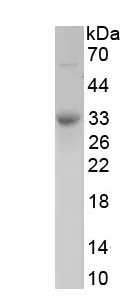 |
Greater than 90% as determined by reducing SDS-PAGE. |
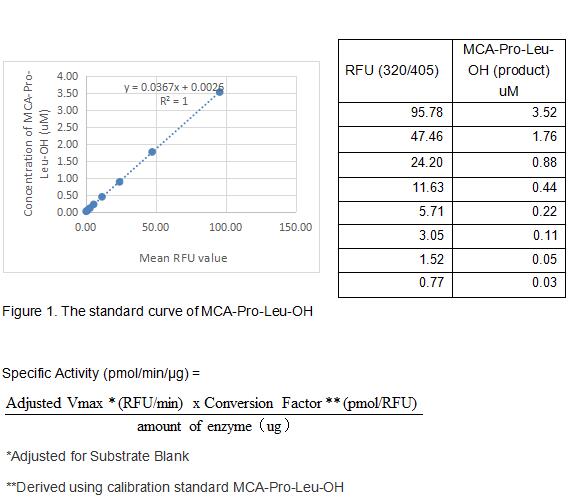 |
Cathepsin S (CTSS) is a lysosomal cysteine protease of the papain family. It plays a major role in the processing of the MHC class II associated invariant chain. It has been implicated in the pathogenesis of several diseases such as Alzheimer’s disease and degenerative disorders associated with the cells of the mononuclear phagocytic system. Mouse Cathepsin S is synthesized as a preproenzyme of 340 amino acid residues consisting a signal peptide (residues 1 17), a pro region (residues 18 122), and the mature enzyme (residues 123 340). Cathepsin S is less abundant in tissues than Cathepsins B, L and H. The activity of recombinant mouse CTSS is measured by its ability to cleave a fluorogenic peptide substrate Mca-Arg-Pro-Lys-Pro-Val-Glu-Nval-Trp-Arg-Lys(Dnp)-NH2 in the assay buffer 50 mM NaOAc, 5 mM DTT, 250 mM NaCl, pH 4.5. The rmCTSS is diluted to 50 ug/ml in assay buffer, then incubated at room temperature for 2h. The incubated rmCTSS is diluted to 5 ug/mL in assay buffer. Loading into a black well plate 50 µL of 5 ug/mL rmCTSS and start the reaction by adding 50 µL of 20 µM substrate, with a substrate blank containing 50 µL assay buffer, 50 µL substrate, and no rmCTSS. Then read at excitiation and emission wavelengths of 320 nm and 405 nm, respectively, in kinetic mode for 5 minutes. The specific activity of recombinant mouse CTSS is > 10 pmol/min/µg. |
| 分子别名Alternative Names | CTS-S |
|---|---|
| 背景介绍Background | Thiol protease. Key protease responsible for the removal of the invariant chain from MHC class II molecules and MHC class II antigen presentation. The bond-specificity of this proteinase is in part similar to the specificities of cathepsin L. |
| 功能Function | Thiol protease. Key protease responsible for the removal of the invariant chain from MHC class II molecules and MHC class II antigen presentation. The bond-specificity of this proteinase is in part similar to the specificities of cathepsin L. |
| 亚细胞定位Subcellular Location | Lysosome. Secreted. Cytoplasmic vesicle, phagosome. |
| 数据库链接Databases |
基因功能参考文献41 条
- The present data indicating that Cat-S activity increases with CKD progression suggest that Cat-S might be a therapeutic target to prevent cardiovascular complications in CKD. PMID: 28240259 : 28240259
- CatS(-/-) mice exhibited impaired social interaction and social novelty recognition in the three-chamber test. PMID: 28623134 : 28623134
- Cathepsin S activity controls injury-related vascular remodeling via TLR2/p38MAPK/PI3K/Akt/p-HDAC6 signaling pathway. PMID: 27365406 : 27365406
- Ctss induction during muscular dystrophy is a pathologic event that partially underlies disease pathogenesis, and its inhibition might serve as a new therapeutic strategy in Duchenne muscular dystrophy. PMID: 26966179 : 26966179
- Fluorogen substrate, Mca-GRWPPMGLPWE-Lys(Dnp)-DArg-NH2 can detect CTSS activities in mouse antigen presenting cells. PMID: 26899824 : 26899824
- Data show that cathepsins S (CatS) regulates CCL2 chemokine expression by modulation of CD74 antigen processing. PMID: 26358505 : 26358505
- Cathepsin S activates MrgprC11 and evokes receptor-dependent scratching in mice. PMID: 26216096 : 26216096
- cathepsin S deficiency alters the balance between adipocyte and osteoblast differentiation, increases bone turnover, and changes bone microarchitecture. Therefore, bone and fat metabolisms should be monitored when using cathepsin S inhibitors clinically PMID: 24780878 : 24780878
- results identify Cat-S as a biased agonist of PAR2 that causes PAR2- and TRPV4-dependent inflammation and pain. PMID: 25118282 : 25118282
- Cathepsin S contributes to macrophage migration via degradation of elastic fibre integrity to facilitate neointima formation of vein grafts PMID: 24319016 : 24319016
- CatS also reduced myocardial Smad2 and Smad3 activation and extra domain A fibronectin expression PMID: 23771947 : 23771947
- CatS is involved in the secondary injury after traumatic brain injury PMID: 24282339 : 24282339
- Disruption of CatS therefore induces hyperlocomotor activity due to failure to downscale the synaptic strength. PMID: 24067868 : 24067868
- These results show a peripheral pivotal role of CatS in the development of neuropathic pain through the antigen-specific activation of CD4(+) T-cells PMID: 24553941 : 24553941
- High cathepsin S promotes cancer growth and neovascularization. PMID: 23629809 : 23629809
- Provide direct evidence that Cat S plays an important role in abdominal aortic aneurysm formation in apoE-deficient mice. PMID: 22871592 : 22871592
- GILT expression decreased the proteolysis of a CatS selective substrate. PMID: 23012103 : 23012103
- Cathepsin S deficiency results in abnormal accumulation of autophagosomes in macrophages and enhances Ang II-induced cardiac inflammation. PMID: 22558139 : 22558139
- Overexpression of cathepsin S induces chronic atopic dermatitis in mice. PMID: 22170489 : 22170489
- Cat-S activates nociceptors to induce visceral pain via protease-activated receptor-2. PMID: 21802389 : 21802389
- only prophylactic Cat S inhibitor dosing blocked lung inflammation, consistent with our findings in Cat S knockout mice. PMID: 20855652 : 20855652
- Cathepsin S inhibition prevented the formation of lung granulomas in a mouse model of sarcoidosis. PMID: 21251246 : 21251246
- Cat S derived from macrophages is involved in the mechanisms of atherosclerotic plaque vulnerability in apoE-deficient mice PMID: 20079903 : 20079903
- For a subset of antigens, epitope generation is critically regulated by cathepsin S, which participates in antigen processing and generates qualitative and quantitative differences in the peptide repertoires displayed by MHC class II molecules. PMID: 11884425 : 11884425
- regulation of the phagosomal CatS, CatL, CatB and CatZ contents during dendritic cell activation PMID: 12186844 : 12186844
- cathepsin S contributes to angiogenesis by microvascular endothelial cells. PMID: 12600886 : 12600886
- In vivo, nonprofessional histocompatibility class (MHC) II-expressing antigen presenting cells of the intestinal epithelium use Cat S, but not Cat L, for MHC class II-mediated antigen presentation. PMID: 15661874 : 15661874
- First direct genetic evidence is reported for a key role of cathepsin S in autoimmune responses to acetylcholine receptor and in the pathogenesis of experimental autoimmune myasthenia gravis. PMID: 15661938 : 15661938
- Transgenic interferon-gamma induces alveolar epithelial cell DNA injury and apoptosis via a novel murine cathepsin S-dependent pathway, a critical event in the pathogenesis of alveolar remodeling, emphysema and inflammation. PMID: 15944319 : 15944319
- The increases in mRNA levels for CatS and GPX3 found in the aging C57BL/6 RPE/choroid appear to represent an increase in both the numbers of cells expressing these messages and an increase in the level of expression in individual cells. PMID: 15947738 : 15947738
- Cathepsin S has a unique role in determining the morphology of class II MHC-positive endosomal compartments PMID: 16094690 : 16094690
- interleukin-6-signal transducer and activator of transcription 3 -mediated increase of cathepsin S activity PMID: 16286017 : 16286017
- Data show that cathepsin S deficiency impairs angiogenesis and tumor cell proliferation, impairing angiogenic islet formation and the growth of solid tumors; while the absence of its endogenous inhibitor cystatin C resulted in opposite phenotypes. PMID: 16365041 : 16365041
- plays an important role in atherosclerotic plaque destabilization and rupture PMID: 16410454 : 16410454
- Plays role in migration and activation of microglia to protect facial motoneurons against axotomy-induced injury. PMID: 17539023 : 17539023
- These results indicate that seizures induced by kainate elicit neurodegeneration, astrogliosis, and microglial activation accompanied by the expression of cathepsin S while those induced by nicotine do not. PMID: 17997037 : 17997037
- Upregulation of elastase proteins results in aortic dilatation in mucopolysaccharidosis I mice. PMID: 18479957 : 18479957
- CAT S participates in inflammatory processes accompanying aging and pathologies of the central nervous system PMID: 18694734 : 18694734
- Leukocyte cathepsin S is a potent regulator of both cell and matrix turnover in advanced atherosclerosis. PMID: 19095996 : 19095996
- catS-induced elastolysis accelerates arterial and aortic valve calcification in chronic renal disease PMID: 19307473 : 19307473
- The active form of cathepsin S was identified as being significantly up-regulated in poorly differentiated TRAMP tumours. PMID: 19487544 : 19487544
蛋白复溶体积计算器缓冲液体积 = 蛋白质量 ÷ 蛋白浓度
输入任意两项,第三项自动计算 |
蛋白浓度稀释计算器初浓度 × 初体积 = 终浓度 × 终体积
输入任意三项,第四项自动计算 |



