


| 纯度Purity | Greater than 90% as determined by reducing SDS-PAGE. |
|---|---|
| 内毒素Endotoxin | Please contact with the lab for this information |
| 蛋白构建Protein Construction |
【Gly25-Pro259】序列区间
|
| Accession | Q61805 |
| 表达宿主Expression Host | E.coli |
| 种属Species | Mus musculus (Mouse) |
| 预测分子量Predicted MW | 29.3 kDa |
| 制剂Formulation | Lyophilized from a 0.2 μm filtered solution of PBS, pH7.4, containing 0.01% SKL, 1mM DTT, 5% Trehalose and Proclin300. |
| 运输方式Shipping | The product is shipped with ice bag. Upon receipt, store it immediately at the temperature listed below. |
| 稳定性&储存Stability & Storage | 12 months at -20°C to -80°C in lyophilized state.6 months at -20°C to -80°C under sterile conditions after reconstitution.7-10 days at 2°C to 8°C under sterile conditions after reconstitution.Please minimize freeze-thaw cycles. |
| 复溶Reconstitution | Reconstitute in 10mM PBS (pH7.4) to a concentration of 0.1-1.0 mg/mL. Do not vortex. |
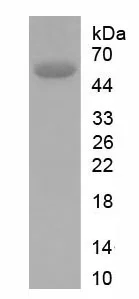 |
Greater than 90% as determined by reducing SDS-PAGE. |
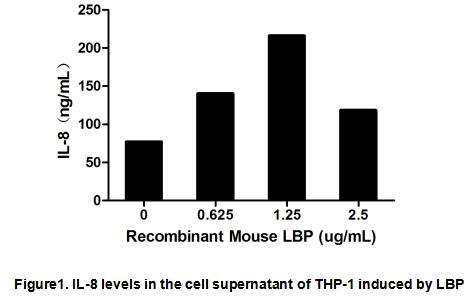 |
Lipopolysaccharide Binding Protein (LBP) is a soluble acute-phase protein that binds to bacterial lipopolysaccharide (or LPS) to elicit immune responses by presenting the LPS to important cell surface pattern recognition receptors called CD14 and TLR4.This protein is part of a family of structurally and functionally related proteins, including BPI, plasma cholesteryl ester transfer protein (CETP), and phospholipid transfer protein (PLTP). It has been reported that LBP can enhance LPS-stimulated IL-8 secretion by THP-1 cells. To test the bioactivity of LBP, THP-1 cells were seeded into 24-well plate at a density of 1x10⁶ cells/mL including 1ug/mL LPS, and treated with certain concentrations (0.625ug/mL-20ug/mL) of LBP for 24h and IL-8 levels in the cell supernatant were determined by ELISA. IL-8 levels in the cell supernatant of THP-1 cells increased significantly after stimulated with LBP have shown in Figure1. |
| 分子别名Alternative Names | LPS-Binding Protein |
|---|---|
| 背景介绍Background | Plays a role in the innate immune response. Binds to the lipid A moiety of bacterial lipopolysaccharides (LPS), a glycolipid present in the outer membrane of all Gram-negative bacteria. Acts as an affinity enhancer for CD14, facilitating its association with LPS. Promotes the release of cytokines in response to bacterial lipopolysaccharide. |
| 功能Function | Plays a role in the innate immune response. Binds to the lipid A moiety of bacterial lipopolysaccharides (LPS), a glycolipid present in the outer membrane of all Gram-negative bacteria. Acts as an affinity enhancer for CD14, facilitating its association with LPS. Promotes the release of cytokines in response to bacterial lipopolysaccharide. |
| 亚细胞定位Subcellular Location | Secreted. Cytoplasmic granule membrane. |
| 数据库链接Databases |
基因功能参考文献22 条
- The LBP gene is a macrophage-specific LXR target that promotes foam cell survival and atherogenesis. PMID: 24671012 : 24671012
- LBP is a critical factor in the development of non-alcoholic fatty liver disease. PMID: 27404046 : 27404046
- LBP is a proinflammatory soluble adipokine that acts as a brake for adipogenesis, strengthening the negative effects of palmitate and LPS on adipocyte differentiation. PMID: 26201685 : 26201685
- Differential expression of LBP and TGFB1, along with other genes, in different mesenchymal stromal cells preparations, produces the variable responses to external stimuli. PMID: 24664302 : 24664302
- findings describe a novel role for LBP in normal hippocampal development and raise the possibility that some of the behavioral sequelae of early life stress are mediated by reduced expression of LBP during a critical period of neurodevelopment. PMID: 21993208 : 21993208
- The amino acid sequence for two mimic epitopes of the inflammatory site of LBP were determined to be WKAQKRFMKKSG and LKTRKLFWKYKD. PMID: 20833181 : 20833181
- LBP plays an important role in early alcohol-induced liver injury by enhancing LPS-induced signal transduction, most likely in Kupffer cells. PMID: 11884468 : 11884468
- LBP plays an important role in resistance to lethal Salmonella peritonitis (but not to oral or intravenous infection) by facilitating the role of neutrophils in mediating acute inflammation. PMID: 12055258 : 12055258
- role LBP plays in local pulmonary immune defenses to bacterial challenge PMID: 12353926 : 12353926
- In the case of intraperitoneal infection of LBP-deficient mice with Salmonella typhimurium, no local inflammatory response is evident, neutrophil influx is delayed, and the mice succumb to the infection. PMID: 12370383 : 12370383
- plays an essential role in the innate immune response to Gram-positive pneumococci PMID: 12932360 : 12932360
- Locally produced LBP is an essential component of an effective innate immune response to E. coli peritonitis. PMID: 14638760 : 14638760
- LBP is one of the critical molecules regulating the acute and chronic airway response to inhaled lipopolysaccharides (LPS). PMID: 15356561 : 15356561
- LBP knockout mice are protected from toxicity with a decrease in hepatic necrosis following acetaminophen challenge. This suggests a novel role for LBP in modulating acetaminophen-induced liver injury. PMID: 15619225 : 15619225
- LBP does not contribute to an effective host response in Mycobacterium tuberculosis infection in mice. PMID: 15993364 : 15993364
- LBP per se possesses a protective effect on acute necrotizing pancreatitis PMID: 16163057 : 16163057
- In conclusion, hemorrhagic shock and resuscitation to mice cause severe, LBP-mediated hepatocellular damage. PMID: 16614372 : 16614372
- Oxidized phospholipid inhibition of toll-like receptor (TLR) signaling is restricted to TLR2 and TLR4: roles for CD14, LPS-binding protein, and MD2 as targets for specificity of inhibition. PMID: 18559343 : 18559343
- LPS-binding protein mediates LPS-induced liver injury and mortality in the setting of biliary obstruction. PMID: 18948440 : 18948440
- Marked concomitant increases in plasma LBP and endotoxin-like activity following murine trypanosome infection might play an important role in the pathogenesis of trypanosomosis PMID: 19022463 : 19022463
- Paneth cells express LBP together with other proteins acting in the innate immune response of the gut, such as lysozyme, defensins and intelectin. PMID: 19234712 : 19234712
- Innate defense against lethal peritoneal infection with Salmonella requires the direct proinflammatory involvement of LPS-binding protein (LBP), a major nonredundant function of LBP in this model. PMID: 11466385 : 11466385
蛋白复溶体积计算器缓冲液体积 = 蛋白质量 ÷ 蛋白浓度
输入任意两项,第三项自动计算 |
蛋白浓度稀释计算器初浓度 × 初体积 = 终浓度 × 终体积
输入任意三项,第四项自动计算 |



