


| 纯度Purity | Greater than 90% as determined by reducing SDS-PAGE. |
|---|---|
| 内毒素Endotoxin | Please contact with the lab for this information |
| 蛋白构建Protein Construction |
【Ala155-Leu292】序列区间
|
| Accession | Q9QZF2 |
| 表达宿主Expression Host | E.coli |
| 种属Species | Mus musculus (Mouse) |
| 预测分子量Predicted MW | 16.7 kDa |
| 制剂Formulation | Lyophilized from a 0.2 μm filtered solution of PBS, pH7.4, containing 0.01% SKL, 1mM DTT, 5% Trehalose and Proclin300. |
| 运输方式Shipping | The product is shipped with ice bag. Upon receipt, store it immediately at the temperature listed below. |
| 稳定性&储存Stability & Storage | 12 months at -20°C to -80°C in lyophilized state.6 months at -20°C to -80°C under sterile conditions after reconstitution.7-10 days at 2°C to 8°C under sterile conditions after reconstitution.Please minimize freeze-thaw cycles. |
| 复溶Reconstitution | Reconstitute in 10mM PBS (pH7.4) to a concentration of 0.1-1.0 mg/mL. Do not vortex. |
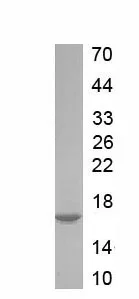 |
Greater than 90% as determined by reducing SDS-PAGE. |
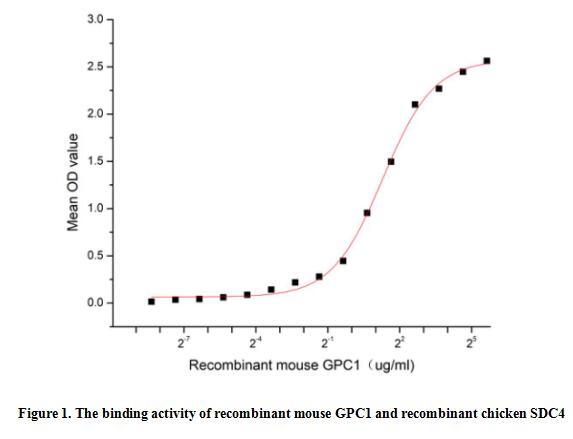 |
Glypican 1 (GPC1) is one of the six glycosylphosphatidylinositol-anchored, cell surface heparan sulfate proteoglycans that acts as a growth factor signaling. Cells known to express GPC-1 include neurons, smooth and skeletal muscle cells, keratinocytes, osteoblasts, Schwann cells, immature dendritic cells, and tumor, plus tumor-associated vascular endothelial cells. The function of GPC-1 is complex and varied, it can modulate various signaling pathways including Heparin Binding Epidermal Growth Factor Like Growth Factor (HBEGF), fibroblast growth factors (FGF), vascular endothelial growth factor-A (VEGF-A), transforming growth factor-β (TGF-β), Wnt, Hedgehog (Hh), and bone morphogenic protein (BMP) through specific interactions with pathway ligands and receptors. Besides, Syndecan 4 (SDC4) has been also identified as an interactor of GPC1, thus a functional binding ELISA assay was conducted to detect the interaction of recombinant mouse GPC1 and recombinant chicken SDC4. Briefly, GPC1 was diluted serially in PBS with 0.01% BSA (pH 7.4). Duplicate samples of 100 μl were then transferred to SDC4-coated microtiter wells and incubated for 1h at 37℃. Wells were washed with PBST and incubated for 1h with anti-GPC1 pAb, then aspirated and washed 3 times. After incubation with HRP labelled secondary antibody for 1h at 37℃, wells were aspirated and washed 5 times. With the addition of substrate solution, wells were incubated 15-25 minutes at 37℃. Finally, add 50 µL stop solution to the wells and read at 450/630 nm immediately. The binding activity of recombinant mouse GPC1 and recombinant chicken SDC4 was shown in Figure 1, the EC50 for this effect is 2.5 ug/mL. |
| 分子别名Alternative Names | Glypican Proteoglycan 1Secreted glypican-1 |
|---|---|
| 背景介绍Background | Cell surface proteoglycan that bears heparan sulfate. Binds, via the heparan sulfate side chains, alpha-4 (V) collagen and participates in Schwann cell myelination. May act as a catalyst in increasing the rate of conversion of prion protein PRPN(C) to PRNP(Sc) via associating (via the heparan sulfate side chains) with both forms of PRPN, targeting them to lipid rafts and facilitating their interaction. Required for proper skeletal muscle differentiation by sequestering FGF2 in lipid rafts preventing its binding to receptors (FGFRs) and inhibiting the FGF-mediated signaling. Binds Cu(2+) or Zn(2+) ions. |
| 功能Function | Cell surface proteoglycan that bears heparan sulfate. Binds, via the heparan sulfate side chains, alpha-4 (V) collagen and participates in Schwann cell myelination. May act as a catalyst in increasing the rate of conversion of prion protein PRPN(C) to PRNP(Sc) via associating (via the heparan sulfate side chains) with both forms of PRPN, targeting them to lipid rafts and facilitating their interaction. Required for proper skeletal muscle differentiation by sequestering FGF2 in lipid rafts preventing its binding to receptors (FGFRs) and inhibiting the FGF-mediated signaling. Binds Cu(2+) or Zn(2+) ions. |
| 亚细胞定位Subcellular Location | Cell membrane; Lipid-anchor, GPI-anchor; Extracellular side. Endosome. Note=S-nitrosylated form recycled in endosomes. Localizes to CAV1-containing vesicles close to the cell surface. Cleavage of heparan sulfate side chains takes place mainly in late endosomes. Associates with both forms of PRNP in lipid rafts. Colocalizes with APP in perinuclear compartments and with CP in intracellular compartments. Associates with fibrillar APP amyloid-beta peptides in lipid rafts in Alzheimer disease brains.; [Secreted glypican-1]: Secreted, extracellular space. |
| 数据库链接Databases |
基因功能参考文献12 条
- This study provides new insights into the roles of GPC1 and GPC3 in mandibular morphogenesis. GPC3-knockout reduces mandibular growth, but GPC1 does not. These findings along with previous studies indicate that glypicans could be potential therapeutic agents to manage craniosynostosis and associated bony dysmorphology. PMID: 28426184 : 28426184
- Data show that notum and glypican-1 and glypican-3 gene expression during colorectal cancer (CRC) development and present evidence to suggest them as potential new biomarkers of CRC pathogenesis. PMID: 26517809 : 26517809
- Amyloid precursor protein (APP)/APP-like protein 2 (APLP2) expression is required to initiate endosome-nucleus-autophagosome PMID: 24898256 : 24898256
- The N-terminal growth-factor-like domain of amyloid-beta precursor protein is necessary for protein-receptor binding, whereas the E2-domain mediates interaction with membrane-anchored syndecan 2 and glypican 1. PMID: 23986479 : 23986479
- Glypican-1 is expressed by neural stem cells and neurons derived from embryonic stem cells, which are then surrounded with cell bodies and processes, which in certain cases show distinctive expression patterns. PMID: 20689858 : 20689858
- Glypican-1 is a novel cellular cofactor for prion conversion. It acts as a scaffold facilitating the interaction of PrP(C) and PrP(Sc) in lipid rafts. PMID: 19936054 : 19936054
- data imply that endogenous Gpc1 is involved in control of growth factor signaling, a finding that is both novel and relevant to the general question of how the activities of co-receptors are exploited during development PMID: 19732411 : 19732411
- Data describe a relationship between heparan sulfate and copper binding of amyloid precursor protein (APP) and amyloid precursor-like protein 2 (APLP2) in the modulation of nitroxyl anion-catalyzed heparan sulfate degradation in glypican-1. PMID: 15677459 : 15677459
- cancer cell- and host-derived GPC1 are crucial for full mitogenic, angiogenic, and metastatic potential of cancer cells PMID: 18064304 : 18064304
- GPC1 regulates EC cell cycle progression at least partially by modulating APC/C-mediated degradation of mitotic cyclins and securin PMID: 18417614 : 18417614
- These results suggest a role for Gpc-1 autoprocessing in the clearance of PrP(Sc) from infected cells. PMID: 18717736 : 18717736
- GPC1 may have an important role in the establishment of a microenvironment that supports early events in hematopoiesis. PMID: 18840400 : 18840400
蛋白复溶体积计算器缓冲液体积 = 蛋白质量 ÷ 蛋白浓度
输入任意两项,第三项自动计算 |
蛋白浓度稀释计算器初浓度 × 初体积 = 终浓度 × 终体积
输入任意三项,第四项自动计算 |



