


| 纯度Purity | Greater than 90% as determined by reducing SDS-PAGE. |
|---|---|
| 内毒素Endotoxin | Please contact with the lab for this information |
| 蛋白构建Protein Construction |
【Ile344-Ser559】序列区间
|
| Accession | Q8CFZ4 |
| 表达宿主Expression Host | E.coli |
| 种属Species | Mus musculus (Mouse) |
| 预测分子量Predicted MW | 28.1 kDa |
| 制剂Formulation | Lyophilized from a 0.2 μm filtered solution of PBS, pH7.4, containing 0.01% SKL, 1mM DTT, 5% Trehalose and Proclin300. |
| 运输方式Shipping | The product is shipped with ice bag. Upon receipt, store it immediately at the temperature listed below. |
| 稳定性&储存Stability & Storage | 12 months at -20°C to -80°C in lyophilized state.6 months at -20°C to -80°C under sterile conditions after reconstitution.7-10 days at 2°C to 8°C under sterile conditions after reconstitution.Please minimize freeze-thaw cycles. |
| 复溶Reconstitution | Reconstitute in 10mM PBS (pH7.4) to a concentration of 0.1-1.0 mg/mL. Do not vortex. |
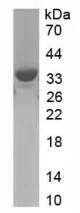 |
Greater than 90% as determined by reducing SDS-PAGE. |
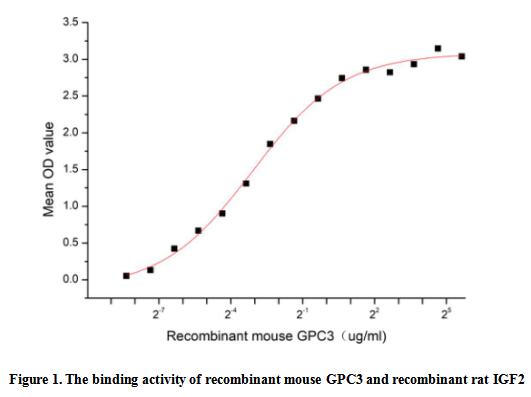 |
Glypican-3 (GPC3), a 70 kDa protein, is a member of the glypican family that attaches to the cell surface by a glycosylphosphatidylinositol anchor, is specifically up-regulated in hepatocellular carcinoma (HCC) although rarely or not expressed in normal liver tissues, making it a perfect diagnostic and treatment target for HCC. GPC3 is also a negative transcriptional regulator and tumor suppressor that inhibits the growth of breast, ovary, and lung cancer cells. It is reported that GPC3 can form a complex with insulin-like growth factor 2 (IGF2), and might thereby modulate IGF2 action. Thus a functional binding ELISA assay was conducted to detect the interaction of recombinant mouse GPC3 and recombinant rat IGF2. Briefly, GPC3 was diluted serially in PBS with 0.01% BSA (pH 7.4). Duplicate samples of 100 μl were then transferred to IGF2-coated microtiter wells and incubated for 1h at 37℃. Wells were washed with PBST and incubated for 1h with anti-GPC3 pAb, then aspirated and washed 3 times. After incubation with HRP labelled secondary antibody for 1h at 37℃, wells were aspirated and washed 5 times. With the addition of substrate solution, wells were incubated 15-25 minutes at 37℃. Finally, add 50 µL stop solution to the wells and read at 450/630 nm immediately. The binding activity of recombinant mouse GPC3 and recombinant rat IGF2 was shown in Figure 1, the EC50 for this effect is 0.12 ug/mL. |
| 分子别名Alternative Names | DGSXOCI5SDYSSGBSGBS1MXR7Glypican Proteoglycan 3GTR2-2Intestinal protein OCI-5Secreted glypican-3 |
|---|---|
| 背景介绍Background | Cell surface proteoglycan that bears heparan sulfate. Negatively regulates the hedgehog signaling pathway when attached via the GPI-anchor to the cell surface by competing with the hedgehog receptor PTC1 for binding to hedgehog proteins. Binding to the hedgehog protein SHH triggers internalization of the complex by endocytosis and its subsequent lysosomal degradation. Positively regulates the canonical Wnt signaling pathway by binding to the Wnt receptor Frizzled and stimulating the binding of the Frizzled receptor to Wnt ligands. Positively regulates the non-canonical Wnt signaling pathway. Binds to CD81 which decreases the availability of free CD81 for binding to the transcriptional repressor HHEX, resulting in nuclear translocation of HHEX and transcriptional repression. Inhibits the dipeptidyl peptidase activity of DPP4. Plays a role in limb patterning and skeletal development by controlling the cellular response to BMP4. Modulates the effects of growth factors BMP2, BMP7 and FGF7 on renal branching morphogenesis. Required for coronary vascular development. Plays a role in regulating cell movements during gastrulation. |
| 功能Function | Cell surface proteoglycan that bears heparan sulfate. Negatively regulates the hedgehog signaling pathway when attached via the GPI-anchor to the cell surface by competing with the hedgehog receptor PTC1 for binding to hedgehog proteins. Binding to the hedgehog protein SHH triggers internalization of the complex by endocytosis and its subsequent lysosomal degradation. Positively regulates the canonical Wnt signaling pathway by binding to the Wnt receptor Frizzled and stimulating the binding of the Frizzled receptor to Wnt ligands. Positively regulates the non-canonical Wnt signaling pathway. Binds to CD81 which decreases the availability of free CD81 for binding to the transcriptional repressor HHEX, resulting in nuclear translocation of HHEX and transcriptional repression. Inhibits the dipeptidyl peptidase activity of DPP4. Plays a role in limb patterning and skeletal development by controlling the cellular response to BMP4. Modulates the effects of growth factors BMP2, BMP7 and FGF7 on renal branching morphogenesis. Required for coronary vascular development. Plays a role in regulating cell movements during gastrulation. |
| 亚细胞定位Subcellular Location | Cell membrane; Lipid-anchor, GPI-anchor; Extracellular side. |
| 数据库链接Databases |
基因功能参考文献17 条
- Coupling of pGPC3 to liposomes was essential for effective priming of GPC3-specific CTLs. PMID: 26616051 : 26616051
- The expression of GPC-3 was altered by DEN treatment. PMID: 24377529 : 24377529
- Finding represents a rare four layer genomic overlap consisting of growth associated quantitative trait locus (QTL), body mass associated Gpc3 gene, highly conserved miRNA gene and mature miRNA seed SNP identified in the lean mouse. PMID: 21152117 : 21152117
- Hepatocyte overexpression of GPC3 suppresses hepatocyte proliferation and liver regeneration and alters gene expression profiles. PMID: 20812357 : 20812357
- glypican-3 is involved in the recruitment of M2-polarized tumor-associated macrophages in hepatocellular carcinoma PMID: 19838081 : 19838081
- GPC3 inhibits the PI3K/Akt anti-apoptotic pathway while it stimulates the p38MAPK stress-activated one in murine mammary adenocarcinoma LM3 cells PMID: 19288189 : 19288189
- Gpc3 function in development of Simpson-Golabi-Behmel syndrome is IGF-independent PMID: 11846487 : 11846487
- GPC3 knockout mice exhibit alterations in the Wnt signaling pathway, which is also associated with the regulation of cell proliferation PMID: 15537637 : 15537637
- Polymorphisms in the 3' untranslated region of Gpc3 are strong candidates for the causal sequence variation and loss-of-function mutations can cause overgrowth and developmental abnormalities. PMID: 15799711 : 15799711
- Altered hematopoiesis in glypican-3-deficient mice results in decreased osteoclast differentiation and a delay in endochondral ossification. PMID: 15936336 : 15936336
- Zhx2 acts as a repressor of Gpc3 in the adult liver. Gpc3 is activated in the regenerating liver in an Afr2-dependent manner. PMID: 17668883 : 17668883
- A novel glycosyl phosphatidyl inositol (GPI)-linked proteoglycan, Glypican3 (GPC3, binding to GLUT4 was identified. PMID: 18343214 : 18343214
- Glypican-3 regulates migration, adhesion and actin cytoskeleton organization in mammary tumor cells through Wnt signaling modulation. PMID: 18404367 : 18404367
- GPC3 acts as a negative regulator of Hedgehog signaling during mammalian development. PMID: 18477453 : 18477453
- The heparan sulfate proteoglycan (HSPG) glypican-3 mediates commitment of MC3T3-E1 cells toward osteogenesis. PMID: 19479939 : 19479939
- The Gpc3-null mice show increased levels of Ihh protein and signalling, but similar levels of Ihh messenger RNA. PMID: 19590577 : 19590577
- Data show that glypican-3-deficient mice display a high incidence of congenital cardiac malformations like ventricular septal defects, common atrioventricular canal and double outlet right ventricle. PMID: 19733558 : 19733558
蛋白复溶体积计算器缓冲液体积 = 蛋白质量 ÷ 蛋白浓度
输入任意两项,第三项自动计算 |
蛋白浓度稀释计算器初浓度 × 初体积 = 终浓度 × 终体积
输入任意三项,第四项自动计算 |



