


| 纯度Purity | Greater than 97% as determined by reducing SDS-PAGE. |
|---|---|
| 内毒素Endotoxin | Please contact with the lab for this information |
| 蛋白构建Protein Construction |
【Ala41-Gln132】序列区间
|
| Accession | P50228 |
| 表达宿主Expression Host | E.coli |
| 种属Species | Mus musculus (Mouse) |
| 预测分子量Predicted MW | 13.6 kDa |
| 制剂Formulation | Lyophilized from a 0.2 μm filtered solution of PBS, pH7.4, containing 0.01% SKL, 1mM DTT, 5% Trehalose and Proclin300. |
| 运输方式Shipping | The product is shipped with ice bag. Upon receipt, store it immediately at the temperature listed below. |
| 稳定性&储存Stability & Storage | 12 months at -20°C to -80°C in lyophilized state.6 months at -20°C to -80°C under sterile conditions after reconstitution.7-10 days at 2°C to 8°C under sterile conditions after reconstitution.Please minimize freeze-thaw cycles. |
| 复溶Reconstitution | Reconstitute in 10mM PBS (pH7.4) to a concentration of 0.1-1.0 mg/mL. Do not vortex. |
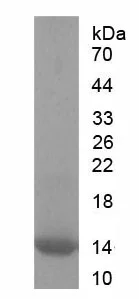 |
Greater than 97% as determined by reducing SDS-PAGE. |
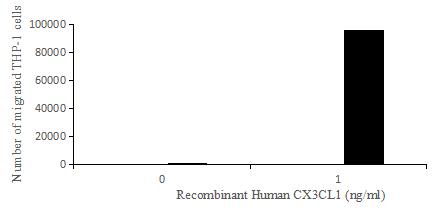 |
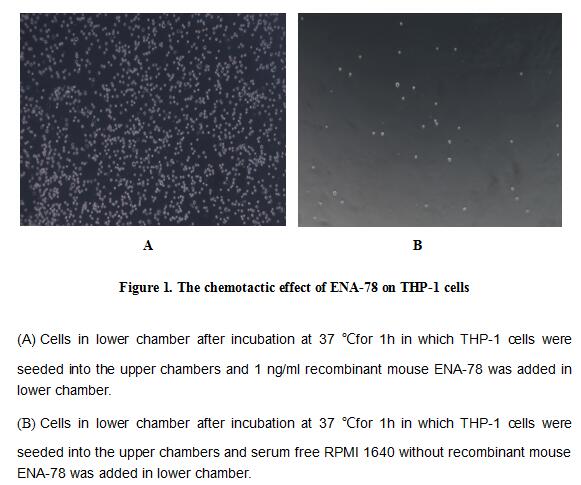
Epithelial Neutrophil Activating Peptide 78 (ENA-78) is a member of the CXC subfamily of chemokines. Full-length ENA-78 is 114 amino acids (aa) in length with a predicted molecular weight of 12 kDa. ENA-78 is expressed by many immune cells, such as macrophages, eosinophils, as well as non-immune cells including mesothelial cells, and fibroblasts. Soluble ENA-78 potently chemoattracts T cells and monocytes, while the cell-bound chemokine promotes strong adhesion of leukocytes to activated endothelial cells, where it is primarily expressed. Thus, chemotaxis assay used 24-well microchemotaxis system was undertaken to detect the chemotactic effect of ENA-78 on THP-1 the human monocytic cell line. Briefly, THP-1 cells were seeded into the upper chambers (150 ul cell suspension,106 cells/ml in RPMI 1640 with FBS free) and different concentrations of recombinant mouse ENA-78 diluted with serum free RPMI 1640 was added in lower chamber with a polycarbonate filter (8 um pore size) used to separate the two compartments. After incubation at 37 ℃ with 5% CO2 for 1h, the filter was removed, then cells in low chamber were observed by inverted microscope at low magnification (×10) and the number of migrated cells were counted using Fluorescence Activating Cell Sorter. Result shows ENA-78 is able to induce migration of THP-1 cells. The migrated THP-1 cells in low chamber at low magnification (×10) were shown in Figure 1. Statistical results of FACS were shown in Figure 2. The optimum chemotaxis of ENA-78 occurs at 1 ng/ml. Figure 2. The chemotactic effect of ENA-78 on THP-1 cells |
 |
| 分子别名Alternative Names | CXCL5SCYB5Chemokine C-X-C-Motif Ligand 5Small Inducible Cytokine Subfamily B(Cys-X-Cys),Member 5Neutrophil-activating peptide ENA-78 |
|---|---|
| 背景介绍Background | May participate in the recruitment of inflammatory cells by injured or infected tissue. GCP-2(1-78) and, more potent, GCP-2(9-78) attract neutrophils and are involved in neutrophil activation. |
| 功能Function | May participate in the recruitment of inflammatory cells by injured or infected tissue. GCP-2(1-78) and, more potent, GCP-2(9-78) attract neutrophils and are involved in neutrophil activation. |
| 亚细胞定位Subcellular Location | Secreted. |
| 数据库链接Databases |
基因功能参考文献28 条
- Identify Cxcl5 as a novel target of AHR-mediated gene expression in primary mouse keratinocytes. PMID: 28973351 : 28973351
- IL-17RA regulates CXL-1 and 5 production in the lungs during the adaptive response. PMID: 26871571 : 26871571
- STAT3 is required for maximal OSM-induced CXCL5 expression. PMID: 25692402 : 25692402
- CXCL5 has a role in neutrophil recruitment in TH17-mediated glomerulonephritis PMID: 24904089 : 24904089
- Since adaptive villus growth occurs despite impaired CXCL5 expression and enhanced angiogenesis, this suggests that the growth of new blood vessels is not needed for resection-induced mucosal surface area expansion following massive SBR. PMID: 24888846 : 24888846
- CXCL5 regulates pulmonary responses to infection and plays a central role in conferring clock control of inflammation. PMID: 25064128 : 25064128
- findings demonstrated that CXCL1 and CXCL5 are increased in circulation with onset of T2D, are produced by islets under stress, and synergistically affect islet function, suggesting that these chemokines participate in pathogenesis of T2D. PMID: 24928936 : 24928936
- TLR2-induced epithelial-derived CXCL5 is critical for polymorphonuclear leukocyte-driven destructive inflammation in pulmonary tuberculosis. PMID: 24509076 : 24509076
- data suggest that CXCL6 contributes to experimental pulmonary fibrosis, and CXCL6 inhibition might be used to reduce lung toxicity associated with bleomycin treatment. PMID: 23975892 : 23975892
- Our data suggest that the differential regulation of the chemokine CXCL5 between osteoblasts and endothelial cells upon FGF2 treatment is involved in Hematopoietic stem cell mobilization from the osteoblast niche or bone marrow to peripheral blood. PMID: 22827607 : 22827607
- CXCL5 modulated macrophage activation, increased expression of the cholesterol efflux regulatory protein ABCA1, and enhanced cholesterol efflux activity in macrophages. PMID: 23376791 : 23376791
- The omentum is the main site of early neutrophil entry into the peritoneal cavity, where the action of CXCL5 synergizes with matrix metalloproteinases MMP-2 and -9 to promote neutrophil migration during the inflammatory process. PMID: 23225890 : 23225890
- CXCL5-dependent signaling cascades are essential for the recruitment of macrophages to the lungs upon subacute second hand smoke exposure. PMID: 22362385 : 22362385
- Cxcr2, Cxcl5, and commensal bacteria have critical roles in regulation of the IL-17/G-CSF axis and neutrophil homeostasis at mucosal sites PMID: 22326959 : 22326959
- In a mouse model of lung ischemia-induced angiogenesis, LIX predominates in eliciting a pro-angiogenic phenotype among the three ELR+ CXC chemokines (KC, LIX, and MIP-2) studied. PMID: 20144627 : 20144627
- regulates chemokine scavenging and pulmonary host defense to bacterial infection PMID: 20643340 : 20643340
- The villus growth observed in resection-induced adaptation is associated with increased expression of the chemokine CXCL5 within the lamina propria. PMID: 20471049 : 20471049
- LIX is expressed in response to muscle damage in vivo. Its spatial distribution in injured muscle suggests expression by satellite cells. PMID: 12077361 : 12077361
- Cloning and genomic localization of Scyb5. PMID: 12439624 : 12439624
- The PMN transendothelial migration induced by the activated myocytes is dependent on the production and secretion of the chemokines LIX and KC by the activated myocytes. PMID: 14988231 : 14988231
- proliferative effect of LIX is specific towards the primitive hematopoietic cells PMID: 15036238 : 15036238
- GCP-2 modulates cellular immunity in part through IL-8Rbeta interactions PMID: 15356099 : 15356099
- alveolar epithelial type II (AEII) cells are the primary source of CXCL5 in the rodent lung via TLR4-dependent signaling PMID: 15778492 : 15778492
- CXCR1 is a functional receptor for GCP-2/CXCL6 and interleukin-8/CXCL8 in mouse PMID: 17197447 : 17197447
- One of the mechanisms whereby endogenous IFN-gamma mitigates the manifestations of CIA consists of inhibiting production of GCP-2, thereby limiting mobilization and infiltration of neutrophils, which are important actors in joint inflammation. PMID: 17200147 : 17200147
- unveils a proinflammatory pathway centered on kinin B1 receptor activation of CXCL5 leading to leukocyte trafficking PMID: 17878384 : 17878384
- CXCL5, is ectopically expressed in the corneal epithelial cells of Dstn(corn1) mice, and targeting of the receptor for this chemokine inhibits neutrophil recruitment PMID: 18628996 : 18628996
- Secretion of CXCL5 by white adipose tissue resident macrophages represents a link between obesity, inflammation, and insulin resistance. PMID: 19356715 : 19356715
蛋白复溶体积计算器缓冲液体积 = 蛋白质量 ÷ 蛋白浓度
输入任意两项,第三项自动计算 |
蛋白浓度稀释计算器初浓度 × 初体积 = 终浓度 × 终体积
输入任意三项,第四项自动计算 |



