


| 纯度Purity | Greater than 80% as determined by reducing SDS-PAGE. |
|---|---|
| 内毒素Endotoxin | Please contact with the lab for this information |
| 蛋白构建Protein Construction |
【Gln23-Pro258】序列区间
|
| Accession | P15379 |
| 表达宿主Expression Host | E.coli |
| 种属Species | Mus musculus (Mouse) |
| 预测分子量Predicted MW | 29.9 kDa |
| 制剂Formulation | Lyophilized from a 0.2 μm filtered solution of PBS, pH7.4, containing 0.01% SKL, 1mM DTT, 5% Trehalose and Proclin300. |
| 运输方式Shipping | The product is shipped with ice bag. Upon receipt, store it immediately at the temperature listed below. |
| 稳定性&储存Stability & Storage | 12 months at -20°C to -80°C in lyophilized state.6 months at -20°C to -80°C under sterile conditions after reconstitution.7-10 days at 2°C to 8°C under sterile conditions after reconstitution.Please minimize freeze-thaw cycles. |
| 复溶Reconstitution | Reconstitute in 10mM PBS (pH7.4) to a concentration of 0.1-1.0 mg/mL. Do not vortex. |
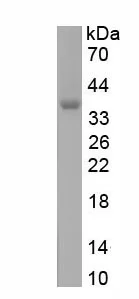 |
Greater than 80% as determined by reducing SDS-PAGE. |
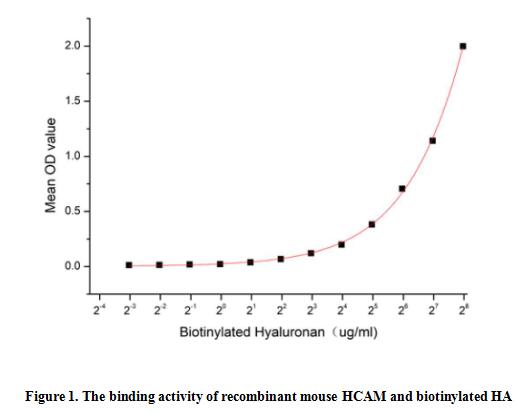 |
Homing Associated Cell Adhesion Molecule (HCAM), also known as CD44, is a ubiquitous multistructural and multifunctional cells surface adhesion molecule involved in cell-cell and cell-matrix interactions. CD44 is broadly expressed, including in the membranes of B cells, granulocytes, monocytes, and erythrocytes as well as on many thymocytes and mature T cells, besides it is highly expressed in many cancers and regulates metastasis via recruitment of CD44 to the cell surface. This protein is a receptor for hyaluronic acid (HA) and can also interact with other ligands, such as osteopontin, collagens, and matrix metalloproteinases (MMPs). Thus a functional binding ELISA assay was conducted to detect the interaction of recombinant mouse HCAM and biotinylated hyaluronan (HA). Briefly, biotin-linked HA was diluted serially in PBS, with 0.01% BSA (pH 7.4). Duplicate samples of 100 ul were then transferred to HCAM-coated microtiter wells and incubated for 2h at 37℃. Wells were washed with PBST 3 times and incubation with Streptavidin-HRP for 1 hour, then wells were aspirated and washed 5 times. With the addition of substrate solution, wells were incubated 15-25 minutes at 37℃. Finally, add 50 µl stop solution to the wells and read at 450/630 nm immediately. The binding activity of recombinant mouse HCAM and biotinylated HA was shown in Figure 1, and this effect was in a dose dependent manner. |
| 分子别名Alternative Names | CDW44CD44CSPG8ECMR-IIIHCELLINLHRMC56MDU2MDU3MIC4MUTCH-IPgp1Hematopoietic Cell E- And L-Selectin LigandChondroitin Sulfate Proteoglycan 8 |
|---|---|
| 背景介绍Background | Cell-surface receptor that plays a role in cell-cell interactions, cell adhesion and migration, helping them to sense and respond to changes in the tissue microenvironment. Participates thereby in a wide variety of cellular functions including the activation, recirculation and homing of T-lymphocytes, hematopoiesis, inflammation and response to bacterial infection. Engages, through its ectodomain, extracellular matrix components such as hyaluronan/HA, collagen, growth factors, cytokines or proteases and serves as a platform for signal transduction by assembling, via its cytoplasmic domain, protein complexes containing receptor kinases and membrane proteases. Such effectors include PKN2, the RhoGTPases RAC1 and RHOA, Rho-kinases and phospholipase C that coordinate signaling pathways promoting calcium mobilization and actin-mediated cytoskeleton reorganization essential for cell migration and adhesion. |
| 功能Function | Cell-surface receptor that plays a role in cell-cell interactions, cell adhesion and migration, helping them to sense and respond to changes in the tissue microenvironment. Participates thereby in a wide variety of cellular functions including the activation, recirculation and homing of T-lymphocytes, hematopoiesis, inflammation and response to bacterial infection. Engages, through its ectodomain, extracellular matrix components such as hyaluronan/HA, collagen, growth factors, cytokines or proteases and serves as a platform for signal transduction by assembling, via its cytoplasmic domain, protein complexes containing receptor kinases and membrane proteases. Such effectors include PKN2, the RhoGTPases RAC1 and RHOA, Rho-kinases and phospholipase C that coordinate signaling pathways promoting calcium mobilization and actin-mediated cytoskeleton reorganization essential for cell migration and adhesion. |
| 亚细胞定位Subcellular Location | Cell membrane; Single-pass type I membrane protein. Cell projection, microvillus. |
| 数据库链接Databases |
基因功能参考文献50 条
- this study shows that absence of specific alternatively spliced exon of CD44 in macrophages prevents colitis PMID: 29186109 : 29186109
- this study demonstrates a new role for CD44 and hyaluronan in promoting alveolar macrophage survival PMID: 29067996 : 29067996
- CD44-positive proliferating glomerular cells, most likely parietal epithelial cells, are essential in the pathogenesis of scarring glomerular disease. PMID: 29276101 : 29276101
- We show here that cleavage-stimuli-induced specific ICD-modifications cause structural substrate changes that enhance ectodomain sensitivity of neuregulin-1 (NRG1; epidermal-growth-factor) or CD44 (receptor-tyrosine-kinase (RTK) co-receptor) to chymotrypsin/trypsin or soluble ADAM. PMID: 27876763 : 27876763
- TGF-beta1-mediated hyaluronan/CD44/STAT3 signaling pathway plays a crucial role in the development of atrial fibrosis and atrial fibrillation. PMID: 28871329 : 28871329
- The role of CD44 was evaluated in CD44(-/-) challenged with a methionine- and choline-deficient diet (MCDD). Liver inflammation, liver injury and fibrosis strongly decreased in CD44(-/-) mice compared to wild-type mice on MCDD. PMID: 28323124 : 28323124
- Data (including data from studies using transgenic mice) suggest that a single oral dose of vitamin A (1) amplifies tolerogenic activity of dendritic cells migrating to lymphoid tissue and (2) up-regulates expression of Foxp3 and Cd44 in co-cultures of dendritic cells and CD4+ lymphocytes. (Foxp3 = forkhead box P3; Cd44 = homing receptor) PMID: 28917953 : 28917953
- The pseudo-hypoxic phenotype of stem-like glioma cells is achieved by stabilization of HIF-2a through interaction with CD44, independently of oxygen. PMID: 28813675 : 28813675
- the survival outcomes of genetically induced glioma-bearing mice and of high-grade human glioma patients are biphasically correlated with CD44 level, with the poorest outcomes occurring at intermediate levels. PMID: 28052252 : 28052252
- pERK1/2 is a regulator of CD44 expression, and increased CD44 expression leads to a pro-sclerotic and migratory parietal epithelial cell phenotype in focal segmental glomerulosclerosis. PMID: 27998643 : 27998643
- MET signaling regulates intestinal homeostasis and regeneration, as well as adenoma formation. These activities of MET are promoted by the stem cell CD44 isoform CD44v4-10. PMID: 28716720 : 28716720
- study demonstrates that CD44 plays a critical role in the regulation of experimental autoimmune encephalomyelitis through alterations in the gut microbiome profile and short-chain fatty acid production PMID: 28543188 : 28543188
- CD44 variant isoform 9 emerges in response to injury and contributes to the regeneration of the gastric epithelium. PMID: 28497484 : 28497484
- OA/GPNMB acts through ERK and AKT signaling pathways in mesenchymal stem cells via CD44 PMID: 26442636 : 26442636
- These findings support the usefulness of the conditional Cd44 allele in unraveling essential physiological and pathological functions of CD44 isoforms. PMID: 27831556 : 27831556
- CD44 role in the atrophic epidermis PMID: 28099467 : 28099467
- CD44(high) type II cells likely represent a type II cell subpopulation important for constitutive regulation of alveolar homeostasis. PMID: 28473330 : 28473330
- CD44V6 is part of a positive-feedback loop with TGFbeta1/TGFbetaRI signaling that acts to increase NOX4/ROS production, which is required for myofibroblast differentiation, myofibroblast differentiation, myofibroblast extracellular matrix production, myofibroblast invasion, and myofibroblast contractility. PMID: 28389561 : 28389561
- HAS2-produced hyaluronan is required for CD44V6 and TGFbetaRI co-localization and subsequent CD44V6/ERK1/EGR1 signaling. These results demonstrate a novel positive-feedback loop that links the myofibroblast phenotype to TGFbeta1-stimulated CD44V6/ERK/EGR1 signaling. PMID: 28389562 : 28389562
- CD44 promotes accumulation of M2 macrophages, extracellular matrix deposition, and wall thickening during arteriovenous fistula maturation. PMID: 28450292 : 28450292
- CD44-expressing Neural Stem Cells are self-renewing and multipotent and they synthesize Hyaluronan that accumulates with aging. CD44-null Neural Stem Cells demonstrate increased proliferation in vitro and in vivo. PMID: 28154169 : 28154169
- CD44 knockout mice are more susceptible to stress-induced anxiety-like behavior than control mice. PMID: 27619521 : 27619521
- CD44 contributes to effective antibacterial defense during S. zooepidemicus infection, thereby limiting the accompanying injury and death. PMID: 28062002 : 28062002
- These studies demonstrate that both endometrial cell and peritoneal mesothelial cell CD44 play a role in the development of early endometriotic lesion. PMID: 26169039 : 26169039
- Targeting CD44 expressing colon cancer cells with anti-CD44 monoclonal antibody improves cellular uptake and antitumor efficacy of liposomal doxorubicin. PMID: 26518722 : 26518722
- depletion of CD44s inhibits breast cancer cell metastasis to the lung in animals. These findings suggest a crucial mechanism underlying the role of the CD44s splice isoform in breast cancer metastasis. PMID: 26869223 : 26869223
- MGK as hydrophobic moieties and oHA as the target of CD44 receptor. PMID: 24892632 : 24892632
- CD44, NOD2, and Fas have distinct functions in regulating changes in trabecular and cortical bone indices during unloading. PMID: 26546009 : 26546009
- The absence of CD44 in neonatal bone marrow has no impact on the size of the long-term reconstituting hematopoietic stem cell pool, but results in an enhanced long-term engraftment potential of hematopoietic stem cells. PMID: 26546504 : 26546504
- CD44 deficiency can reduce osteoclast activity and counteract cortical bone loss in the hindlimb of unloaded mice. PMID: 26530337 : 26530337
- Genetic deficiency of CD44 augments activation, apoptosis and pro-thrombotic potential of platelets. PMID: 26355696 : 26355696
- The high targeting ability of HA-MFNPs was observed at MKN-45 cells (gastric cancer cell line) which high-expressing CD44 in contrast with MKN-28 cells which low-expressing CD44. PMID: 27398445 : 27398445
- the aggravation of pulmonary inflammation upon combined exposure to allergen and an environmental pollutant is CD44-dependent. PMID: 26999446 : 26999446
- CD44 promotes chemoresistance in T-ALL by increased drug efflux. PMID: 26708679 : 26708679
- HA-binding to CD44-expressing beta cells is implicated in beta-cell demise PMID: 26624007 : 26624007
- Peptide inhibitors of CD44v6 isoforms block tumor growth and metastasis in several independent models of pancreatic cancer. PMID: 26597578 : 26597578
- Suggest CD44 is involved in the development of mucous metaplasia in mice infected with Helicobacter pylori. PMID: 26639196 : 26639196
- CD44 enhances T cell receptor signaling strength by delivering lymphocyte-specific protein kinase, which is required for induction of IL-17 producing T helper cells PMID: 26172046 : 26172046
- Endogenous hyaluronic acid increases Lgr5(+) stem cell proliferation, crypt fission, and intestinal lengthening and that these effects are dependent on signaling through CD44 and TLR4. PMID: 26505972 : 26505972
- consistent with CD44's pivotal role in modulating several diverse behaviors important for adhesion, proliferation, apoptosis, migration and invasion during development, growth, repair, maintenance and regression of a wide variety of mesenchymal tissues PMID: 26248063 : 26248063
- The current study reports a unique approach to study H. pylori interaction with the human gastric epithelium. Here, we show that CD44 plays a functional role in H. pylori-induced epithelial cell proliferation. PMID: 25658601 : 25658601
- CD44 and pro-NRG1 are posttranslationally modified at their intracellular domains. PMID: 26217011 : 26217011
- Data indicate that a short course of anti-CD44 treatment improved Treg cell therapy efficacy in type 1 diabetes (T1D) model. PMID: 25447401 : 25447401
- Thymic innate CD8(+)CD44(hi) SP T-cells have critical roles in influenza A(H1N1)pdm09 infection-induced thymic atrophy through secreting IFN-gamma. PMID: 25275588 : 25275588
- CD44 deficiency could result in decreased proinflammatory cytokine production in lung induced by porcine circovirus type 2 (PCV2) in mice, suggesting a previously unrecognized role for CD44 in the development of pneumonia response to PCV2 infection. PMID: 25294252 : 25294252
- PRG4 is a novel putative ligand for CD44 and may control synoviocyte overgrowth in inflammatory arthropathies via a CD44-mediated mechanism. PMID: 25708025 : 25708025
- These data support an important role for CD44 in locomotor and sensorimotor functions, and in spatial memory retention. PMID: 25219362 : 25219362
- This study displays for the first time a different role of CD44-specific isoforms in the progression of chronic kidney disease. PMID: 24717295 : 24717295
- We hypothesize that polyvalent electrostatic interactions are responsible for the assembly of CD44 clusters and the multimeric PIP2-CD44-Ezrin complexes. PMID: 25572402 : 25572402
- of the transcripts of tissue inhibitors of matrix metalloproteinases (TIMPs) showed that expression of both TIMP1 and TIMP2 correlates negatively with the invasive potential of cells. PMID: 25180193 : 25180193
蛋白复溶体积计算器缓冲液体积 = 蛋白质量 ÷ 蛋白浓度
输入任意两项,第三项自动计算 |
蛋白浓度稀释计算器初浓度 × 初体积 = 终浓度 × 终体积
输入任意三项,第四项自动计算 |



