


| 纯度Purity | Greater than 97% as determined by reducing SDS-PAGE. |
|---|---|
| 内毒素Endotoxin | Please contact with the lab for this information |
| 蛋白构建Protein Construction |
【Leu457-Asp634】序列区间
|
| Accession | Q61554 |
| 表达宿主Expression Host | E.coli |
| 种属Species | Mus musculus (Mouse) |
| 预测分子量Predicted MW | 13.4 kDa |
| 制剂Formulation | Lyophilized from a 0.2 μm filtered solution of 20mM Tris, 150mM NaCl, pH8.0, containing 1mM EDTA, 1mM DTT, 0.01% SKL, 5% Trehalose and Proclin300. |
| 运输方式Shipping | The product is shipped with ice bag. Upon receipt, store it immediately at the temperature listed below. |
| 稳定性&储存Stability & Storage | 12 months at -20°C to -80°C in lyophilized state.6 months at -20°C to -80°C under sterile conditions after reconstitution.7-10 days at 2°C to 8°C under sterile conditions after reconstitution.Please minimize freeze-thaw cycles. |
| 复溶Reconstitution | Reconstitute in ddH₂O to a concentration of 0.1-0.5 mg/mL. Do not vortex. |
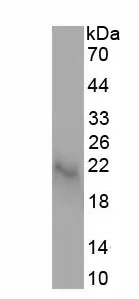 |
Greater than 97% as determined by reducing SDS-PAGE. |
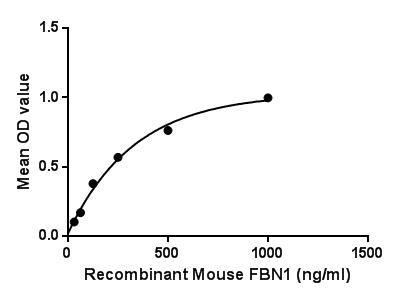 |
Figure. The binding activity of FBN1 with FBLN2. Fibrillin 1 (FBN1) is a 230-kb gene with 65 coding exons that encode a 2,871-amino-acid long proprotein called profibrillin which is proteolytically cleaved near its C-terminus by the enzyme furin convertase to give fibrillin-1, a member of the fibrillin family, and the 140-amino-acid long protein hormone asprosin. FBN1 is a large, extracellular matrix glycoprotein that serves as a structural component of 10-12nm calcium-binding microfibrils. These microfibrils provide force bearing structural support in elastic and nonelastic connective tissue throughout the body. Besides, Fibulin 2 (FBLN2) has been identified as an interactor of FBN1, thus a binding ELISA assay was conducted to detect the interaction of recombinant mouse FBN1 and recombinant mouse FBLN2. Briefly, FBN1 were diluted serially in PBS, with 0.01% BSA (pH 7.4). Duplicate samples of 100μL were then transferred to FBLN2-coated microtiter wells and incubated for 2h at 37℃. Wells were washed with PBST and incubated for 1h with anti-FBN1 pAb, then aspirated and washed 3 times. After incubation with HRP labelled secondary antibody, wells were aspirated and washed 3 times. With the addition of substrate solution, wells were incubated 15-25 minutes at 37℃. Finally, add 50µL stop solution to the wells and read at 450nm immediately. The binding activity of FBN1 and FBLN2 was shown in Figure 1, and this effect was in a dose dependent manner. |
| 分子别名Alternative Names | FBNMASSMFS1OCTDSGS |
|---|---|
| 背景介绍Background | Structural component of the 10-12 nm diameter microfibrils of the extracellular matrix, which conveys both structural and regulatory properties to load-bearing connective tissues. Fibrillin-1-containing microfibrils provide long-term force bearing structural support. In tissues such as the lung, blood vessels and skin, microfibrils form the periphery of the elastic fiber, acting as a scaffold for the deposition of elastin. In addition, microfibrils can occur as elastin-independent networks in tissues such as the ciliary zonule, tendon, cornea and glomerulus where they provide tensile strength and have anchoring roles. Fibrillin-1 also plays a key role in tissue homeostasis through specific interactions with growth factors, such as the bone morphogenetic proteins (BMPs), growth and differentiation factors (GDFs) and latent transforming growth factor-beta-binding proteins (LTBPs), cell-surface integrins and other extracellular matrix protein and proteoglycan components. Regulates osteoblast maturation by controlling TGF-beta bioavailability and calibrating TGF-beta and BMP levels, respectively. Negatively regulates osteoclastogenesis by binding and sequestering an osteoclast differentiation and activation factor TNFSF11. This leads to disruption of TNFSF11-induced Ca(2+) signaling and impairment of TNFSF11-mediated nuclear translocation and activation of transcription factor NFATC1 which regulates genes important for osteoclast differentiation and function. Mediates cell adhesion via its binding to cell surface receptors integrins ITGAV:ITGB3 and ITGA5:ITGB1. Binds heparin and this interaction plays an important role in the assembly of microfibrils.; Adipokine secreted by white adipose tissue that plays an important regulatory role in the glucose metabolism of liver, muscle and pancreas. Hormone that targets the liver in response to fasting to increase plasma glucose levels. Binds the olfactory receptor Olfr734 at the surface of hepatocytes and promotes hepatocyte glucose release by activating the protein kinase A activity in the liver, resulting in rapid glucose release into the circulation. May act as a regulator of adaptive thermogenesis by inhibiting browning and energy consumption, while increasing lipid deposition in white adipose tissue. Also acts as an orexigenic hormone that increases appetite: crosses the blood brain barrier and exerts effects on the hypothalamus. In the arcuate nucleus of the hypothalamus, asprosin directly activates orexigenic AgRP neurons and indirectly inhibits anorexigenic POMC neurons, resulting in appetite stimulation. Activates orexigenic AgRP neurons via binding to the olfactory receptor Olfr734. May also play a role in sperm motility in testis via interaction with Olfr734 receptor. |
| 功能Function | Structural component of the 10-12 nm diameter microfibrils of the extracellular matrix, which conveys both structural and regulatory properties to load-bearing connective tissues. Fibrillin-1-containing microfibrils provide long-term force bearing structural support. In tissues such as the lung, blood vessels and skin, microfibrils form the periphery of the elastic fiber, acting as a scaffold for the deposition of elastin. In addition, microfibrils can occur as elastin-independent networks in tissues such as the ciliary zonule, tendon, cornea and glomerulus where they provide tensile strength and have anchoring roles. Fibrillin-1 also plays a key role in tissue homeostasis through specific interactions with growth factors, such as the bone morphogenetic proteins (BMPs), growth and differentiation factors (GDFs) and latent transforming growth factor-beta-binding proteins (LTBPs), cell-surface integrins and other extracellular matrix protein and proteoglycan components. Regulates osteoblast maturation by controlling TGF-beta bioavailability and calibrating TGF-beta and BMP levels, respectively. Negatively regulates osteoclastogenesis by binding and sequestering an osteoclast differentiation and activation factor TNFSF11. This leads to disruption of TNFSF11-induced Ca(2+) signaling and impairment of TNFSF11-mediated nuclear translocation and activation of transcription factor NFATC1 which regulates genes important for osteoclast differentiation and function. Mediates cell adhesion via its binding to cell surface receptors integrins ITGAV:ITGB3 and ITGA5:ITGB1. Binds heparin and this interaction plays an important role in the assembly of microfibrils.; Adipokine secreted by white adipose tissue that plays an important regulatory role in the glucose metabolism of liver, muscle and pancreas. Hormone that targets the liver in response to fasting to increase plasma glucose levels. Binds the olfactory receptor Olfr734 at the surface of hepatocytes and promotes hepatocyte glucose release by activating the protein kinase A activity in the liver, resulting in rapid glucose release into the circulation. May act as a regulator of adaptive thermogenesis by inhibiting browning and energy consumption, while increasing lipid deposition in white adipose tissue. Also acts as an orexigenic hormone that increases appetite: crosses the blood brain barrier and exerts effects on the hypothalamus. In the arcuate nucleus of the hypothalamus, asprosin directly activates orexigenic AgRP neurons and indirectly inhibits anorexigenic POMC neurons, resulting in appetite stimulation. Activates orexigenic AgRP neurons via binding to the olfactory receptor Olfr734. May also play a role in sperm motility in testis via interaction with Olfr734 receptor. |
| 亚细胞定位Subcellular Location | Secreted.; [Fibrillin-1]: Secreted, extracellular space, extracellular matrix.; [Asprosin]: Secreted. |
| 数据库链接Databases |
基因功能参考文献49 条
- The abundance of elastic fibers was reduced and fragmented in obesity, suggesting that the reduction in elastic fibers is initially caused by increased neprilysin and decreased fibrillin-1 expression, which may inhibit formation and stabilization of elastic fibers, resulting in skin fragility in obesity. PMID: 27892729 : 27892729
- fibrillin-1 contributes little to lipid storage and metabolic homeostasis, which is in contrast to the obesity and metabolic changes associated with MAGP1 deficiency. PMID: 26902431 : 26902431
- In young Fbn1(C1039G/+) mice, aortopathy develops in the absence of detectable alterations in smooth muscle cell (SMC) TGF-beta signaling. Loss of physiologic SMC TGF-beta signaling exacerbates MFS-associated aortopathy. Our data support a protective role for SMC TGF-beta signaling during early development of MFS-associated aortopathy. PMID: 28119285 : 28119285
- Studies of Marfan syndrome and congenital contractural arachnodactyly mice have correlated the skeletal phenotypes of these mutant animals with distinct pathophysiological mechanisms that reflect the contextual contribution of fibrillin-1 and -2 scaffolds to TGFbeta and BMP signaling during bone patterning, growth and metabolism. [review] PMID: 26408953 : 26408953
- Findings demonstrate that loss of fibrillin-1 in the mouse's marrow causes significant hematopoietic abnormalities, such as hematopoietic stem cell (HSC) depletion and augmented erythropoiesis (polycythemia). Furthermore, the distinct outcomes of systemic TGFbeta neutralization in mutant mice strongly suggest that fibrillin-1 differentially modulates TGFbeta signaling within HSC and erythroid niches. PMID: 26610678 : 26610678
- This study shows that Raman microspectroscopy is able to reveal structural changes in fibrillin-1 microfibrils and elastic fiber networks and to discriminate between normal and diseased networks in vivo and in vitro. PMID: 27956365 : 27956365
- Resveratrol inhibits aortic root dilatation in Fbn1C1039G/+ Marfan mice by promoting elastin integrity and smooth muscle cell survival, involving downregulation of the aneurysm-related micro-RNA-29b in the aorta. PMID: 27283746 : 27283746
- These results suggest that both fibrillin-1 and fibrillin-2 expression is required to form thick oxytalan fibers in periodontal ligament. PMID: 25524144 : 25524144
- findings show that fibrillin-1 regulates MSC activity by modulating TGFbeta bioavailability within the microenvironment of marrow niches. PMID: 26189658 : 26189658
- Fibrillin-1 mgDelta(lpn) Marfan syndrome mutation associates with preserved proteostasis and bypass of a protein disulfide isomerase-dependent quality checkpoint PMID: 26718974 : 26718974
- fibrillin-1 deficiency is associated with relevant dysfunction of the endothelial barrier that enables adenovirus to induce vessel-harming inflammation. PMID: 26840980 : 26840980
- the Fbn1(C1039G/+) mouse model demonstrates mild intrinsic left ventricular dysfunction PMID: 26042521 : 26042521
- This study demonstrated that dysfunctional fibrillin-1 impairs blood-brain barrier permeability /BCSFB integrity, facilitating peripheral leukocyte infiltration, which further degrades the BBB/BCSFB. PMID: 25797463 : 25797463
- The review discuss FBN1 point mutations on the structure and function of the protein associated with Marfan syndrome in affected patients impairing protein folding and traficking, secretion, proteolysis or heparin binding. PMID: 26281765 : 26281765
- The concomitant induction of both fibrillin-1 and alpha8 integrin in a self-limited model of glomerular injury points to a protective role of the interaction of fibrillin-1 with alpha8 integrin in the glomerulus. PMID: 25482639 : 25482639
- Data show that fibrillin-1 (FBN1) modulates bone marrow mesenchymal stem cells (BMMSCs) lineage differentiation via IL4 receptor alpha/mTOR protein signaling. PMID: 25534817 : 25534817
- latent transforming growth factor-beta-1 binding protein-2 was prominently associated with annular fibrils containing fibrillin-1 PMID: 24867584 : 24867584
- Activation of IL-6-STAT3 signaling contributes to aneurysmal dilation in fibrillin-1 deficient mice through increased MMP-9 activity, aggravating extracellular matrix degradation. PMID: 24449804 : 24449804
- We targeted mutations in Pkd1 and Fbn1. Double heterozygotes displayed an exacerbation of the typical Fbn1 heterozygous aortic phenotype. The basis of this genetic interaction results from upregulation of TGF-beta signaling caused by Pkd1 haploinsufficiency. PMID: 24071006 : 24071006
- Report immunolocalization of fibrillin-1/perlecan in HS-deficient hspg2 exon 3 null mutant mouse intervertebral disc. PMID: 23104139 : 23104139
- analysis of the global biomechanical and local cell-matrix deformation relationships in the aging and Marfan related Fbn1 mutated murine mitral valve PMID: 22984535 : 22984535
- Data show that fibrillin-1 expression was intense in the ligamentum flavum from E16 through P0, with E17 appearing to be the stage with the greatest staining intensity. PMID: 22685574 : 22685574
- ADAMTSL6beta has a role in fibrillin-1 microfibril formation PMID: 21880733 : 21880733
- fibrillin-1 plays a predominantly greater role than fibrillin-2 in determining the material properties of bones PMID: 21440062 : 21440062
- Data support the development of therapies based on increasing Fbn1 expression. PMID: 21152435 : 21152435
- Tight-skinned (Tsk-/+) mice demonstrate abnormal "big fibrillin" expression (405 kDa)and chronic oxidative stress that contribute to mesenchymal trnasition and reduction in angiogenesis in a model of systemic sclerosis. PMID: 21160034 : 21160034
- Data show that a cluster of 205 genes, including Fbn1, were selectively expressed by mouse cell lines of different mesenchymal lineages. PMID: 20551991 : 20551991
- Fibrillin 1 is indispensable for normal tissue architecture and gene expression of periodontal ligaments. PMID: 20714769 : 20714769
- Fibrillin-1 and -2, the structural components of extracellular microfibrils, differentially regulate TGF-beta and bone morphogenetic protein (BMP) bioavailability in bone. PMID: 20855508 : 20855508
- analysis of mutant fibrillin-1 microfibrils PMID: 20529844 : 20529844
- Results indicated that ADAMTSL-6 is a novel microfibril-associated protein that binds directly to fibrillin-1 and promotes fibrillin-1 matrix assembly. PMID: 19940141 : 19940141
- interaction with microfibril-associated glycoprotein-2 PMID: 12122015 : 12122015
- there is a molecular basis for compensation of one fibrillin (1 or 2) by the other during fetal life PMID: 12429739 : 12429739
- relaxin does not regulate its mRNA and protein expression by human dermal fibroblasts and murine fetal skin. PMID: 12590922 : 12590922
- mice deficient in fibrillin-1 have marked dysregulation of transforming growth factor-beta (TGF-beta) activation and signaling, resulting in apoptosis in the developing lung, in a model of Marfan syndrome PMID: 12598898 : 12598898
- Tight skin fibrillin 1 altered extracellular matrix organization and caused fibrosis by affecting deposition of MAGP-2 or other fibrillin-1-associated proteins. PMID: 15022335 : 15022335
- Data are consistent with a model that invokes haploinsufficiency for wild type fibrillin-1, rather than production of mutant protein, as the primary determinant of failed microfibrillar assembly in Marfan syndrome. PMID: 15254584 : 15254584
- High affinity interactions between fibrillin-1 and perlecan were found by kinetic binding studies with dissociation constants in the low nanomolar range. PMID: 15657057 : 15657057
- ANG II can directly induce fibrillin-1 expression in cardiac fibroblasts PMID: 15849235 : 15849235
- fibrillin-1 may contribute to glomerular damage in hypertensive and diabetic kidney disease PMID: 16380460 : 16380460
- involvement of fibrillin-2 in the initial assembly of the aortic matrix overlaps in part with fibrillin-1 and continued fibrillin-1 deposition is absolutely required for the maturation and function of the vessel during neonatal life PMID: 16407178 : 16407178
- Results suggest that changes in microfibril architecture brought about by fibrillin-1 mutation lead to a complex disease phenotype. PMID: 16488411 : 16488411
- The distribution of Fbn1 was studied in the endometrium during estrus, diestrus, and pregnancy. PMID: 17587800 : 17587800
- In Tsk mice the mutation in Fbn1 alters bone cell metabolism. PMID: 17705049 : 17705049
- Fibrillin-1 microfibril deposition is dependent on fibronectin assembly. PMID: 18653538 : 18653538
- Loss of fibrillin-1 deposition promotes the production of intracellular reactive oxygen species and abnormal accumulation of phosphorylated TGF-beta-activated kinase 1 and p38 MAPK in Marfan syndrome phenotype. PMID: 19109253 : 19109253
- fibrillin-1, but not fibulin-2 or fibulin-4, is required for appropriate matrix assembly of latent transforming growth factor beta-binding proteins PMID: 19349279 : 19349279
- The promoter region of the Fbn1 gene has been characterized. PMID: 19573590 : 19573590
- Fragmentation of elastic fibers leads to increased vascular stiffness, which promotes features of multifocal plaque instability in atherosclerotic apolipopotein E-deficient mice with a mutated fibrillin 1 gene. PMID: 19948973 : 19948973
蛋白复溶体积计算器缓冲液体积 = 蛋白质量 ÷ 蛋白浓度
输入任意两项,第三项自动计算 |
蛋白浓度稀释计算器初浓度 × 初体积 = 终浓度 × 终体积
输入任意三项,第四项自动计算 |



