


| 纯度Purity | Greater than 95% as determined by reducing SDS-PAGE. |
|---|---|
| 内毒素Endotoxin | Please contact with the lab for this information |
| 蛋白构建Protein Construction |
【Ile22-Asn182】序列区间
|
| Accession | P01575 |
| 表达宿主Expression Host | E.coli |
| 种属Species | Mus musculus (Mouse) |
| 预测分子量Predicted MW | 49.7 kDa |
| 制剂Formulation | Lyophilized from a 0.2 μm filtered solution of PBS, pH7.4, containing 0.01% SKL, 1mM DTT, 5% Trehalose and Proclin300. |
| 运输方式Shipping | The product is shipped with ice bag. Upon receipt, store it immediately at the temperature listed below. |
| 稳定性&储存Stability & Storage | 12 months at -20°C to -80°C in lyophilized state.6 months at -20°C to -80°C under sterile conditions after reconstitution.7-10 days at 2°C to 8°C under sterile conditions after reconstitution.Please minimize freeze-thaw cycles. |
| 复溶Reconstitution | Reconstitute in 10mM PBS (pH7.4) to a concentration of 0.1-1.0 mg/mL. Do not vortex. |
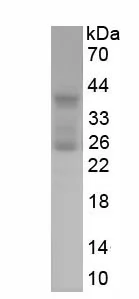 |
Greater than 95% as determined by reducing SDS-PAGE. |
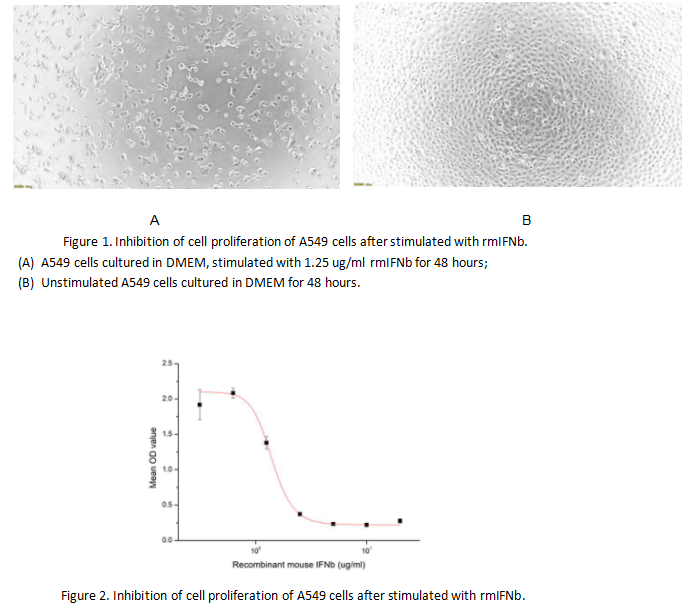 |
Interferon Beta (IFNb) is belongs to type I interferons (IFNs) family which a large subgroup of interferon proteins that help regulate the activity of the immune system.The IFNb proteins are produced in large quantities by fibroblasts. They have antiviral activity that is involved mainly in innate immune response. Two types of IFNb have been described, IFNb1 (IFNB1) and IFNb3 (IFNB3). IFNb1 is used as a treatment for multiple sclerosis as it reduces the relapse rate. To test the effect of IFNb on cell apoptosis, A549 cells were seeded into triplicate wells of 96-well plates and allowed to attach, replaced with various concentrations of recombinant mouse IFNb. After incubated for 48 hours, cells were observed by inverted microscope and cell proliferation was measured by Cell Counting Kit-8 (CCK-8). Briefly, 10 µl of CCK-8 solution was added to each well of the plate, then the absorbance at 450 nm was measured using a microplate reader after incubating the plate for 1-4 hours at 37 ℃. Apoptosis of A549 cells after incubation with rmIFNb for 48 hours observed by inverted microscope was shown in Figure 1. Cell viability was assessed by CCK-8 (Cell Counting Kit-8 ) assay after incubation with recombinant mouse IFNb for 48 hours. The result was shown in Figure2. It was obvious that rmIFNb significantly decreased cell viability of A549 cells. |
| 分子别名Alternative Names | IFNB1IFN-BIFBIFFIFNBInterferon Beta 1 Fibroblast |
|---|---|
| 背景介绍Background | Has antiviral, antibacterial and anticancer activities. |
| 功能Function | Has antiviral, antibacterial and anticancer activities. |
| 亚细胞定位Subcellular Location | Secreted. |
| 数据库链接Databases |
基因功能参考文献50 条
- IFNbeta activates neuronal PI3K/Akt signalling and Akt binds to transcription factor FoxA1 that translocates to the nucleus and induces PDL1. Conversely, inhibition of PI3K/Akt, FoxA1 and PDL1 blocked neuronal ability to generate FoxA1(+)Tregs. PMID: 28436428 : 28436428
- Macrophages activated by metabolic endotoxemia infiltrated into islets and produced IFNbeta, which induced beta-cell apoptosis by increasing the expression of Xaf1. PMID: 29132171 : 29132171
- Reactive oxygen species (ROS) scavenger N-acetyl cysteine (NAC) prevented mitochondrial dysfunctions, type I IFN-stimulated transcript levels, inflammatory cell infiltrate, and muscle weakness in an experimental autoimmune myositis mouse model. Thus, these data highlight a central role of mitochondria and ROS in dermatomyositis . PMID: 28623559 : 28623559
- Nontypeable Haemophilus influenzae DNA as a Pathogen-Associated Molecular Pattern Molecules triggered I-IFN response, which was STING/TBK1/IRF3 dependent. PMID: 29421524 : 29421524
- The Lipopolysaccharide and IFN-beta-mediated increase of STAT1 mRNA and protein levels was abrogated by chelation of Zn(2+) with the membrane permeable chelator N,N,N',N'-Tetrakis(2-pyridylmethyl)ethylenediamine (TPEN) in RAW 264.7 macrophages. PMID: 28965604 : 28965604
- MAVS is essential for spontaneous high basal expression of IFN-beta in cardiac myocytes and the heart. PMID: 28822807 : 28822807
- Mycobacterium smegmatis induces higher Ifnb expression in macrophages than Mycobacterium avium subspecies. PMID: 28422568 : 28422568
- Chronic presence of IFN-I in the brain microenvironment, which negatively affects cognitive function, is mediated via modulation of microglial activity. PMID: 28959042 : 28959042
- In experimental autoimmune encephalomyelitis, IFN-beta inhibited downstream inflammatory cytokines through the inhibition of PI3K/AKT/NF-kappaB axis and p38, JNK-MAPK, as well as the regulation of mTOR complexes. Moreover, IFN-beta inhibited Th17 differentiation and influenced the acetylation of the Il17a and Opn gene promoters. IFN-beta plays a role in Th17 differentiation partly through the inhibition of OPN. PMID: 29127843 : 29127843
- This review briefly discusses the dysregulation of main T cell subpopulations in CNS autoimmunity and summarized the T cell targeted effects of endogenous and exogenous IFN-beta in health and EAE/MS, with emphasis on the direct actions of IFN-beta on each T cell subset involved in the disease. PMID: 27033173 : 27033173
- Rb selectively inhibits innate IFN-beta production by enhancing deacetylation of Ifnb1 promoter, exhibiting a previous unknown non-classical role in innate immunity, which also suggests a role of Rb in the regulation of type I IFN production in inflammatory or autoimmune diseases. PMID: 27267461 : 27267461
- The effect of topical TREX1 knockdown and local interferon production on HIV transmission in human cervicovaginal explants and humanized mice, is reported. PMID: 27184854 : 27184854
- The TBK1 Y179A mutant failed to rescue type I IFN production by virally infected RAW264.7 macrophages deficient in TBK1. PMID: 28049762 : 28049762
- The data demonstrate that an atypical TLR7 signaling pathway contributes to type interferon-beta expression during Y. pestis infection and suggest that the TLR7-driven type I IFN response plays an important role in determining the outcome of plague. PMID: 28847850 : 28847850
- Long-term exposure to atmospheric particulates, PM2.5 up-regulated H3K4 and H3K9 methylation in IL-6 and IFN-beta promoter regions through down-regulating Kdm6a expression. The results suggest that short-term exposure to PM2.5 significantly enhances the survival rate of influenza A-contaminated mice, while long-term PM2.5 inhalation lowers the capacity of pulmonary macrophages to secrete IL-6 and IFN-beta. PMID: 28887033 : 28887033
- Extracellular ATP reduces the replication of VSV, Newcastle disease virus, murine leukemia virus and HSV in vivo and in vitro through the P2X7 receptor; ATP increases IFN-beta expression. Mechanistically, ATP facilitates IFN-beta secretion through P38/JNK/ATF-2 signaling pathways, which are crucial in promoting antiviral immunity. PMID: 28687662 : 28687662
- study reports that mitochondrial antiviral signaling protein (MAVS), -mediated IFN-alpha/beta production and IFNAR signaling are required for alloimmune responses to the human K1 Ag in a murine model of inflammation-induced alloimmunization PMID: 28630094 : 28630094
- study identifies a novel role for RIPK1 and RIPK3, a pair of homologous serine/threonine kinases previously implicated in the regulation of necroptosis and pathologic tissue injury, in directing IFN-beta production in macrophages PMID: 28461567 : 28461567
- results suggest that, in addition to its well-known signaling activity, IFN-beta may be directly antimicrobial and be part of a growing family of cytokines and chemokines, called kinocidins, that also have antimicrobial properties. PMID: 28411186 : 28411186
- results show that resistance to HSV-1 in the trigeminal ganglia during acute infection is conferred in part by STING and IFN-alpha/beta signaling in both bone marrow-derived and -resident cells, which coalesce to support a robust HSV-1-specific CD8(+) T cell response PMID: 27511736 : 27511736
- RIPK3 regulates type I IFN both transcriptionally, by interacting with MAVS and limiting RIPK1 interaction with MAVS, and post-transcriptionally. PMID: 28410401 : 28410401
- neddylation contributes to HSV-1-induced early phase IFN-beta production. PMID: 27593482 : 27593482
- Rubicon specifically interacts with the interferon regulatory factor (IRF) association domain (IAD) of IRF3, and this interaction leads to inhibition of the dimerization of IRF3, which negatively regulates interferon-mediated antiviral response. PMID: 28468885 : 28468885
- Translation arrest is further demonstrated to be key for anti-viral response by acting synergistically with MAVS activation to amplify TBK1 signaling and IFN-beta mRNA transcription, while GADD34-dependent protein synthesis recovery contributes to the heterogeneous expression of interferon observed in dsRNA-activated cells. PMID: 28100675 : 28100675
- The authors report that Raf kinase inhibitory protein (RKIP) is essential for TBK1 activation and type I interferon production triggered by viral infection. PMID: 27753621 : 27753621
- this study shows that paracrine type I IFN can profoundly enhance innate recognition and TLR2-dependent transcriptional responses to Francisella tularensis infection upstream of its role in inflammasome regulation in primary murine peritoneal macrophages but not murine bone marrow-derived macrophages PMID: 27231145 : 27231145
- STAT2 recruits USP18 to the type I IFN receptor subunit IFNAR2 via its constitutive membrane-distal STAT2-binding site. PMID: 28165510 : 28165510
- In the exorbital lachrymal gland, the mRNA expression of IFN beta and IFN alpha (type I IFNs) was weak- to strong-positive at 1 days post inoculation (DPI), and became negative at 2DPI. PMID: 27079771 : 27079771
- TBK1 complexes required for the phosphorylation of IRF3 and the production of interferon-beta have been identified. PMID: 28159912 : 28159912
- The authors conclude that IFN-alphabeta is pathogenic during chronic Mycobacterium africanum infection and that the pathogenic effects may be mediated through poorer control of bacterial growth. PMID: 27803172 : 27803172
- IRF-1 and interferon-alpha with interferon-beta cooperate to control acute gammaherpesvirus infection. PMID: 27795415 : 27795415
- this study shows that endosomal signalling by Lactobacillus acidophilus that leads to IFN-beta production is inhibited by TLR stimulation from the plasma membrane PMID: 27441725 : 27441725
- Truncated rabies virus phosphoprotein isoforms promote viral replication in muscle cells through their IFN-beta antagonist activities and thereby support infection of peripheral nerves. PMID: 27384657 : 27384657
- identify iNOS/NO as an integral component of IFN-beta production in response to dsRNA in hepatocytes in a pathway that involves the coordinated activities of TLR3/Trif and PKR PMID: 27226571 : 27226571
- Data show that using adipose-derived mesenchymal stem cells (AD-MSCs) expressing interferon-beta (IFN-beta) as an anti-inflammatory agent, offer evidence supporting that the stem cell therapies in experimental autoimmune encephalomyelitis (EAE) may improve the valuable effects of IFN-beta in the autoimmune disease. PMID: 27373971 : 27373971
- NLRX1 was observed to reduce interferon beta and cytokines in response to HIV-1 reverse-transcribed DNA. PMID: 27078069 : 27078069
- This study establishes IL-1beta and IFN-I levels as key homeostatic variables of protective, yet tuned, immune responses against severe invasive bacterial infection. PMID: 26962946 : 26962946
- Type I IFN Does Not Promote Susceptibility to Foodborne Listeria monocytogenes PMID: 26895837 : 26895837
- Results suggest that the lack of autocrine response to interferon-betaI by the host cell may be one mechanism for maintenance of respiratory syncytial virus persistence. PMID: 26501312 : 26501312
- TRIM33 deficiency results in high expression of Ifnb1 at late stages of macrophages activation. PMID: 26592194 : 26592194
- Inhibition of PI3K or Akt abrogated the ability of Syk deficiency to enhance IFNbeta and IL-10 in Syk deficient cells PMID: 26708990 : 26708990
- IFN-beta significantly attenuated the progression of liver fibrosis, with accompanying transcriptional downregulation of the TLR4 adaptor molecule MyD88. PMID: 25715168 : 25715168
- Thus, despite their use of the same receptor, IFNbeta and IFNalpha have unique and distinguishable biologic functions, with IFNbeta being mainly responsible for promoting lymphocytic choriomeningitis virus persistence. PMID: 25974304 : 25974304
- Mice lacking Ifnb function exhibited motor and cognitive learning impairments with accompanying alpha-synuclein-containing Lewy bodies in the brain, as well as a reduction in dopaminergic neurons and defective dopamine signaling in the nigrostriatal region. PMID: 26451483 : 26451483
- Data show that interferon beta knockout IFN-beta(-/-) mice exhibit greater resistance to Salmonella typhimurium infection. PMID: 26202980 : 26202980
- results indicate that Lyn plays a positive regulatory role in RIG-I-mediated interferon expression as a downstream component of IPS-1 PMID: 25585356 : 25585356
- Data show that decreased type I interferon gene expression in T cell subsets of human CASP8 and FADD-like apoptosis regulating protein c-FLIPS transgenic female mice. PMID: 24816846 : 24816846
- Data suggest that Brd4 (bromodomain containing 4) is essential for Toll-like receptor-stimulated interferon-beta (Ifnb) gene transcription by permitting transcription factors to interact with the Ifnb promoter in macrophages. PMID: 25891802 : 25891802
- PP1 directly interacts with IRF3 and dephosphorylates IRF3 at Ser385 and Ser396, resulting in the suppression of TLR- and RLR-triggered IFN-beta production. PMID: 25239187 : 25239187
- Interferons alpha and beta control propagation of long interspersed element-1. PMID: 25716322 : 25716322
蛋白复溶体积计算器缓冲液体积 = 蛋白质量 ÷ 蛋白浓度
输入任意两项,第三项自动计算 |
蛋白浓度稀释计算器初浓度 × 初体积 = 终浓度 × 终体积
输入任意三项,第四项自动计算 |



