


| 纯度Purity | Greater than 90% as determined by reducing SDS-PAGE. |
|---|---|
| 内毒素Endotoxin | Please contact with the lab for this information |
| 蛋白构建Protein Construction |
【Thr15-Asn211】序列区间
|
| Accession | P35456 |
| 表达宿主Expression Host | E.coli |
| 种属Species | Mus musculus (Mouse) |
| 预测分子量Predicted MW | 51.9 kDa |
| 制剂Formulation | Lyophilized from a 0.2 μm filtered solution of PBS, pH7.4, containing 0.01% SKL, 1mM DTT, 5% Trehalose and Proclin300. |
| 运输方式Shipping | The product is shipped with ice bag. Upon receipt, store it immediately at the temperature listed below. |
| 稳定性&储存Stability & Storage | 12 months at -20°C to -80°C in lyophilized state.6 months at -20°C to -80°C under sterile conditions after reconstitution.7-10 days at 2°C to 8°C under sterile conditions after reconstitution.Please minimize freeze-thaw cycles. |
| 复溶Reconstitution | Reconstitute in 10mM PBS (pH7.4) to a concentration of 0.1-1.0 mg/mL. Do not vortex. |
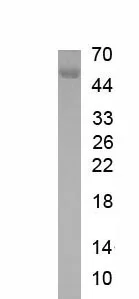 |
Greater than 90% as determined by reducing SDS-PAGE. |
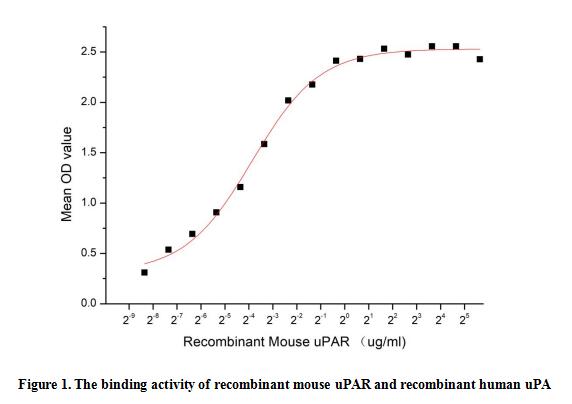 |
Plasminogen Activator, Urokinase Receptor (uPAR) is the receptor for urokinase plasminogen activator and, given its role in localizing and promoting plasmin formation, likely influences many normal and pathological processes related to cell-surface plasminogen activation and localized degradation of the extracellular matrix. The urokinase receptor (uPAR) was identified as the membrane receptor of the serine protease urokinase (uPA), thereby implicated in the plasminogen activation cascade and regulation of pericellular proteolysis, thus a binding ELISA assay was conducted to detect the interaction of recombinant mouse uPAR and recombinant human uPA. Briefly, uPAR was diluted serially in PBS with 0.01% BSA (pH 7.4). Duplicate samples of 100μl were then transferred to uPA-coated microtiter wells and incubated for 1h at 37℃. Wells were washed with PBST and incubated for 1h with anti-uPAR pAb, then aspirated and washed 3 times. After incubation with HRP labelled secondary antibody for 1h at 37℃, wells were aspirated and washed 5 times. With the addition of substrate solution, wells were incubated 15-25 minutes at 37℃. Finally, add 50µL stop solution to the wells and read at 450/630nm immediately. The binding activity of recombinant mouse uPAR and recombinant human uPA was shown in Figure 1, the EC50 for this effect is 0.069 ug/mL. |
| 分子别名Alternative Names | CD87PLAURPLAU-RU-PARURKRMonocyte Activation Antigen Mo3 |
|---|---|
| 背景介绍Background | Acts as a receptor for urokinase plasminogen activator. Plays a role in localizing and promoting plasmin formation. Mediates the proteolysis-independent signal transduction activation effects of U-PA. |
| 功能Function | Acts as a receptor for urokinase plasminogen activator. Plays a role in localizing and promoting plasmin formation. Mediates the proteolysis-independent signal transduction activation effects of U-PA. |
| 亚细胞定位Subcellular Location | [Isoform 1]: Cell membrane; Lipid-anchor, GPI-anchor.; [Isoform 2]: Secreted. |
| 数据库链接Databases |
基因功能参考文献50 条
- The results establish GDE3 as a negative regulator of the uPAR signaling network and, furthermore, highlight GPI-anchor hydrolysis as a cell-intrinsic mechanism to alter cell behavior. PMID: 28849762 : 28849762
- The ratio of full-length versus cleaved uPAR as analysed by Western blotting and its regulation was assessed by addition of different protease inhibitors and transforming growth factor - beta1 (TGF-beta1). The role of uPAR cleavage in cell proliferation and migration was analysed using real-time cell analysis and invasion was assessed using the myoma invasion model PMID: 28526008 : 28526008
- Plg-RKT is required for plasminogen binding and macrophage migration in vivo PMID: 27714956 : 27714956
- Results identify soluble uPAR as a functional connection between the bone marrow and the kidney, and they implicate bone marrow immature myeloid cells as a key source of soluble uPAR that leads to glomerular dysfunction. PMID: 27941791 : 27941791
- Plaur deficiency does not increase susceptibility to epileptogenesis after traumatic brain injury in an animal model. PMID: 27208924 : 27208924
- Findings indicate a significant correlation of uPAR cleavage with breast cancer progression, but the precise biological consequence(s) of the cleavage or the cleavage products still remains to be elucidated. PMID: 25809119 : 25809119
- interaction of full-length suPAR with alphavbeta3 integrin expressed on podocytes results in down-modulation of nephrin that may affect kidney functionality in different human pathologies characterized by increased concentration of suPAR. PMID: 26380915 : 26380915
- In an in vivo murine angiogenesis model uPAR-deficient PTEN heterozygous animals increased the impaired angiogenic phenotype of uPAR knockout mice and were able to reverse the high invasive potential of PTEN heterozygotes. PMID: 25925849 : 25925849
- uPAR contributes to macrophage driven atherosclerotic lesion formation. PMID: 26313756 : 26313756
- our data show that uPAR is required for efficient skin tumor formation PMID: 26527290 : 26527290
- Tumours with high levels of uPAR, as well as cells invading leiomyoma tissue with up-regulated uPAR expression, all displayed enhanced activity of gelatinolytic enzymes. PMID: 25157856 : 25157856
- deficiency of uPAR and PSMD6 delays DNA repair and leads to decreased cell survival. PMID: 24987841 : 24987841
- uPA promotes remodeling of the fracture cartilage by osteoclasts that are associated with angiogenesis and suggest that uPA promotes angiogenesis and remodeling of the fracture cartilage at this time of bone fracture repair. PMID: 23700285 : 23700285
- Binding of urokinase to uPAR promotes the reorganization of the actin cytoskeleton and re-emergence of dendritic filopodia after excitotoxic injury. PMID: 25339736 : 25339736
- Inactivation of urokinase-type plasminogen activator receptor gene induces dermal and pulmonary fibrosis and peripheral microvasculopathy in mice. PMID: 23852693 : 23852693
- High uPAR expression is associated with glioma. PMID: 22495828 : 22495828
- A deficiency in uPAR represents a mechanisms which results in the development of a more severe epilepsy phenotype. PMID: 23263886 : 23263886
- sLR11 regulates the hypoxia-enhanced adhesion of HSPCs via an uPAR-mediated pathway that stabilizes the hematological pool size by controlling cell attachment to the BM niche. PMID: 23486467 : 23486467
- Importance of vitronectin and its interaction with the urokinase receptor in tumor growth. PMID: 23327926 : 23327926
- uPAR silencing by uPAR knockout in mouse VSMC resulted in abrogation of doxorubicin-induced cellular senescence. PMID: 23172421 : 23172421
- our studies indicated that uPAR plays a significant role in ovarian cancer PMID: 22577342 : 22577342
- uPAR is dispensable for nerve development, whereas, loss of uPAR affects nerve regeneration. PMID: 22363796 : 22363796
- pulmonary and systemic inflammation induced by TLR2, but not TLR4 stimulation is reduced in uPAR-/- mice PMID: 21998707 : 21998707
- Nuclear uPAR associates with myocardin, which is then recruited from the promoters of serum response factor target genes and undergoes proteasomal degradation. This mechanism contributes to adverse vascular remodeling after injury in vivo. PMID: 22075245 : 22075245
- NYD-SP8 has a role in regulating ECM degradation, providing a novel mechanism that modulates urokinase signalling in the suppression of cancer progression PMID: 19017363 : 19017363
- uPAR might guide/control the trafficking of mesenchymal stem cells to the injured vascular wall and their differentiation towards functional smooth muscle cells. PMID: 21088115 : 21088115
- Results suggest that uPAR plays a pivotal role in the development of adipose tissue through PI3K/Akt pathway. PMID: 20886176 : 20886176
- Downregulation of uPAR reduced the radiation-induced tumor cell adhesion, migration and invasion by inhibiting phosphorylation of FAK. PMID: 20886051 : 20886051
- uPAR overexpression induced stem cell-like properties and an increase in breast tumor initiation and growth. PMID: 20940399 : 20940399
- The plasminogen system is critical for liver repair by facilitating macrophage accumulation and triggering a cascade of subsequent repair events. PMID: 20345714 : 20345714
- fibrin loss from microarteriolar thrombi is mediated, at least in part, by leukocyte-associated uPA in a process that requires leukocyte uPAR and PSGL-1 PMID: 19967153 : 19967153
- uPAR is necessary for adequate recruitment of neutrophils into the alveoli and lungs during pneumonia caused by Streptococcus pneumoniae, a pathogen eliciting a beta 2 integrin-independent inflammatory response. PMID: 11907112 : 11907112
- Targeting urokinase-type plasminogen activator receptor on human glioblastoma tumors with diphtheria toxin fusion protein DTAT. PMID: 11959893 : 11959893
- essential role in acute inflammation as well as in chronic degenerative vascular processes such as atherosclerosis PMID: 12023845 : 12023845
- MMP-12 and other MMPs directly and efficiently cleave uPAR at the Thr86 paralal Tyr87 peptide bond located in the linker region connecting uPAR domains 1 and 2, releasing the major ligand binding domain 1 from the rest of the receptor. PMID: 12195704 : 12195704
- Knockout causes disruption of cortical interneuron development, region- and GABA cell type-specific deficits, epilepsy, and behavioral dysfunction PMID: 12533622 : 12533622
- This protein, along with the associated protein, is essential for cellular uptake of collagen and promotes fibroblast collagen adhesion. PMID: 12668656 : 12668656
- uPAR deficiency suppresses renal macrophage recruitment, but its absence accentuates the fibrogenic response, likely due in part to the delayed clearance of angiogenic/profibrotic molecules such as PAI-1 and decreased receptor-associated uPA activity. PMID: 12707393 : 12707393
- uPAR attenuates the fibrogenic response to renal injury, an outcome that is mediated in part by urokinase-dependent but plasminogen-independent functions. PMID: 12707394 : 12707394
- REVIEW of roles in regulation of diverse physiological and pathological processes, including cellular adhesion, cell motility, angiogenesis, tumor invasion, and tumor metastasis. PMID: 12828301 : 12828301
- Data report the identification of novel promoter regions required for expression of the urokinase-type plasminogen activator receptor in transgenic mice. PMID: 12875967 : 12875967
- signaling for the uPAR response, as mediated by B. burgdorferi, proceeds with CD14 and TLR2 as partial contributors PMID: 14500474 : 14500474
- Protein C inhibitor may contribute to proteolysis equilibrium within the testis by acting in tandem with urokinase in Leydig cells and with PC and/or urokinase in spermatogenic cells. PMID: 14645112 : 14645112
- The u-PAR plays an important role in the proliferative response of VSMCs and that without u-PAR, there is no intracellular signaling for cell proliferation. PMID: 15081564 : 15081564
- uPAR seems to play a pivotal role in VEGFR-2-induced endothelial cell migration. PMID: 15131009 : 15131009
- uPA transgenic mice have chalky-white incisors and, when uPAR is co-expressed, develop extensive alopecia, epidermal thickening, and subepidermal blisters. PMID: 15161662 : 15161662
- Enhanced proliferation of uPAR-/- fibroblasts seems to be mediated by uPA-dependent ERK signaling via an alternative urokinase receptor. PMID: 15284295 : 15284295
- Domain 2 of the urokinase receptor plays a pivotal role in the regulation of uPAR-integrin alphavbeta3 interactions PMID: 15863511 : 15863511
- uPAR function is necessary for the development of a subpopulation of GABAergic neurons in the telencephalon. It is likely that the late-onset parvalbumin phenotype is due to the effects of an altered local environment on selectively vulnerable neurons. PMID: 16025458 : 16025458
- Loss of urokinase-type plasminogen activator is associated with inflammation and neurodegeneration in the central nervous system during experimental allergic encephalomyelitis PMID: 16049338 : 16049338
蛋白复溶体积计算器缓冲液体积 = 蛋白质量 ÷ 蛋白浓度
输入任意两项,第三项自动计算 |
蛋白浓度稀释计算器初浓度 × 初体积 = 终浓度 × 终体积
输入任意三项,第四项自动计算 |



