


| 纯度Purity | Greater than 90% as determined by reducing SDS-PAGE. |
|---|---|
| 内毒素Endotoxin | Please contact with the lab for this information |
| 蛋白构建Protein Construction |
【Ser25-Thr251】序列区间
|
| Accession | O09164 |
| 表达宿主Expression Host | E.coli |
| 种属Species | Mus musculus (Mouse) |
| 预测分子量Predicted MW | 26.2 kDa |
| 制剂Formulation | Lyophilized from a 0.2 μm filtered solution of 20mM Tris, 150mM NaCl, pH8.0, containing 1mM EDTA, 1mM DTT, 0.01% SKL, 5% Trehalose and Proclin300. |
| 运输方式Shipping | The product is shipped with ice bag. Upon receipt, store it immediately at the temperature listed below. |
| 稳定性&储存Stability & Storage | 12 months at -20°C to -80°C in lyophilized state.6 months at -20°C to -80°C under sterile conditions after reconstitution.7-10 days at 2°C to 8°C under sterile conditions after reconstitution.Please minimize freeze-thaw cycles. |
| 复溶Reconstitution | Reconstitute in 20mM Tris, 150mM NaCl (pH8.0) to a concentration of 0.1-1.0 mg/mL. Do not vortex. |
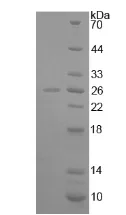 |
Greater than 90% as determined by reducing SDS-PAGE. |
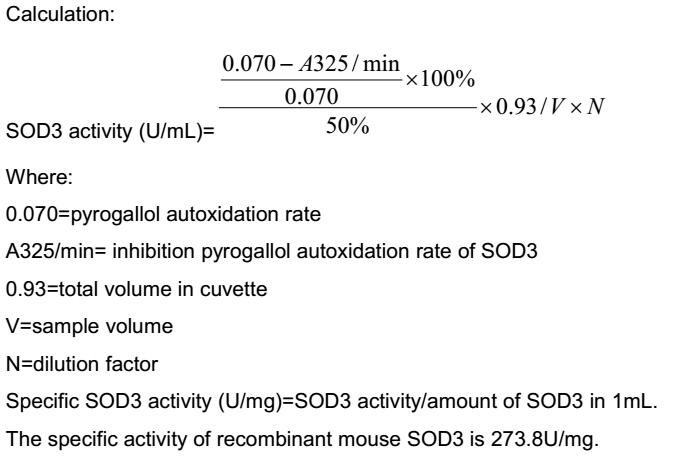 |
Extracellular superoxide dismutase [Cu-Zn] is an enzyme that in humans is encoded by the SOD3 gene. This gene encodes a member of the superoxide dismutase (SOD) protein family. SODs are antioxidant enzymes that catalyze the dismutation of two superoxide radicals into hydrogen peroxide and oxygen. According to the report, in a weakly alkaline buffer solution (pH=8.2) with N-tris (hydroxymethyl) amino methane-HCL, pyrogallol can occur autoxidation in the air, then SOD can inhibit this reaction. Thus, we use this way to measure the activity of recombinant mouse SOD3. The reaction was performed in adding 30μL 50mmol/L pyrogallol to 900μL 50mmol/L Tris-HCl in 1.5mL cuvette (1.0cm light path), rapidly mixing at 25℃,then read at 325nm (zero the spectrophotometer using 50mmol/L Tris-HCl), record the OD value every 30 second for 6 times. Control the pyrogallol autoxidation rate at 0.70 OD/min. After, adding various concentrations of recombinant of SOD3 to 900μL 50mmol/L Tris-HCl, incubated for 20min at 25℃, then adding 30μL 50mmol/L pyrogallol to each tube, rapidly mixing and read at 325nm, record the OD value every 30 second for 6 times. Under these conditions, the enzyme amount of 50% per minute inhibition of pyrogallol autooxidation is defined as a unit. |
| 分子别名Alternative Names | SOD-3EC-SODExtracellular Superoxide Dismutase Cu-Zn |
|---|---|
| 背景介绍Background | Protect the extracellular space from toxic effect of reactive oxygen intermediates by converting superoxide radicals into hydrogen peroxide and oxygen. |
| 功能Function | Protect the extracellular space from toxic effect of reactive oxygen intermediates by converting superoxide radicals into hydrogen peroxide and oxygen. |
| 亚细胞定位Subcellular Location | Secreted, extracellular space. Golgi apparatus, trans-Golgi network. |
| 数据库链接Databases |
基因功能参考文献50 条
- Enhanced expression of EcSOD in skeletal muscle profoundly protects against multiple organ dysfunction syndrome by inhibiting endothelial activation and inflammatory cell adhesion. PMID: 28982599 : 28982599
- Epigenetic regulation of EC-SOD expression in aging lung fibroblasts is exerted via histone acetylation. PMID: 28757400 : 28757400
- Results indicate that medium molecular weight heparinyl phenylalanine (MHF) and medium molecular weight heparinyl leucine (MHL) show a radical scavenging ability by increasing the extracellular superoxide dismutase (EC-SOD) activity and MHF may be a candidate for clinical use. PMID: 27815470 : 27815470
- Thus, our findings suggest that deficient management of extracellular superoxide can lead to altered lung developmental signaling during alveogenesis in mice. PMID: 28220305 : 28220305
- the redistribution of SOD3 as a result of the R213G single-nucleotide polymorphism protects mice from bleomycin-induced fibrosis and secondary pulmonary hypertension by improved resolution of alveolar inflammation. PMID: 27805412 : 27805412
- These data reveal that ecSOD activity modulates neutrophil recruitment and function in a cell-extrinsic fashion, highlighting the importance of the enzyme in protecting tissues from oxidative damage. PMID: 27600509 : 27600509
- wound healing impairments in ageing are associated with increased levels of ROS, decreased SOD3 expression and impaired extracellular oxidative stress regulation PMID: 26663425 : 26663425
- FXR may regulate SOD3 expression to suppress reactive oxygen species production, resulting in decreasing JNK activity. PMID: 25496033 : 25496033
- Arginine 213 in the heparin-binding domain of SOD3 is critical for maintaining proper organ function through moderating the normal innate immune response, which would otherwise lead to chronic inflammation and degenerative diseases in aged mice. PMID: 25927599 : 25927599
- the rs1799895 polymorphism in extracellular superoxide dismutase affects cardiopulmonary disease risk by altering protein distribution PMID: 25085920 : 25085920
- the localized loss of pulmonary artery EC-SOD augments chronic hypoxic pulmonary hypertension. In addition to oxidative inactivation of nitric oxide, deletion of EC-SOD seems to reduce eNOS activity, further compromising pulmonary vascular function. PMID: 25326578 : 25326578
- Our results suggest that EC-SOD plays a dynamic role in the inflammatory response mounted by activated macrophages. PMID: 24512907 : 24512907
- reduced SOD3 expression correlates with alveolar injury measures in the recovered neonatal hyperoxic lung PMID: 24673633 : 24673633
- Data suggest that epigenetic silencing of EcSOD may contribute to mammary tumorigenesis and that restoring the extracellular superoxide scavenging activity could be an effective strategy for breast cancer treatment. PMID: 23318435 : 23318435
- When Cys195 was introduced, both active EC-SOD and a novel inactive EC-SOD were generated, and the specific activity of the EC-SOD was significantly reduced by the mutation. PMID: 23594119 : 23594119
- a decrease in ATP7A protein expression contributes to impaired SOD3 activity, resulting in O2(*-) overproduction and endothelial dysfunction in blood vessels of type 1 diabetes mellitus. PMID: 23884884 : 23884884
- Cardiac-selective expression of EcSOD from the cardiac troponin-T promoter after systemic administration of AAV9 provides significant protection against both acute myocardial infarction and left ventricular remodeling. PMID: 23536266 : 23536266
- EC-SOD plays a key role in preserving angiogenesis by scavenging free radicals which has an inhibitory effect on angiogenesis process in neonatal mice lung following exposure to hyperoxia. PMID: 23284826 : 23284826
- Data suggest that SOD3 is required to maintain lung homeostasis and acts, at least in part, as a controller of signaling and a decision maker to determine the progression of allergic lung disease. PMID: 22583151 : 22583151
- the SOD3-mediated anti-inflammatory effect on arthritis and peritonitis operates independently of NOX2 complex derived oxidative burst PMID: 22529530 : 22529530
- The SOD3 might provide an effective strategy for the treatment of HAF-mediated skin inflammation. PMID: 21957979 : 21957979
- High levels of ecSOD activity resulted in neutrophils with limited protective capacity, whereas neutrophils from mice lacking ecSOD provided superior protection compared with neutrophils from wild-type mice. PMID: 22393157 : 22393157
- physiological venous catalase activity prevents exercise-induced up-regulation of endothelial nitric oxide synthase and extracellular superoxide dismutase PMID: 21129156 : 21129156
- ER stress leads to the down-regulation of claudin-5 among tight junction proteins and may induce the elevation of endothelial permeability and leakage of EC-SOD into the vitreous body. PMID: 21736484 : 21736484
- AAV9-mediated overexpression of EcSOD in skeletal muscle significantly improves recovery from hind-limb ischemia in mice, consistent with improved capillary density and perfusion ratios in treated mice. PMID: 21723687 : 21723687
- A single direct injection into the left ventricular wall of an adeno-associated virus 9 (AAV9) vector expressing extracellular superoxide dismutase from the cardiac troponin-T promoter protects mice against myocardial infarction. PMID: 21674736 : 21674736
- Extracellular superoxide dismutase facilitates clearance of bacteria and limits inflammation in response to infection by promoting bacterial phagocytosis. PMID: 21641397 : 21641397
- These data suggest that the extracellular superoxide dismutase in vascular smooth muscle is not involved in the genesis of angiotensin II-induced hypertension and further emphasize the role of central SOD3 in the modulation of blood pressure. PMID: 21730294 : 21730294
- endogenous SOD3 has no role in the development of pulmonary artery hypertension under control conditions but plays an important role in protecting the lung from the development of PAH under stress conditions. PMID: 21730301 : 21730301
- The ecSOD as an important anti-inflammatory gene, responsible for most, if not all of the resistance to asbestos-induced lung injury reported for the 129/J strain of mice. PMID: 21362472 : 21362472
- Extracellular superoxide dismutase protects cardiovascular syndecan-1 from oxidative shedding and prevents from its subsequent induction of fibroblast proliferation. PMID: 21334435 : 21334435
- extracellular superoxide dismutase is expressed spatiotemporally in developing embryos and surrounding extraembryonic tissues during mouse organogenesis, thus suggesting that EC-SOD may be relevant to organogenesis PMID: 21156216 : 21156216
- extracellular H(2)O(2) generated by ecSOD localized at caveolae/lipid rafts via heparin-binding domain promotes VEGFR2 signaling via oxidative inactivation of PTPs in these microdomains. PMID: 20422004 : 20422004
- When cortices and hippocampi were analyzed for nitrotyrosine formation as an index of oxidative stress, the levels were chronically elevated in mice lacking extracellular superoxide dismutase PMID: 20020436 : 20020436
- role of SOD3 in recovery of renal blood flow, increased oxidative stress, and injury following renal ischemia/reperfusion PMID: 20505656 : 20505656
- Data show that SOD3 attenuates emphysema and reduces oxidative fragmentation of ECM in lung. PMID: 20713693 : 20713693
- EC-SOD accumulates on endothelial cells in response to brain ischemia by an unknown mechanism, while cortical neurons produce EC-SOD themselves after cerebral ischemia with reperfusion PMID: 11827754 : 11827754
- Furin proteolytically processes the heparin-binding region of extracellular superoxide dismutase PMID: 11861638 : 11861638
- EC-SOD plays an important role in reducing the magnitude of lung injury from extracellular free radicals after bleomycin administration. PMID: 11880297 : 11880297
- Data suggest that competition between Ets activators and Kruppel-like repressors within the proximal promoter region determines the level of extracellular superoxide dismutase expression in a particular cell type. PMID: 12374566 : 12374566
- Extracellular superoxide dismutase, uric acid, and atherosclerosis. Review. PMID: 12858574 : 12858574
- describes a previously unrecognized murine extracellular superoxide dismutase (ecSOD) allele and its effects on the ecSOD phenotype independent of other strain specific factors. Underlines need for backcrossing of genetically modified mice. PMID: 12893682 : 12893682
- Serum EC-SOD might accumulate on brain endothelial cells, while cortical neurons produce EC-SOD themselves after cerebral ischemia with reperfusion. PMID: 14753411 : 14753411
- Hypoxic activation of HIF-1 alpha and its target gene EPO in mouse kidney is regulated by SOD3. PMID: 15016652 : 15016652
- Review. Blood vessels express 3 isoforms of superoxide dismutase SOD, 1 of which is an extracellular form of CuZn-SOD. This review will focus mainly on the role of individual SODs in relation to endothelium under normal conditions and in disease states. PMID: 15166009 : 15166009
- EC-SOD functions as a major repressor of hypoxia-induced Epo gene expression, which implicates superoxide as a signaling intermediate whose downstream effects, at least in part, may be mediated by HIF-1alpha. PMID: 15375030 : 15375030
- EC-SOD's proximal promoter contains 2 previously unknown but putative Sp1 cis elements, the 2d of which contributes up to 70% of the constitutive EC-SOD promoter activity. Sp3 also binds to this region. PMID: 15451065 : 15451065
- EcSOD-fibulin-5 interaction is needed for ecSOD binding to vascular tissues, regulating their O2*- levels. This is a new mechanism for controlling vascular redox state in the extracellular space in cardiovascular diseases with high oxidative stress. PMID: 15528465 : 15528465
- Atox1 functions not only as a copper chaperone for SOD3 but also as a positive regulator for SOD3 transcription and may have an important role in modulating oxidative stress in the cardiovascular system. PMID: 15761197 : 15761197
- EC-SOD may play important role in protection from skeletal muscle ischemia and reperfusion injury caused by excessive generation of reactive oxygen species. PMID: 15778274 : 15778274
蛋白复溶体积计算器缓冲液体积 = 蛋白质量 ÷ 蛋白浓度
输入任意两项,第三项自动计算 |
蛋白浓度稀释计算器初浓度 × 初体积 = 终浓度 × 终体积
输入任意三项,第四项自动计算 |



