


| 纯度Purity | Greater than 95% as determined by reducing SDS-PAGE. |
|---|---|
| 内毒素Endotoxin | Please contact with the lab for this information |
| 蛋白构建Protein Construction |
【Met1-Ser208】序列区间
|
| Accession | P54130 |
| 表达宿主Expression Host | E.coli |
| 种属Species | Mus musculus (Mouse) |
| 预测分子量Predicted MW | 24.7 kDa |
| 制剂Formulation | Lyophilized from a 0.2 μm filtered solution of PBS, pH7.4, containing 0.01% SKL, 1mM DTT, 5% Trehalose and Proclin300. |
| 运输方式Shipping | The product is shipped with ice bag. Upon receipt, store it immediately at the temperature listed below. |
| 稳定性&储存Stability & Storage | 12 months at -20°C to -80°C in lyophilized state.6 months at -20°C to -80°C under sterile conditions after reconstitution.7-10 days at 2°C to 8°C under sterile conditions after reconstitution.Please minimize freeze-thaw cycles. |
| 复溶Reconstitution | Reconstitute in 10mM PBS (pH7.4) to a concentration of 0.1-1.0 mg/mL. Do not vortex. |
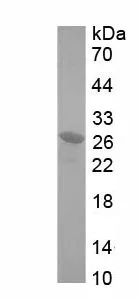 |
Greater than 95% as determined by reducing SDS-PAGE. |
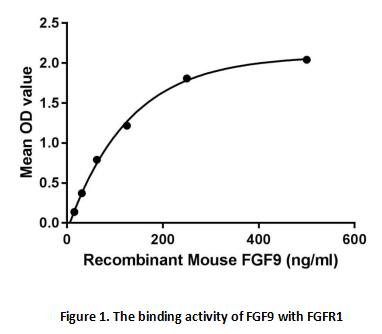 |
Fibroblast Growth Factor 9 (FGF9) is a member of the fibroblast growth factor (FGF) family. FGF family members possess broad mitogenic and cell survival activities, and are involved in a variety of biological processes, including embryonic development, cell growth, morphogenesis, tissue repair, tumor growth and invasion. FGF9 was isolated as a secreted factor that exhibits a growth-stimulating effect on cultured glial cells. In nervous system, this protein is produced mainly by neurons and may be important for glial cell development. Besides, Fibroblast Growth Factor Receptor 1 (FGFR1) has been identified as an interactor of FGF9, thus a binding ELISA assay was conducted to detect the interaction of recombinant mouse FGF9 and recombinant mouse FGFR1. Briefly, FGF9 were diluted serially in PBS, with 0.01% BSA (pH 7.4). Duplicate samples of 100ul were then transferred to FGFR1-coated microtiter wells and incubated for 2h at 37℃. Wells were washed with PBST and incubated for 1h with anti-FGF9 pAb, then aspirated and washed 3 times. After incubation with HRP labelled secondary antibody, wells were aspirated and washed 3 times. With the addition of substrate solution , wells were incubated 15-25 minutes at 37℃. Finally, add 50µL stop solution to the wells and read at 450nm immediately. The binding activity of FGF9 and FGFR1 was shown in Figure 1, and this effect was in a dose dependent manner. |
| 分子别名Alternative Names | GAFHBFG9Glia-Activating FactorHeparin-Binding Growth Factor 9 |
|---|---|
| 背景介绍Background | Plays an important role in the regulation of embryonic development, cell proliferation, cell differentiation and cell migration. May have a role in glial cell growth and differentiation during development, gliosis during repair and regeneration of brain tissue after damage, differentiation and survival of neuronal cells, and growth stimulation of glial tumors. |
| 功能Function | Plays an important role in the regulation of embryonic development, cell proliferation, cell differentiation and cell migration. May have a role in glial cell growth and differentiation during development, gliosis during repair and regeneration of brain tissue after damage, differentiation and survival of neuronal cells, and growth stimulation of glial tumors. |
| 亚细胞定位Subcellular Location | Secreted. |
| 数据库链接Databases |
基因功能参考文献42 条
- stage-specific expression of FGF9 in XY gonads regulates different signal transduction pathways, ERK1/2 and p38, in XY primordial germ cells, resulting in the balance between proliferation and differentiation of the cells PMID: 28395336 : 28395336
- the localization of FGF9 and its receptors at different embryonic and postnatal stages in mice testes, was examined. PMID: 27078042 : 27078042
- results suggested that the combination of nCS (to support bone formation) with a fibrin-based VEGF/FGF9 release system (support vascular formation) is an innovative and effective strategy that significantly enhanced ectopic bone formation in vivo. PMID: 27269204 : 27269204
- FGF9 is a crucial factor required for establishing an appropriate microenvironment for successful implantation and for pregnancy establishment. Additional analyses of pathways through which FGF9 participates in angiogenesis and endometrium-embryo communication should contribute to the understanding of molecular mechanisms that underlay process of implantation. PMID: 28848153 : 28848153
- we conclude that the S99N mutation in Fgf9 causes multiple synostoses syndrome (SYNS) via the disturbance of joint interzone formation. These results further implicate the crucial role of Fgf9 during embryonic joint development PMID: 28169396 : 28169396
- Our results suggest that mature osteoblasts are an important source of FGF9, positively regulating skeletal homeostasis in male mice PMID: 28189801 : 28189801
- suggests FGF-9 has the potential to attenuate vascular cell apoptosis, activate c-Kit progenitor cells, and enhance angiogenesis and neovascularization in C57BL/6 and db/db mice leading to improved cardiac function. PMID: 26682010 : 26682010
- Sox11 directly regulates the expression of Fgf9; ablation of the Sox11 gene results in clefting of the secondary palate resembling the Pierre Robin sequence. PMID: 26826126 : 26826126
- data demonstrated that overexpressing FGF9 in PCa cells augmented the formation of reactive stroma and promoted PCa initiation and progression PMID: 26157349 : 26157349
- These studies identify FGF9 as a target of DICER1 in lung epithelium that functions as an initiating factor for pleuropulmonary blastoma. PMID: 25978641 : 25978641
- FGF-9 possesses novel therapeutic potential in its ability to mediate monocyte to M2 differentiation and confer cardiac protection in the post-infarction diabetic heart. PMID: 25768089 : 25768089
- Data show that Fibroblast Growth Factors (FGF) 9 and 20 regulate the number of cochlear progenitors. PMID: 25915623 : 25915623
- cerebellar microexplant cultures treated with an FGFR agonist or antagonist, we also show that FGF9/FGFR-mediated signaling inhibits the outward migration of radial glia and Bergmann glia precursors and cells PMID: 24983448 : 24983448
- our data demonstrate that FGF9 can initiate a complex astrocytic response predicted to compromise remyelination, while at the same time stimulating microglial/macrophage recruitment in multiple sclerosis lesions PMID: 25907862 : 25907862
- Demonstrate the complex role of FGF9-FGFR3 signalling in the initiation, growth and propagation of lung cancer. PMID: 25413587 : 25413587
- FGF9 overexpression in lung leads to adenocarcinoma. PMID: 23867472 : 23867472
- Loss of Fgf9 in XX Wnt4-/- gonads does not rescue their partial female-to-male sex-reversal. PMID: 22705479 : 22705479
- The data suggested that, at a minimum, Fgf9/20 and Bmp7 organize the nephron progenitor niche. FGF signaling likely regulates multiple important steps in the niche, including survival, proliferation, and competence. PMID: 22698282 : 22698282
- TGFbeta-FGF9-PITX2 signaling cascade regulates cranial neural crest cell proliferation during palate formation. PMID: 22123828 : 22123828
- Data point to a role of Fgf9 signalling in primary and secondary lens fiber cell growth. PMID: 21858205 : 21858205
- Data demonstrate that mesothelial- and epithelial-derived FGF9, mesenchymal Wnt2a and epithelial Wnt7b have unique functions in lung development in mouse. PMID: 21750028 : 21750028
- Conditional expression of FGF9 promotes myocardial vascularization and hypertrophy with enhanced systolic function and reduced heart failure mortality after MI PMID: 21262993 : 21262993
- Results suggest collectively that Fgf9 signalling from the outer mesothelial lining induce Spred/Sprouty expression in the underlying pancreatic mesenchyme. PMID: 20934536 : 20934536
- Fgf9 stimulates steroidogenesis in postnatal Leydig cells. PMID: 19508331 : 19508331
- data suggest a unique role for Fgf-9 in bone healing, presumably by initiating angiogenesis through Vegf-a PMID: 20547837 : 20547837
- Data demonstrate that FGF9 can act as a diffusible conductor for a poleward expansion of tubulogenic programs at early phases of testis differentiation. PMID: 20040496 : 20040496
- Recombinant fgf9 protein inhibits the differentiation response of the mesoderm to Shh, but does not affect proliferation. PMID: 12781691 : 12781691
- Data show that Fgf9 is necessary for testis development, playing a role in the proliferation of cells that give rise to Sertoli progenitors and in the nuclear localization of FGF receptor R2 in Sertoli cell precursors. PMID: 15229180 : 15229180
- To address the role of Fgf9 signaling, we analyzed the inner ears of mice homozygous for Fgf9 null alleles. Fgf9 inactivation leads to a hypoplastic vestibular component of the otic capsule and to the absence of the epithelial semicircular ducts. PMID: 15328018 : 15328018
- FGF9 plays an important role in proliferation and organisation of embryonic Sertoli cells during testis morphogenesis PMID: 15470636 : 15470636
- An epithelial FGF9 signal is necessary for the expansion of cecal mesenchyme and the expression of mesenchymal genes that are required for epithelial budding. PMID: 16308329 : 16308329
- FGF9 acts on the lung mesenchyme to induce proliferation and decrease differentiation PMID: 16494859 : 16494859
- FGF9 is necessary for 11.5 days post coitum fetal XY gonocyte survival and is the earliest reported factor with a sex-specific role in regulating germ cell survival. PMID: 16540514 : 16540514
- the Sprouty proteins are involved normally in mediating the sexually dimorphic signaling of FGF9 and controlling cell migration from the mesonephros during testis development PMID: 16675530 : 16675530
- The fate of the gonad is controlled by antagonism between Fgf9 and Wnt4. PMID: 16700629 : 16700629
- Although Fgf9 is expressed in the apical ectodermal ridge in the limb bud, we demonstrate that the Fgf9-/- limb phenotype results from loss of FGF9 functions after formation of the mesenchymal condensation. PMID: 17544391 : 17544391
- These data suggest a molecular mechanism through which FGF9 and sonic hedgehog signaling coordinately control the growth and patterning of the lung capillary plexus, and regulate the temporal and spatial expression of Vegfa. PMID: 17881491 : 17881491
- The interaction of FGF and TGFbeta signaling pathways in the intestinal mesenchyme could represent novel targets for future short bowel syndrome therapies. PMID: 18653563 : 18653563
- Results show that loss of fibroblast growth factor 9 or conditional inactivation of Fgf receptors (Fgfr) 1 and 2 in mouse lung mesenchyme results in ectopic airway smooth muscle cells. PMID: 19097117 : 19097117
- A mechanism in which the range of FGF9 signaling in developing tissues is limited by its ability to homodimerize and its affinity for extracellular matrix heparan sulfate proteoglycans. PMID: 19219044 : 19219044
- Neuron-derived Fgf9 is essential for scaffold formation of Bergmann radial fibers and migration of granule neurons in the cerebellum. PMID: 19232523 : 19232523
- the PGD2 signaling pathway is likely to act independently of FGF9, thus implicating two independent feedforward loops between Sox9/Fgf9 and Sox9/L-Pgds in the coordination of growth, cell differentiation and morphogenesis of the gonad. PMID: 19429785 : 19429785
蛋白复溶体积计算器缓冲液体积 = 蛋白质量 ÷ 蛋白浓度
输入任意两项,第三项自动计算 |
蛋白浓度稀释计算器初浓度 × 初体积 = 终浓度 × 终体积
输入任意三项,第四项自动计算 |



