


| 纯度Purity | Greater than 90% as determined by reducing SDS-PAGE. |
|---|---|
| 内毒素Endotoxin | Please contact with the lab for this information |
| 蛋白构建Protein Construction |
【Glu139-Arg249】序列区间
|
| Accession | P21237 |
| 表达宿主Expression Host | E.coli |
| 种属Species | Mus musculus (Mouse) |
| 预测分子量Predicted MW | 42.6 kDa |
| 制剂Formulation | Lyophilized from a 0.2 μm filtered solution of 20mM Tris, 150mM NaCl, pH8.0, containing 1mM EDTA, 1mM DTT, 0.01% SKL, 5% Trehalose and Proclin300. |
| 运输方式Shipping | The product is shipped with ice bag. Upon receipt, store it immediately at the temperature listed below. |
| 稳定性&储存Stability & Storage | 12 months at -20°C to -80°C in lyophilized state.6 months at -20°C to -80°C under sterile conditions after reconstitution.7-10 days at 2°C to 8°C under sterile conditions after reconstitution.Please minimize freeze-thaw cycles. |
| 复溶Reconstitution | Reconstitute in 20mM Tris, 150mM NaCl (pH8.0) to a concentration of 0.1-1.0 mg/mL. Do not vortex. |
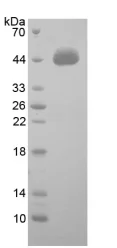 |
Greater than 90% as determined by reducing SDS-PAGE. |
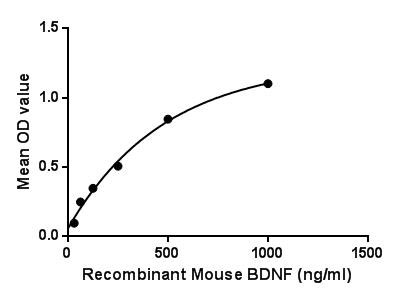 |
Figure. The binding activity of BDNF with APP. Brain-derived neurotrophic factor, also known as BDNF, is a member of the neurotrophin family of growth factors, which are related to the canonical Nerve Growth Factor. BDNF acts on certain neurons of the central nervous system and the peripheral nervous system, helping to support the survival of existing neurons, and encourage the growth and differentiation of new neurons and synapses. Besides, Amyloid Precursor Protein (APP) has been identified as an interactor of BDNF, thus a binding ELISA assay was conducted to detect the interaction of recombinant mouse BDNF and recombinant mouse APP. Briefly, BDNF were diluted serially in PBS with 0.01% BSA (pH 7.4). Duplicate samples of 100μL were then transferred to APP-coated microtiter wells and incubated for 2h at 37℃. Wells were washed with PBST and incubated for 1h with anti-BDNF pAb, then aspirated and washed 3 times. After incubation with HRP labelled secondary antibody, wells were aspirated and washed 3 times. With the addition of substrate solution, wells were incubated 15-25 minutes at 37℃. Finally, add 50µL stop solution to the wells and read at 450nm immediately. The binding activity of of BDNF and APP was shown in Figure 1, and this effect was in a dose dependent manner. |
| 分子别名Alternative Names | NeurotrophinAbrineurin |
|---|---|
| 背景介绍Background | Important signaling molecule that activates signaling cascades downstream of NTRK2. During development, promotes the survival and differentiation of selected neuronal populations of the peripheral and central nervous systems. Participates in axonal growth, pathfinding and in the modulation of dendritic growth and morphology. Major regulator of synaptic transmission and plasticity at adult synapses in many regions of the CNS. The versatility of BDNF is emphasized by its contribution to a range of adaptive neuronal responses including long-term potentiation (LTP), long-term depression (LTD), certain forms of short-term synaptic plasticity, as well as homeostatic regulation of intrinsic neuronal excitability.; Important signaling molecule that activates signaling cascades downstream of NTRK2. Activates signaling cascades via the heterodimeric receptor formed by NGFR and SORCS2. Signaling via NGFR and SORCS2 plays a role in synaptic plasticity and long-term depression (LTD). Binding to NGFR and SORCS2 promotes neuronal apoptosis. Promotes neuronal growth cone collapse. |
| 功能Function | Important signaling molecule that activates signaling cascades downstream of NTRK2. During development, promotes the survival and differentiation of selected neuronal populations of the peripheral and central nervous systems. Participates in axonal growth, pathfinding and in the modulation of dendritic growth and morphology. Major regulator of synaptic transmission and plasticity at adult synapses in many regions of the CNS. The versatility of BDNF is emphasized by its contribution to a range of adaptive neuronal responses including long-term potentiation (LTP), long-term depression (LTD), certain forms of short-term synaptic plasticity, as well as homeostatic regulation of intrinsic neuronal excitability.; Important signaling molecule that activates signaling cascades downstream of NTRK2. Activates signaling cascades via the heterodimeric receptor formed by NGFR and SORCS2. Signaling via NGFR and SORCS2 plays a role in synaptic plasticity and long-term depression (LTD). Binding to NGFR and SORCS2 promotes neuronal apoptosis. Promotes neuronal growth cone collapse. |
| 亚细胞定位Subcellular Location | Secreted.; [BDNF precursor form]: Secreted. |
| 数据库链接Databases |
基因功能参考文献50 条
- We report here on the incorporation of a BDNF mimetic sequence into a supramolecular peptide amphiphile filamentous nanostructure capable of activating the BDNF receptor TrkB and downstream signaling in primary cortical neurons in vitro. PMID: 30211565 : 30211565
- Data (including data from studies in knockout mice) suggest that Bdnf is involved in neuroprotection and regulation of synaptic protein loss in cerebral cortex due to oxidative stress caused by high-fat diet. PMID: 29277119 : 29277119
- Total abdominal irradiation exposure impairs cognitive function involving miR-34a-5p/BDNF axis. PMID: 28668331 : 28668331
- role in the maintenance of intestinal epithelial barrier function via anti-apoptotic properties PMID: 29527912 : 29527912
- upregulation of PAI-1 may be a critical mechanism underlying insufficient neurotrophic support and increased neurodegeneration associated with AD. Thus, targeting BDNF maturation through pharmacological inhibition of PAI-1 might become a potential treatment for AD. PMID: 28132883 : 28132883
- These observations suggest that GGA administration is a therapeutic candidate for depressive diseases by increasing hippocampal BDNF levels via HSP105 expression. PMID: 28580422 : 28580422
- In a model of traumatic brain injury, transcranial ultrasound stimulation increases brain BDNF levels. PMID: 28939348 : 28939348
- Results suggest that brain derived neurotrophic factor (BDNF) activation in the nucleus accumbens (NAc) may overcome memory and plasticity deficits linked to Actl6a protein (BAF53b) mutations. PMID: 27226355 : 27226355
- Upregulating BDNF-AS inhibits osteogenesis, possibly through inverse regulation on BDNF and osteogenic signaling pathways PMID: 29247276 : 29247276
- miR-322 promotes Tau phosphorylation via negatively controlling BDNF-TrkB receptor activation PMID: 29464486 : 29464486
- BDNF preserves intestinal mucosal barrier function and alters gut microbiota in mice. PMID: 29475460 : 29475460
- Results demonstrate that heterotrimeric Galphai1 and Galphai3 proteins are essential for TrkB signaling and that disruption of Galphai1 or Galphai3 function could contribute to depressive behaviors. PMID: 29507199 : 29507199
- The present study revealed that long-term exercise increased BDNF expression in the motor cortex and facilitated a transfer of motor learning from aerobic exercise to postural coordination. PMID: 29019708 : 29019708
- These results suggested that the effects of Valeriana fauriei (VF) extract on a model of fibromyalgia (FM)may be associated with its modulatory effects on the BDNF signaling pathway in the hippocampus and medial prefrontal cortex. In conclusion, the mechanism underlying the protective effects of VF as a therapeutic agent against FM may involve the BDNF signaling pathway PMID: 29115388 : 29115388
- findings demonstrate that not only is BDNF actively secreted by the transdifferentiated BDNF-mesenchymal stem cells, but also that it has the capacity to promote neurite sprouting and regeneration PMID: 28694020 : 28694020
- Results indicate a modulatory effect of valproic acid on the Bbrain-derived neurotrophic factor levels in the ventral striatum. Study brings initial insights into the involvement of neurotrophic mechanisms in the ventral striatum in ethanol-induced addictive-like behavior. PMID: 28889008 : 28889008
- significant increase of BDNF levels in the hippocampus and prefrontal cortex was observed in ethanol-treated mice receiving ginseng extract G115. PMID: 28837087 : 28837087
- This findings consistently demonstrate that long-lasting nociceptive input activates VTA neurons and, via increased release of BDNF. PMID: 28390647 : 28390647
- increased BDNF-TrkB signaling and synaptogenesis in the nucleus accumbens by deletion of alpha7 nAChR plays a key role in depression PMID: 27821848 : 27821848
- Findings suggest that carriers of the BDNF-Met allele may exhibit greater vulnerability to anxiety disorders and anorexia nervosa, contributed by increased excitability of pyramidal neurons, due to the combination of decreased GABAergic innervation of distal dendrites and BDNF-mediated suppression of perisomatic inhibitory inputs. PMID: 27578497 : 27578497
- the ZnT3 null state removed synaptic zinc, it rather increased free zinc in the cytosol of brain cells, which appeared to increase MMP-9 activity and BDNF levels. The present results suggest that zinc dyshomeostasis during the critical period of brain development may be a possible contributing mechanism for ASD. PMID: 27352957 : 27352957
- the BDNFVal66Met polymorphism contribute to the individual propensity for arterial thrombosis related to acute myocardial infarction PMID: 26705390 : 26705390
- There was a significant decrease in the BDNF protein expression along with an increase in the mRNA expression of CRH, NR3C1, CART, and NPY in intact females PMID: 28527954 : 28527954
- Daily OMR testing during the critical period leads to general visual function improvements accompanied by increased DA and BDNF in the retina, with this process being requisitely mediated by TrkB activation PMID: 29408880 : 29408880
- The changes in the expression patterns of proBDNF, BDNF, and their receptors under the influence of chronic alcohol consumption in the depressive ASC strain and nondepressive CBA strain mice are different. PMID: 28900083 : 28900083
- These results suggest that BDNF is implicated in MDMA-induced dependence and psychosis by activating the midbrain serotonergic and dopaminergic neurons. PMID: 28472632 : 28472632
- newborn neurons improve social recognition persistence through a BDNF-independent mechanism. PMID: 27165290 : 27165290
- Study shows long-term physical exercise in mice led to a significant increase in the synthesis and release of brain derived neurotrophic factor along with an alteration in the morphology of astrocytes in the dentate gyrus. PMID: 27686571 : 27686571
- Mice exposed to aggressive confrontations exhibited a similar pattern of species-typical aggressive and non-aggressive behaviors on the first and the last session. Repeated aggressive confrontations promoted an increase in plasma corticosterone. Repeated sessions of social instigation or aggressive confrontation did not alter BDNF concentrations at the prefrontal cortex and hippocampus. PMID: 28614436 : 28614436
- High-intensity acute exercise increased total Bdnf mRNA in hippocampus of sedentary mice. PMID: 28556463 : 28556463
- Thus, the expression of BDNF in the hippocampal CA1 region has the potential to improve fear and object location memory in wild type mouse strains when the region and expression levels of BDNF are well controlled. PMID: 27394686 : 27394686
- Study demonstrates the importance of 14,15-EET-mediated production of astrocyte-derived brain derived neurotrophic factor for enhancing viability of astrocytes and protecting neurons from the ischaemic injury and provides insights into the mechanism by which 14,15-EET is involved in neuroprotection. PMID: 26526810 : 26526810
- Orthopedic surgery modulates the expression of neuropeptide Y and BDNF at the spinal and hippocampal levels. PMID: 27791037 : 27791037
- treating BACHD cortical neurons with ApiCCT1 prevented BACHD striatal neuronal atrophy by enhancing release of BDNF that subsequently acts through tyrosine receptor kinase B (TrkB) receptor on striatal neurons. Our findings are evidence that TRiC reagent-mediated reductions in mHTT enhanced BDNF delivery to restore the trophic status of BACHD striatal neurons. PMID: 27601642 : 27601642
- BDNF in the lower parts of the auditory system drives auditory fidelity along the entire ascending pathway up to the cortex by increasing inhibitory strength in behaviorally relevant frequency regions. PMID: 26476841 : 26476841
- Results highlight the biological significance of alternative brain-derived neurotrophic factor transcripts and provide evidence that individual isoforms serve distinct molecular and behavioral functions. PMID: 26585288 : 26585288
- A critical period of susceptibility to cigarette smoke exposure exists in the prenatal and early postnatal period, which results a downregulation in brain-derived neurotrophic factor/tyrosine kinase receptor B signaling in the hippocampus and enhances depression-like behaviors later in life. PMID: 26503133 : 26503133
- Deletion of Bdnf in DRG neurons leads to a temporary dysregulation of miR-1. PMID: 27346077 : 27346077
- Excitatory synaptic activation-dependent up-regulation of XBP1 directly facilitated transcriptional activation of BDNF. BDNF in turn drove its own expression via IRE1-XBP1 pathway in a protein kinase A-dependent manner. Exogenous treatment with BDNF promoteSynaptic activity- and BDNF-dependent distinct activation of dendritic IRE1-XBP1 cascade drives BDNF expression in cell soma and may be involved in dendritic extension. PMID: 28921568 : 28921568
- We hypothesize that BDNF in the developing brain regulates fear circuit plasticity during a sensitive period in early adolescence, and alterations in BDNF expression (genetic or environmental) have a persistent impact on fear behavior and fear-related disorders. PMID: 27699937 : 27699937
- High BDNF expression is associated with neuropathic pain. PMID: 29054488 : 29054488
- The authors show that BDNF acts cell autonomous and autocrine, as wildtype neurons are not capable of rescuing growth deficits in neighboring MeCP2 deficient neurons in vitro and in vivo. PMID: 27782879 : 27782879
- BDNF acts retrogradely on TrkB in climbing fibers , and facilitates elimination of climbing fibers synapses from Purkinje cells somata during the third postnatal week. PMID: 28775326 : 28775326
- EGCG significantly ameliorated insulin resistance and cognitive disorder by up-regulating the insulin receptor substrate-1 (IRS-1)/AKT and ERK/cAMP response element binding protein (CREB)/brain-derived neurotrophic factor (BDNF) signaling pathways. PMID: 28739640 : 28739640
- Results suggest that activity-dependent BDNF signaling is critical for regulating oscillatory activity, which may contribute to altered behavior. PMID: 27552586 : 27552586
- the transcriptional induction of Bdnf by a mnemonic stimulus is impaired in aged hippocampal neurons. PMID: 27626660 : 27626660
- BDNF deficiency results in depression-like behavior, regardless of age and gender. PMID: 27648918 : 27648918
- Study reports that an endogenous molecule released after exercise is capable of inducing key promoters of the Mus musculus Bdnf gene. The metabolite beta-hydroxybutyrate, which increases after prolonged exercise, induces the activities of Bdnf promoters, particularly promoter I, which is activity-dependent. PMID: 27253067 : 27253067
- Results show that (1) large-soma retinal ganglion cells are particularly susceptible to optic nerve injury; and (2) overexpression of BDNF prolongs the survival of retinal ganglion cells, including large-soma retinal ganglion cells. PMID: 28101532 : 28101532
- GR downregulates Bdnf expression through direct binding to Bdnf regulatory sequences. PMID: 28403881 : 28403881
蛋白复溶体积计算器缓冲液体积 = 蛋白质量 ÷ 蛋白浓度
输入任意两项,第三项自动计算 |
蛋白浓度稀释计算器初浓度 × 初体积 = 终浓度 × 终体积
输入任意三项,第四项自动计算 |



