Recombinant Human NNT (N-6His)
Alternative NamesNAD(P) transhydrogenase; NNT
规格参数 Specifications
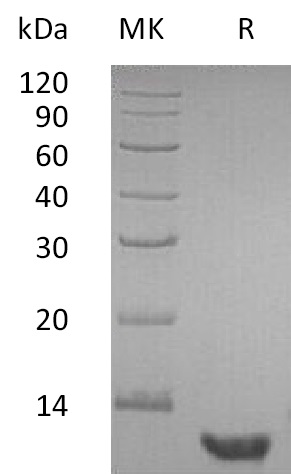
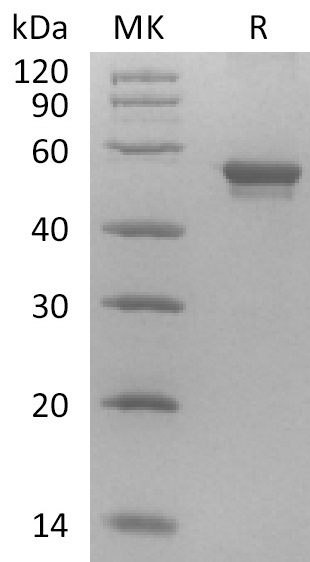
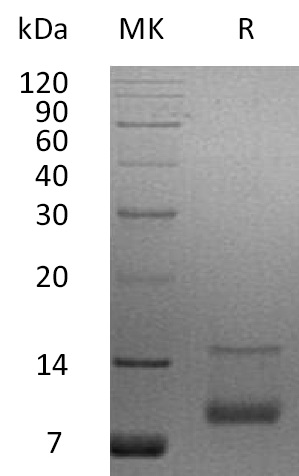
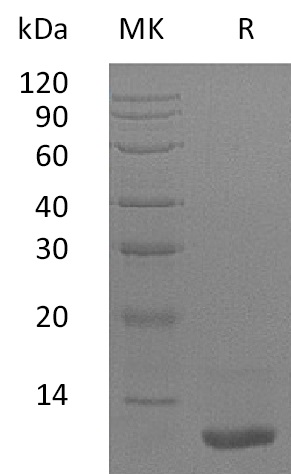
| 纯度Purity | Greater than 95% as determined by reducing SDS-PAGE |
|---|---|
| 内毒素Endotoxin | <1 EU/µg as determined by LAL test. |
| 蛋白构建Protein Construction |
6HisN 端标签-【Met880-Lys1086】序列区间
|
| Accession | Q13423 |
| 表达宿主Expression Host | E. coli |
| 种属Species | Human |
| 预测分子量Predicted MW | 24.4 kDa |
| 制剂Formulation | Lyophilized From a 0.2 μm filtered solution of PBS, 10mM GSH, 50% Glycerol, pH7.4. |
| 运输方式Shipping | The product is shipped with ice bag. Upon receipt, store it immediately at the temperature listed below. |
| 稳定性&储存Stability & Storage | 12 months at -20°C to -80°C in lyophilized state.6 months at -20°C to -80°C under sterile conditions after reconstitution.7-10 days at 2°C to 8°C under sterile conditions after reconstitution.Please minimize freeze-thaw cycles. |
!
本司产品仅用于科研,不用于临床诊断和治疗。
产品图片 Product Images点击图片可查看原图
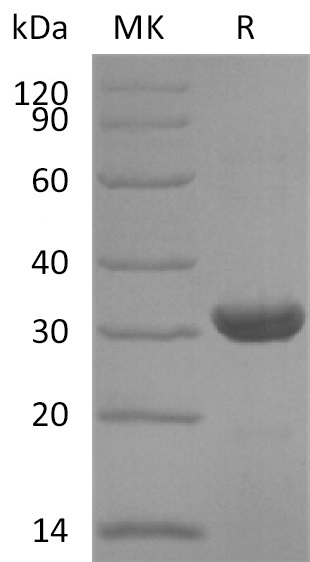 |
Greater than 95% as determined by reducing SDS-PAGE. |
靶点信息 Target Information
| 分子别名Alternative Names | NAD(P) transhydrogenaseNNT |
|---|---|
| 功能Function | The transhydrogenation between NADH and NADP is coupled to respiration and ATP hydrolysis and functions as a proton pump across the membrane. May play a role in reactive oxygen species (ROS) detoxification in the adrenal gland. |
| 亚细胞定位Subcellular Location | Mitochondrion inner membrane; Multi-pass membrane protein; Matrix side. |
| 数据库链接Databases |
基因功能参考文献11 条
- Overexpression of nicotinamide nucleotide transhydrogenase (NNT) was associated with shorter overall and disease free survival in gastric cancer. Knockdown of NNT caused significantly NADPH reduction, induced high levels of Reactive Oxygen Species and significant cell apoptosis under oxidative stress conditions such as glucose deprival and anoikis. PMID: 30059901 : 30059901
- Findings suggest that NNT is essential to homeostasis of NADH and NADPH pools, anomalies of which affect HIF-1alpha- and HDAC1-dependent pathways, and hence retrograde response of mitochondria. PMID: 28478381 : 28478381
- Study describes the fi rst structural model of the human NNT. The 3D model identifies functional and structural H-NNT key motifs and gain essential insight into the structural and functional effect of deleterious amino acid substitutions causing glucocorticoid de fi ciency and LVNC cardiomyopathy, as well as rare homozygote amino acid variations. PMID: 27459240 : 27459240
- NNT should be sequenced in all primary adrenal insufficiencies for which the most frequent etiologies have been ruled out. As NNT is involved in oxidative stress, careful follow-up is needed to evaluate mineralocorticoid biosynthesis extent, and gonadal, heart and thyroid function. PMID: 27129361 : 27129361
- identified a 6.67 Mb homozygous region harboring the NNT gene in a Dutch patient presenting with familial glucocorticoid deficiency (FGD); a novel homozygous mutation (NM_012343.3: c.1259dupG) in NNT was revealed; reviewed the literature for all the reported NNT mutations and their clinical presentation PMID: 26548497 : 26548497
- This report of a novel NNT mutation, p.G200S, expands the phenotype of NNT mutations to include mineralocorticoid deficiency. It provides the first evidence that NNT mutations can cause oxidative stress and mitochondrial defects. PMID: 26070314 : 26070314
- Data suggest mutations in nicotinamide nucleotide transhydrogenase (NNT) as contributory to left ventricular noncompaction (LVNC). PMID: 26025024 : 26025024
- NNT mRNA expression is significantly higher in visceral fat of obese patients and correlates with body weight, BMI, % body fat, visceral and sc fat area, waist and hip circumference, and fasting plasma insulin. PMID: 23592659 : 23592659
- Results suggest that NNT may have a role in ROS detoxification in human adrenal glands. PMID: 22634753 : 22634753
- In the failing heart a partial loss of Nnt activity adversely impacts NADPH-dependent enzymes and the capacity to maintain membrane potential, thus contributing to a decline in bioenergetic capacity, redox regulation and antioxidant defense. PMID: 20388492 : 20388492
- the expression of the transhydrogenase gene in subsections of the human brain showed a distribution that apparently varied as a function of neuronal density PMID: 12223207 : 12223207
蛋白复溶体积计算器缓冲液体积 = 蛋白质量 ÷ 蛋白浓度
输入任意两项,第三项自动计算 |
蛋白浓度稀释计算器初浓度 × 初体积 = 终浓度 × 终体积
输入任意三项,第四项自动计算 |