


Recombinant RNA Binding Motif Protein 38 (RBM38)(N-6His)
Alternative NamesHSRNASEB; SEB4D; Seb4B; RNPC1; RNA-Binding Region(RNP1,RRM)Containing 1; CLL-associated antigen KW-5; ssDNA-binding protein SEB4
规格参数 Specifications
| 纯度Purity | Greater than 95% as determined by reducing SDS-PAGE. |
|---|---|
| 内毒素Endotoxin | <1 EU/µg as determined by LAL test. |
| 蛋白构建Protein Construction |
6HisN 端标签-【His25-Tyr207】序列区间
|
| Accession | Q9H0Z9 |
| 表达宿主Expression Host | E.coli |
| 种属Species | Homo sapiens (Human) |
| 预测分子量Predicted MW | 23.5 kDa |
| 制剂Formulation | Lyophilized from a 0.2 μm filtered solution of PBS, pH7.4, containing 0.01% SKL, 1mM DTT, 5% Trehalose and Proclin300. |
| 运输方式Shipping | The product is shipped with ice bag. Upon receipt, store it immediately at the temperature listed below. |
| 稳定性&储存Stability & Storage | 12 months at -20°C to -80°C in lyophilized state.6 months at -20°C to -80°C under sterile conditions after reconstitution.7-10 days at 2°C to 8°C under sterile conditions after reconstitution.Please minimize freeze-thaw cycles. |
| 复溶Reconstitution | Reconstitute in ddH₂O to a concentration of 0.1-0.5 mg/mL. Do not vortex. |
!
本司产品仅用于科研,不用于临床诊断和治疗。
产品图片 Product Images点击图片可查看原图
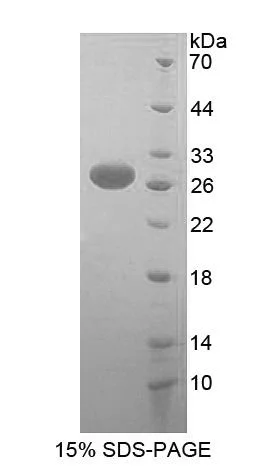 |
Greater than 95% as determined by reducing SDS-PAGE. |
靶点信息 Target Information
| 分子别名Alternative Names | HSRNASEBSEB4DSeb4BRNPC1RNA-Binding Region(RNP1,RRM)Containing 1CLL-associated antigen KW-5ssDNA-binding protein SEB4 |
|---|---|
| 背景介绍Background | RNA-binding protein that specifically bind the 3'-UTR of CDKN1A transcripts, leading to maintain the stability of CDKN1A transcripts, thereby acting as a mediator of the p53/TP53 family to regulate CDKN1A. CDKN1A is a cyclin-dependent kinase inhibitor transcriptionally regulated by the p53/TP53 family to induce cell cycle arrest. Isoform 1, but not isoform 2, has the ability to induce cell cycle arrest in G1 and maintain the stability of CDKN1A transcripts induced by p53/TP53. Also acts as a mRNA splicing factor. Specifically regulates the expression of FGFR2-IIIb, an epithelial cell-specific isoform of FGFR2. Plays a role in myogenic differentiation.; (Microbial infection) Essential factor for the splicing of the pre-mRNAs of human parvovirus B19 (B19V) and for the expression of B19V 11-kDa protein, which enhances viral replication. |
| 功能Function | RNA-binding protein that specifically bind the 3'-UTR of CDKN1A transcripts, leading to maintain the stability of CDKN1A transcripts, thereby acting as a mediator of the p53/TP53 family to regulate CDKN1A. CDKN1A is a cyclin-dependent kinase inhibitor transcriptionally regulated by the p53/TP53 family to induce cell cycle arrest. Isoform 1, but not isoform 2, has the ability to induce cell cycle arrest in G1 and maintain the stability of CDKN1A transcripts induced by p53/TP53. Also acts as a mRNA splicing factor. Specifically regulates the expression of FGFR2-IIIb, an epithelial cell-specific isoform of FGFR2. Plays a role in myogenic differentiation.; (Microbial infection) Essential factor for the splicing of the pre-mRNAs of human parvovirus B19 (B19V) and for the expression of B19V 11-kDa protein, which enhances viral replication. |
| 亚细胞定位Subcellular Location | Cytoplasm, cytosol. Nucleus. |
| 数据库链接Databases |
基因功能参考文献27 条
- Our findings suggested that RBM38 may be a core contributor in stabilizing the p53-mdm2 loop function to prevent hepatocellular carcinoma (HCC) and a potential novel target to provide a therapeutic strategy for HCC by inhibiting mdm2 and rescuing p53 from inactivation PMID: 30176896 : 30176896
- Investigated RNA-binding region-containing protein 1 (RNPC1) action on signal pathways and disease progression in lung cancer samples and cells. Found RNPC1 acts to downregulate the miR-181a mediated inhibition of cancer susceptibility 2 (CASC2) expression in lung cancer. Results show RNPC1 inhibits NSCLC progression in a miR-181a/CASC2 axis-dependent manner. PMID: 29288351 : 29288351
- Results showed that the expressions of RBM38 and PTEN was positively correlated in human breast cancer tissues. RBM38 upregulated PTEN expression and activity in breast cancer cells through its direct binding to PTEN mRNA 3'UTR enhancing its stability. These data implied that RBM38 acted as a tumor suppressor partly by enhancing PTEN expression. PMID: 29052531 : 29052531
- Taken together, these results suggest that the 11-kDa protein facilitates B19V DNA replication and that RBM38 is an essential host factor for B19V pre-mRNA splicing and for the expression of the 11-kDa protein. PMID: 29437973 : 29437973
- Results report that RBM38 mediates direct inhibition of c-Myc expression, which in turn suppresses RBM38 expression. Thus, it can be concluded that RBM38 and c-Myc form a unique mutually antagonistic RBM38-c-Myc loop in breast cancer. PMID: 28399911 : 28399911
- Here we uncovered a novel mechanism that RBM38 is a positive posttranscriptional regulator of ZO-1 in breast cancer. PMID: 28683467 : 28683467
- Overexpression of RNA-binding region-containing protein 1 (RNPC1) increased, whereas knockdown of RNPC1 decreased, the level of progesterone receptor (PR) protein and transcripts. PMID: 27634883 : 27634883
- aplan-Meier analysis showed that renal cell carcinoma patients with lower expression of RBM38 had a significantly shorter survival time than those with higher expression of RBM38 ( p = 0.028). All these suggested that RBM38 acts as a tumor suppressor in renal cell carcinoma, which has the potential value for the prediction of renal cell carcinoma prognosis. PMID: 28459215 : 28459215
- RBM38 and DND1 are repressed in primary acute myeloid leukemia, neutrophil differentiation is dependent on increased expression of both proteins, and they have a role in regulating p21(CIP1) expression during acute promyelocytic leukemia differentiation PMID: 26740055 : 26740055
- RNPC1 was found to be expressed in bladder, blood, brain, breast, colorectal, eye, head and neck, lung, ovarian, skin and soft tissue cancer. In 14 of the 94 tests, an association between RNPC1 gene expression and cancer prognosis was observed. PMID: 26046131 : 26046131
- our data suggest that RBM38 is a novel translational regulator of HIF1alpha under a hypoxic condition. PMID: 25622105 : 25622105
- Suggest that RNPC1 had a potential function to play a tumor-suppressor role which may be a potential marker in the therapeutic and prognostic of breast cancer. PMID: 24884756 : 24884756
- Data indicate that long non-coding RNA HOTAIR is functionally related to RNA binding motif protein 38 (RBM38). PMID: 24663081 : 24663081
- RBM38 as novel transcriptional target of E2F1 restricts E2F1-induced proliferation. Furthermore, this negative feedback loop seems to restrict tumor aggressiveness, thereby promoting survival of patients with cancer. PMID: 22798430 : 22798430
- A role for RBM38 in regulating alternative splicing during erythroid differentiation. PMID: 24250749 : 24250749
- Data suggest that RNPC1 is a critical regulator of Mdm2. PMID: 23912475 : 23912475
- GSK3 promotes p53 mRNA translation through phosphorylation of RNPC1 PMID: 24142875 : 24142875
- knockdown of MIC-1 can decrease RNPC1-induced cell growth suppression. PMID: 23836903 : 23836903
- Novel regulation of MDM2 gene expression by the RNA binding protein RNPC1 via mRNA stability. PMID: 22710720 : 22710720
- knockdown of p73 or p21, another target of RNPC1, attenuates the inhibitory effect of RNPC1 on cell proliferation and premature senescence, whereas combined knockdown of p73 and p21 completely abolishes it PMID: 22508983 : 22508983
- a novel mechanism by which HuR is regulated by RNPC1 via mRNA stability and HuR is a mediator of RNPC1-induced growth suppression. PMID: 22371495 : 22371495
- RNPC1 contributes to tumor resistance to radiotherapy, which likely occurs through a p21-mediated G/G accumulation mechanism PMID: 22214381 : 22214381
- identify RBM38 in a genetic screen for RBPs whose expression controls miRNA access to target mRNAs PMID: 22027593 : 22027593
- identified RNPC1, a p53 target and a RNA-binding protein, as a critical regulator of p53 translation PMID: 21764855 : 21764855
- found that RNPC1, a RNA-binding protein and a target of the p53 family, regulates p63 mRNA stability and consequently p63 activity. PMID: 20457941 : 20457941
- it was found that this protein Rbm38 regulates myogenic differentiation via the p21 signal pathway. PMID: 19817877 : 19817877
- RNPC1a is required to maintain the stability of p21 transcript induced by p53. PMID: 17050675 : 17050675
蛋白复溶体积计算器缓冲液体积 = 蛋白质量 ÷ 蛋白浓度
输入任意两项,第三项自动计算 |
蛋白浓度稀释计算器初浓度 × 初体积 = 终浓度 × 终体积
输入任意三项,第四项自动计算 |



