


Recombinant Transient Receptor Potential Cation Channel Subfamily V, Member 3 (TRPV3)(N-6His)
Alternative NamesVRL3; Vanilloid receptor-like 3
规格参数 Specifications
| 纯度Purity | Greater than 97% as determined by reducing SDS-PAGE. |
|---|---|
| 内毒素Endotoxin | <1 EU/µg as determined by LAL test. |
| 蛋白构建Protein Construction |
6HisN 端标签-【Asn671-Val790】序列区间
|
| Accession | Q8NET8 |
| 表达宿主Expression Host | E.coli |
| 种属Species | Homo sapiens (Human) |
| 预测分子量Predicted MW | 18.0 kDa |
| 制剂Formulation | Lyophilized from a 0.2 μm filtered solution of PBS, pH7.4, containing 0.01% SKL, 1mM DTT, 5% Trehalose and Proclin300. |
| 运输方式Shipping | The product is shipped with ice bag. Upon receipt, store it immediately at the temperature listed below. |
| 稳定性&储存Stability & Storage | 12 months at -20°C to -80°C in lyophilized state.6 months at -20°C to -80°C under sterile conditions after reconstitution.7-10 days at 2°C to 8°C under sterile conditions after reconstitution.Please minimize freeze-thaw cycles. |
| 复溶Reconstitution | Reconstitute in 10mM PBS (pH7.4) to a concentration of 0.1-1.0 mg/mL. Do not vortex. |
!
本司产品仅用于科研,不用于临床诊断和治疗。
产品图片 Product Images点击图片可查看原图
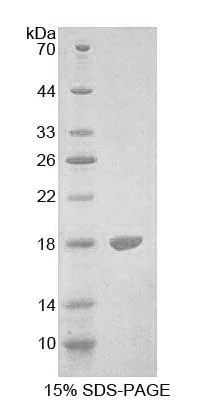 |
Greater than 97% as determined by reducing SDS-PAGE. |
靶点信息 Target Information
| 分子别名Alternative Names | VRL3Vanilloid receptor-like 3 |
|---|---|
| 背景介绍Background | Putative receptor-activated non-selective calcium permeant cation channel. It is activated by innocuous (warm) temperatures and shows an increased response at noxious temperatures greater than 39 degrees Celsius. Activation exhibits an outward rectification. May associate with TRPV1 and may modulate its activity. Is a negative regulator of hair growth and cycling: TRPV3-coupled signaling suppresses keratinocyte proliferation in hair follicles and induces apoptosis and premature hair follicle regression (catagen). |
| 功能Function | Putative receptor-activated non-selective calcium permeant cation channel. It is activated by innocuous (warm) temperatures and shows an increased response at noxious temperatures greater than 39 degrees Celsius. Activation exhibits an outward rectification. May associate with TRPV1 and may modulate its activity. Is a negative regulator of hair growth and cycling: TRPV3-coupled signaling suppresses keratinocyte proliferation in hair follicles and induces apoptosis and premature hair follicle regression (catagen). |
| 亚细胞定位Subcellular Location | Membrane; Multi-pass membrane protein. |
| 数据库链接Databases |
基因功能参考文献35 条
- Data suggest that Thr264 in TRPV3 is key ERK1 phosphorylation site mediating EGFR-induced sensitization of TRPV3 to stimulate signaling pathways involved in regulating skin homeostasis. (TRPV3 = transient receptor potential cation channel subfamily V member-3; ERK1 = extracellular signal-regulated kinase-1; EGFR = epidermal growth factor receptor) PMID: 29084846 : 29084846
- This study identified a direct regulatory effect of MBTPS2 on TRPV3 which can partially contribute to the overlapping clinical features of IFAP and Olmsted syndromes under a common signaling pathway. PMID: 28717930 : 28717930
- TRPV3 may contribute to pruritus in burn scars through TSLP. PMID: 29140280 : 29140280
- the expression of transient receptor potential vanilloid-1 (TRPV1), transient receptor potential vanilloid-2 (TRPV2) and transient receptor potential vanilloid-3 (TRPV3) channels in native human odontoblasts, was examined. PMID: 28905239 : 28905239
- TRPV3 was highly expressed in the infiltrating eosinophils and mucosal epithelium of the nasal polyps of ECRS, and further that the more severe the refractoriness was after surgery, the higher the TRPV3 expression was in nasal polyps. PMID: 28462829 : 28462829
- Data indicate that the restoration of a single residue that is apparently missing in the use-dependent homologs could largely eliminate the use dependence of heat sensitivity of vanilloid receptor transient receptor potential 3 (TRPV3). PMID: 28154143 : 28154143
- TRPV3 mutants causing Olmsted Syndrome induce impaired cell adhesion and nonfunctional lysosomes PMID: 27754757 : 27754757
- *We describe two cases of Olmsted-like syndrome in a Mongolian family. *The underlying cause was a previously undescribed G573V point mutation in TRPV3. PMID: 27273692 : 27273692
- The results of the present study show that polymorphism of TRPV3 contributed towards symptom severity in FM. PMID: 27079220 : 27079220
- A novel mutation in TRPV3 gene causes atypical familial Olmsted syndrome in a Chinese family. PMID: 26902751 : 26902751
- High Transient receptor potential vanilloid 3 protein expression could promote the proliferation of lung cancer cells. Transient receptor potential vanilloid 3 inhibition decreased [Ca2+]i of lung cancer cells and cell cycle arrest at the G1/S boundary. PMID: 27023518 : 27023518
- these data suggest that TRPV3 sparklets cause dilation of cerebral parenchymal arterioles by activating IK and SK channels in the endothelium PMID: 26453324 : 26453324
- TRPV3 missense mutation identified as a cause of the rare Olmsted syndrome. PMID: 26067147 : 26067147
- TPRV3 was significantly elevated in the epidermis of burn scars with pruritus. PMID: 24695993 : 24695993
- Study illustrates the antiadipogenic role of TRPV3 in the adipocytes. PMID: 25774551 : 25774551
- this study provides powerful tools to broaden our understanding of ligand interaction with TRPV channels, and the availability of purified human TRPV3 opens up perspectives for further structural and functional studies PMID: 25829496 : 25829496
- A mutation in TRPV3 causes focal palmoplantar keratoderma in a Chinese family. PMID: 25285920 : 25285920
- Demonstrate similarities but also notable differences in TRPV3 pharmacology between recombinant and native systems. PMID: 23848361 : 23848361
- a TRPV3 mutation has a role in Olmsted syndrome [case report] PMID: 24463422 : 24463422
- TRPV3 missense mutation found in patient with Olmsted syndrome. PMID: 24452206 : 24452206
- TRPV3-ARD with characteristic finger 3 loop likely plays an important role in channel function and pharmacology. PMID: 24248473 : 24248473
- TRPV3 has roles in skin physiology and in certain skin diseases [review] PMID: 23800054 : 23800054
- The Olmsted syndrome patient was found to harbour a previously undescribed 1718G-C transversion in TRPV3, causing a G573A point mutation with immunological dysregulation function. PMID: 23692804 : 23692804
- TRPV3 is a therapeutic target for itch PMID: 22475759 : 22475759
- Nucleotide sequencing of five additional affected individuals also revealed missense mutations in TRPV3. PMID: 22405088 : 22405088
- Nominal association was confirmed for TRPV3 rs7217270 in migraine with aura and TRPV1 rs222741 in the overall migraine group. PMID: 22162417 : 22162417
- It was concluded that the sensitization of TRPV3 is intrinsic to the channel itself and occurs as a result of hysteresis of channel gating. PMID: 22006988 : 22006988
- TRPV3 channel is expressed in skin, its likely role is to detect noxious cold temperatures. PMID: 21490957 : 21490957
- PI(4,5)P(2)-dependent modulation of TRPV3 activity represents an attractive mechanism for acute regulation of keratinocyte signaling cascades that control cell proliferation and the release of autocrine and paracrine factors. PMID: 21321070 : 21321070
- Farnesyl pyrophosphate is the firstly identified endogenous TRPV3 activator that causes nociception PMID: 20395302 : 20395302
- A multiligand binding site for ATP and calmodulin previously identified in the TRPV1 ankyrin repeat domain is conserved in TRPV3 and TRPV4, but not TRPV2. PMID: 19864432 : 19864432
- member of the vanilloid channel family that is expressed in skin, tongue, dorsal root ganglion, trigeminal ganglion, spinal cord and brain; a calcium-permeable temperature-sensitive cation channel PMID: 12077604 : 12077604
- temperature-sensitive (but capsaicin-insensitive) vanilloid receptor-like protein; may represent an additional vanilloid receptor subunit involved in the formation of heteromeric vanilloid receptor channels PMID: 12077606 : 12077606
- Ca(2+) inhibits TRPV3 from both the extracellular and intracellular sides. The inhibition is sequentially reduced, appearing as sensitization to repetitive stimulations. PMID: 18178557 : 18178557
- vanilloid type 3 (TRPV3) channel is crucially involved in pruritic dermatitis [review] PMID: 19209153 : 19209153
蛋白复溶体积计算器缓冲液体积 = 蛋白质量 ÷ 蛋白浓度
输入任意两项,第三项自动计算 |
蛋白浓度稀释计算器初浓度 × 初体积 = 终浓度 × 终体积
输入任意三项,第四项自动计算 |



