


Recombinant Kelch Domain Containing Protein 2 (KLHDC2)(N-6His)
Alternative NamesHCLP-1; LCP; HCA33; Hepatocellular carcinoma-associated antigen 33; Host cell factor homolog LCP; Host cell factor-like protein 1
规格参数 Specifications
| 纯度Purity | Greater than 95% as determined by reducing SDS-PAGE. |
|---|---|
| 内毒素Endotoxin | <1 EU/µg as determined by LAL test. |
| 蛋白构建Protein Construction |
6HisN 端标签-【Met1-Asp279】序列区间
|
| Accession | Q9Y2U9 |
| 表达宿主Expression Host | E.coli |
| 种属Species | Homo sapiens (Human) |
| 预测分子量Predicted MW | 35.4 kDa |
| 制剂Formulation | Lyophilized from a 0.2 μm filtered solution of 20mM Tris, 150mM NaCl, pH8.0, containing 1mM EDTA, 1mM DTT, 0.01% SKL, 5% Trehalose and Proclin300. |
| 运输方式Shipping | The product is shipped with ice bag. Upon receipt, store it immediately at the temperature listed below. |
| 稳定性&储存Stability & Storage | 12 months at -20°C to -80°C in lyophilized state.6 months at -20°C to -80°C under sterile conditions after reconstitution.7-10 days at 2°C to 8°C under sterile conditions after reconstitution.Please minimize freeze-thaw cycles. |
| 复溶Reconstitution | Reconstitute in 20mM Tris, 150mM NaCl (pH8.0) to a concentration of 0.1-1.0 mg/mL. Do not vortex. |
!
本司产品仅用于科研,不用于临床诊断和治疗。
产品图片 Product Images点击图片可查看原图
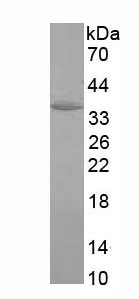 |
Greater than 95% as determined by reducing SDS-PAGE. |
靶点信息 Target Information
| 分子别名Alternative Names | HCLP-1LCPHCA33Hepatocellular carcinoma-associated antigen 33Host cell factor homolog LCPHost cell factor-like protein 1 |
|---|---|
| 背景介绍Background | Substrate-recognition component of a Cul2-RING (CRL2) E3 ubiquitin-protein ligase complex of the DesCEND (destruction via C-end degrons) pathway, which recognizes a C-degron located at the extreme C terminus of target proteins, leading to their ubiquitination and degradation. The C-degron recognized by the DesCEND pathway is usually a motif of less than ten residues and can be present in full-length proteins, truncated proteins or proteolytically cleaved forms. The CRL2(KLHDC2) complex specifically recognizes proteins with a diglycine (Gly-Gly) at the C-terminus, leading to their ubiquitination and degradation. The CRL2(KLHDC2) complex mediates ubiquitination and degradation of truncated SELENOK and SELENOS selenoproteins produced by failed UGA/Sec decoding, which end with a diglycine. The CRL2(KLHDC2) complex also recognizes proteolytically cleaved proteins ending with Gly-Gly, such as the N-terminal fragment of USP1, leading to their degradation. May also act as an indirect repressor of CREB3-mediated transcription by interfering with CREB3-DNA-binding. |
| 功能Function | Substrate-recognition component of a Cul2-RING (CRL2) E3 ubiquitin-protein ligase complex of the DesCEND (destruction via C-end degrons) pathway, which recognizes a C-degron located at the extreme C terminus of target proteins, leading to their ubiquitination and degradation. The C-degron recognized by the DesCEND pathway is usually a motif of less than ten residues and can be present in full-length proteins, truncated proteins or proteolytically cleaved forms. The CRL2(KLHDC2) complex specifically recognizes proteins with a diglycine (Gly-Gly) at the C-terminus, leading to their ubiquitination and degradation. The CRL2(KLHDC2) complex mediates ubiquitination and degradation of truncated SELENOK and SELENOS selenoproteins produced by failed UGA/Sec decoding, which end with a diglycine. The CRL2(KLHDC2) complex also recognizes proteolytically cleaved proteins ending with Gly-Gly, such as the N-terminal fragment of USP1, leading to their degradation. May also act as an indirect repressor of CREB3-mediated transcription by interfering with CREB3-DNA-binding. |
| 亚细胞定位Subcellular Location | Nucleus. |
| 数据库链接Databases |
基因功能参考文献1 条
- Data show that KLHDC1 and KLHDC2 have differential localization and activity in cultured mammalian cells. PMID: 16964437 : 16964437
蛋白复溶体积计算器缓冲液体积 = 蛋白质量 ÷ 蛋白浓度
输入任意两项,第三项自动计算 |
蛋白浓度稀释计算器初浓度 × 初体积 = 终浓度 × 终体积
输入任意三项,第四项自动计算 |



