


Recombinant Fibronectin Leucine Rich Transmembrane Protein 3 (FLRT3)(N-6His)
Alternative NamesFibronectin-like domain-containing leucine-rich transmembrane protein 3; Leucine-rich repeat transmembrane protein FLRT3
规格参数 Specifications
| 纯度Purity | Greater than 97% as determined by reducing SDS-PAGE. |
|---|---|
| 内毒素Endotoxin | <1 EU/µg as determined by LAL test. |
| 蛋白构建Protein Construction |
6HisN 端标签-【Lys29-Asp152】序列区间
|
| Accession | Q9NZU0 |
| 表达宿主Expression Host | E.coli |
| 种属Species | Homo sapiens (Human) |
| 预测分子量Predicted MW | 17.8 kDa |
| 制剂Formulation | Lyophilized from a 0.2 μm filtered solution of PBS, pH7.4, containing 0.01% SKL, 1mM DTT, 5% Trehalose and Proclin300. |
| 运输方式Shipping | The product is shipped with ice bag. Upon receipt, store it immediately at the temperature listed below. |
| 稳定性&储存Stability & Storage | 12 months at -20°C to -80°C in lyophilized state.6 months at -20°C to -80°C under sterile conditions after reconstitution.7-10 days at 2°C to 8°C under sterile conditions after reconstitution.Please minimize freeze-thaw cycles. |
| 复溶Reconstitution | Reconstitute in 10mM PBS (pH7.4) to a concentration of 0.1-1.0 mg/mL. Do not vortex. |
!
本司产品仅用于科研,不用于临床诊断和治疗。
产品图片 Product Images点击图片可查看原图
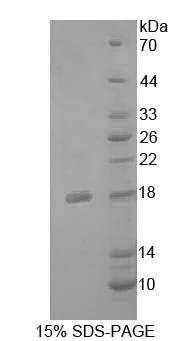 |
Greater than 97% as determined by reducing SDS-PAGE. |
靶点信息 Target Information
| 分子别名Alternative Names | Fibronectin-like domain-containing leucine-rich transmembrane protein 3Leucine-rich repeat transmembrane protein FLRT3 |
|---|---|
| 背景介绍Background | Functions in cell-cell adhesion, cell migration and axon guidance, exerting an attractive or repulsive role depending on its interaction partners. Plays a role in the spatial organization of brain neurons. Plays a role in vascular development in the retina. Plays a role in cell-cell adhesion via its interaction with ADGRL3 and probably also other latrophilins that are expressed at the surface of adjacent cells. Interaction with the intracellular domain of ROBO1 mediates axon attraction towards cells expressing NTN1. Mediates axon growth cone collapse and plays a repulsive role in neuron guidance via its interaction with UNC5B, and possibly also other UNC-5 family members. Promotes neurite outgrowth (in vitro). Mediates cell-cell contacts that promote an increase both in neurite number and in neurite length. Plays a role in the regulation of the density of glutamaergic synapses. Plays a role in fibroblast growth factor-mediated signaling cascades. Required for normal morphogenesis during embryonic development, but not for normal embryonic patterning. Required for normal ventral closure, headfold fusion and definitive endoderm migration during embryonic development. Required for the formation of a normal basement membrane and the maintenance of a normal anterior visceral endoderm during embryonic development. |
| 功能Function | Functions in cell-cell adhesion, cell migration and axon guidance, exerting an attractive or repulsive role depending on its interaction partners. Plays a role in the spatial organization of brain neurons. Plays a role in vascular development in the retina. Plays a role in cell-cell adhesion via its interaction with ADGRL3 and probably also other latrophilins that are expressed at the surface of adjacent cells. Interaction with the intracellular domain of ROBO1 mediates axon attraction towards cells expressing NTN1. Mediates axon growth cone collapse and plays a repulsive role in neuron guidance via its interaction with UNC5B, and possibly also other UNC-5 family members. Promotes neurite outgrowth (in vitro). Mediates cell-cell contacts that promote an increase both in neurite number and in neurite length. Plays a role in the regulation of the density of glutamaergic synapses. Plays a role in fibroblast growth factor-mediated signaling cascades. Required for normal morphogenesis during embryonic development, but not for normal embryonic patterning. Required for normal ventral closure, headfold fusion and definitive endoderm migration during embryonic development. Required for the formation of a normal basement membrane and the maintenance of a normal anterior visceral endoderm during embryonic development. |
| 亚细胞定位Subcellular Location | Cell membrane; Single-pass membrane protein. Endoplasmic reticulum membrane. Cell junction, focal adhesion. Secreted. Cell projection, axon. Cell projection, growth cone membrane. |
| 数据库链接Databases |
基因功能参考文献1 条
- Low FLRT3 expression is associated with lung graft dysfunction. PMID: 27421969 : 27421969
蛋白复溶体积计算器缓冲液体积 = 蛋白质量 ÷ 蛋白浓度
输入任意两项,第三项自动计算 |
蛋白浓度稀释计算器初浓度 × 初体积 = 终浓度 × 终体积
输入任意三项,第四项自动计算 |



