


Recombinant Ectodysplasin A Receptor (EDAR)(N-6His)
Alternative NamesDL; ED1R; ED3; ED5; EDA-A1R; EDA1R; EDA3; Ectodysplasin 1,Anhidrotic Receptor; Downless homolog; EDA-A1 receptor; Ectodermal dysplasia receptor
规格参数 Specifications
| 纯度Purity | Greater than 97% as determined by reducing SDS-PAGE. |
|---|---|
| 内毒素Endotoxin | <1 EU/µg as determined by LAL test. |
| 蛋白构建Protein Construction |
6HisN 端标签-【Lys212-Ser448】序列区间
|
| Accession | Q9UNE0 |
| 表达宿主Expression Host | E.coli |
| 种属Species | Homo sapiens (Human) |
| 预测分子量Predicted MW | 29.5 kDa |
| 制剂Formulation | Lyophilized from a 0.2 μm filtered solution of PBS, pH7.4, containing 0.01% SKL, 1mM DTT, 5% Trehalose and Proclin300. |
| 运输方式Shipping | The product is shipped with ice bag. Upon receipt, store it immediately at the temperature listed below. |
| 稳定性&储存Stability & Storage | 12 months at -20°C to -80°C in lyophilized state.6 months at -20°C to -80°C under sterile conditions after reconstitution.7-10 days at 2°C to 8°C under sterile conditions after reconstitution.Please minimize freeze-thaw cycles. |
| 复溶Reconstitution | Reconstitute in 10mM PBS (pH7.4) to a concentration of 0.1-1.0 mg/mL. Do not vortex |
!
本司产品仅用于科研,不用于临床诊断和治疗。
产品图片 Product Images点击图片可查看原图
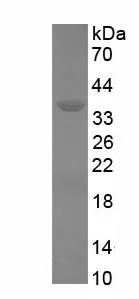 |
Greater than 97% as determined by reducing SDS-PAGE. |
靶点信息 Target Information
| 分子别名Alternative Names | DLED1RED3ED5EDA-A1REDA1REDA3Ectodysplasin 1,Anhidrotic ReceptorDownless homologEDA-A1 receptorEctodermal dysplasia receptor |
|---|---|
| 背景介绍Background | Receptor for EDA isoform A1, but not for EDA isoform A2. Mediates the activation of NF-kappa-B and JNK. May promote caspase-independent cell death. |
| 功能Function | Receptor for EDA isoform A1, but not for EDA isoform A2. Mediates the activation of NF-kappa-B and JNK. May promote caspase-independent cell death. |
| 亚细胞定位Subcellular Location | Membrane; Single-pass type I membrane protein. |
| 数据库链接Databases |
基因功能参考文献28 条
- 10 and five quantitative trait-associated mutations for oxygen saturation (SaO2) and blood platelet count, respectively, are identified at the Edar Receptor (EDAR) locus. rs10865026 and rs3749110 (associated with SaO2 and platelet count, respectively) are functional candidate targets. EDAR has undergone natural selection in recent human history and EDAR variants has an important role in Tibetan high-altitude adaptations. PMID: 28795375 : 28795375
- Results suggested that SNPs in EDAR could be a pathogenic factor for non-syndromic tooth agenesis. Furthermore, EDAR can be regarded as a marker gene for the risk of tooth agenesis. PMID: 28808699 : 28808699
- To evaluate the relative contribution of these variants, we performed a second genome-wide scan in 709 samples from the Uyghur, an admixed population with both eastern and western Eurasian ancestries. In Uyghurs, both EDAR (rs3827760: P = 1.92 x 10(-12)) and TCHH (rs11803731: P = 1.46 x 10(-3)) are associated with hair straightness, but EDAR (OR 0.415) has a greater effect than TCHH (OR 0.575). PMID: 27487801 : 27487801
- Partial least square path model confirms EDARV370A systematically affect these weakly related ectodermal-derived characteristics, suggesting the pleiotropic effect of EDARV370A mainly plays roles in early embryo development PMID: 26603699 : 26603699
- Four traits of ear pinna anatomic variation are associated with a functional variant in the EDAR gene, a key regulator of embryonic skin appendage development. PMID: 26105758 : 26105758
- we have identi fi ed a novel frameshift mutation in an Italian family with autosomal dominant hypohidrotic ectodermal dysplasia resulting in a mild clinical phenotype. PMID: 24641098 : 24641098
- Individuals with a c.1072C > T mutation in the EDAR-gene displayed more hair shaft deformations confirming the role of EDAR for human hair follicle development and postnatal hair follicle cycling. PMID: 26336973 : 26336973
- Confirmed that EDARV370A, a variant that first originated in East Asia about 30000 years ago, played an important role in incisor shoveling in East Asia. This suggests that incisor shoveling in modern East Asians appeared after the late Pleistocene. PMID: 24752358 : 24752358
- Individuals with a c.1072C > T mutation in the EDAR-gene displayed a typical pattern of congenitally missing teeth in the frontal area with functional consequences. PMID: 24884697 : 24884697
- Using whole-exome sequencing we describe a novel homozygous missense mutation in EDAR causing autosomal recessive HED associated with palmoplantar hyperkeratosis and the absence of breasts. PMID: 23210707 : 23210707
- Study generated a knockin mouse model and found that, as in humans, hair thickness is increased in EDAR370A mice; new biological targets affected by the mutation were identified, including mammary and eccrine glands. Building on these results EDAR370A was found to be associated with an increased number of active eccrine glands in the Han Chinese. PMID: 23415220 : 23415220
- This is the first report of a founder EDAR mutation and of a significantly high frequency of autosomal recessive HED. PMID: 22032522 : 22032522
- WNT10A and EDAR were each responsible for 16% of hypohidrotic/anhidrotic ectodermal dysplasia cases. PMID: 20979233 : 20979233
- screening of all the 12 exons and splice junctions of gene EDAR revealed a novel missense mutation (c.1163T>C; p.Ile388Thr) in family A and a novel insertion mutation (c.1014insA; p.V339SfsX6) in family B. PMID: 21771270 : 21771270
- Data show that 25 different mutations on EDA and EDAR genes were detected in HED patients. PMID: 20236127 : 20236127
- a novel compound heterozygous mutation [c.52-2A>G; c.212G>A (p.Cys71Tyr)]; significance of the EDAR signalling pathway in the ectodermal morphogenesis. PMID: 20033817 : 20033817
- DNA sequence analysis of EDAR gene in a Pakistani family, demonstrating autosomal recessive form of hypohidrotic ectodermal dysplasia, identified a novel homozygous mutation affecting splice donor site of exon 5 [IVS5+1G > or = C] of the gene PMID: 20199431 : 20199431
- isoforms of EDA-A5 and A5',activated NF-kappaB through receptors EDAR and XEDAR PMID: 16423472 : 16423472
- EDAR mutations account for one-quarter of non-ED1-related hypohidrotic ectodermal dyspl PMID: 16435307 : 16435307
- novel deletion mutation in a Pakistani family with autosomal recessive hypohidrotic ectodermal dysplasia PMID: 17501952 : 17501952
- study reports the molecular analyses of four patients from India with hypohidrotic ectodermal dysplasia, three who harbour novel mutations, two in the EDA gene and one in the EDAR gene PMID: 17970812 : 17970812
- EDAR is a major genetic determinant of Asian hair thickness and the 1540C allele spread through Asian populations due to recent positive selection PMID: 18065779 : 18065779
- Patients with homozygous or compound heterozygous mutations in the EDAR gene have a more severe phenotype of hypohidrotic ectodermal dysplasia than those with a heterozygous missense, nonsense or frame-shift mutation PMID: 18231121 : 18231121
- Study shows that the derived EDAR370A common in East Asia has a more potent signaling output than the ancestral EDAR370 V; shows that elevation of Edar activity in transgenic mice converts their hair phenotype to the typical East Asian morphology. PMID: 18561327 : 18561327
- EDAR is the genetic determinant of hair thickness as well as a strong contributor to hair fiber thickness variation among Asian populations. PMID: 18704500 : 18704500
- results expand the allelic series for mutations underlying hypohidrotic ectodermal dysplasia PMID: 19438931 : 19438931
- Recurrent mutations in functionally-related EDA and EDAR genes underlie X-linked isolated hypodontia and autosomal recessive hypohidrotic ectodermal dysplasia. PMID: 19551394 : 19551394
- an EDAR variant is a genetic determinant of shovel-shaped incisors PMID: 19804850 : 19804850
蛋白复溶体积计算器缓冲液体积 = 蛋白质量 ÷ 蛋白浓度
输入任意两项,第三项自动计算 |
蛋白浓度稀释计算器初浓度 × 初体积 = 终浓度 × 终体积
输入任意三项,第四项自动计算 |



