


Recombinant Calcium Channel, Voltage Dependent, L-Type, Alpha 1S Subunit (CACNa1S)(N-6His)
Alternative NamesCACNL1A3; CCHL1A3; Cav1.1; HOKPP; MHS5; hypoPP; DHPR; Dihydropyridine Receptor; Voltage-gated calcium channel subunit alpha Cav1.1
规格参数 Specifications
| 纯度Purity | Greater than 95% as determined by reducing SDS-PAGE. |
|---|---|
| 内毒素Endotoxin | <1 EU/µg as determined by LAL test. |
| 蛋白构建Protein Construction |
6HisN 端标签-【Ala1657-Leu1873】序列区间
|
| Accession | Q13698 |
| 表达宿主Expression Host | E.coli |
| 种属Species | Homo sapiens (Human) |
| 预测分子量Predicted MW | 26.8 kDa |
| 制剂Formulation | Lyophilized from a 0.2 μm filtered solution of PBS, pH7.4, containing 0.01% SKL, 1mM DTT, 5% Trehalose and Proclin300. |
| 运输方式Shipping | The product is shipped with ice bag. Upon receipt, store it immediately at the temperature listed below. |
| 稳定性&储存Stability & Storage | 12 months at -20°C to -80°C in lyophilized state.6 months at -20°C to -80°C under sterile conditions after reconstitution.7-10 days at 2°C to 8°C under sterile conditions after reconstitution.Please minimize freeze-thaw cycles. |
| 复溶Reconstitution | Reconstitute in ddH₂O to a concentration of 0.1-0.5 mg/mL. Do not vortex. |
!
本司产品仅用于科研,不用于临床诊断和治疗。
产品图片 Product Images点击图片可查看原图
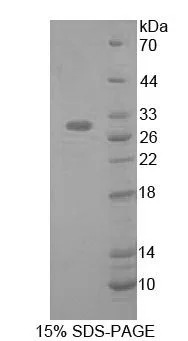 |
Greater than 95% as determined by reducing SDS-PAGE. |
靶点信息 Target Information
| 分子别名Alternative Names | CACNL1A3CCHL1A3Cav1.1HOKPPMHS5hypoPPDHPRDihydropyridine ReceptorVoltage-gated calcium channel subunit alpha Cav1.1 |
|---|---|
| 背景介绍Background | Pore-forming, alpha-1S subunit of the voltage-gated calcium channel that gives rise to L-type calcium currents in skeletal muscle. Calcium channels containing the alpha-1S subunit play an important role in excitation-contraction coupling in skeletal muscle via their interaction with RYR1, which triggers Ca(2+) release from the sarcplasmic reticulum and ultimately results in muscle contraction. Long-lasting (L-type) calcium channels belong to the 'high-voltage activated' (HVA) group. |
| 功能Function | Pore-forming, alpha-1S subunit of the voltage-gated calcium channel that gives rise to L-type calcium currents in skeletal muscle. Calcium channels containing the alpha-1S subunit play an important role in excitation-contraction coupling in skeletal muscle via their interaction with RYR1, which triggers Ca(2+) release from the sarcplasmic reticulum and ultimately results in muscle contraction. Long-lasting (L-type) calcium channels belong to the 'high-voltage activated' (HVA) group. |
| 亚细胞定位Subcellular Location | Cell membrane, sarcolemma, T-tubule; Multi-pass membrane protein. |
| 数据库链接Databases |
基因功能参考文献32 条
- Cav1.1 is specified for the excitation-contraction coupling of skeletal muscles, and has been a prototype in the structural investigations of Cav channels. This article summarized the recent advances in the structural elucidation of Cav1.1 and the mechanistic insights derived from the 3.6 A structure obtained using single-particle, electron cryomicroscopy. PMID: 29594856 : 29594856
- he ryanodine receptor 1 (RyR1) is mainly expressed in the sarcoplasmic reticulum (SR) of skeletal muscle and is a calcium release channel which is coupled to the dihydropyridine receptor (CACNA1S) in the T-tubule of the sarcolemma. PMID: 27147545 : 27147545
- V876E mutation generates a gating pore current that carries strong resting Na(+) inward currents in physiological conditions that are likely responsible for the severe hypokalemic periodic paralysis associated with this mutation. PMID: 29114033 : 29114033
- review of the pharmacogenetics and pathophysiology of CACNA1S mutations in malignant hyperthermia susceptibility type 5 (MHS5); several mutations are known to be risk factors for increased susceptibility; at present, one or at most six CACNA1S mutations display significant linkage or association either to clinically diagnosed MH or to MHS PMID: 28011884 : 28011884
- Study used structure modeling and MD simulations to predict pathogenic omega-currents in CaV1.1 and CaV1.3 Ca(2+) channels bearing several S4 charge mutations: omega-currents conducted in resting state, but not during voltage-sensing domain activation. Mechanism responsible depends on the number of charges in S4, the position of the mutated S4 charge and countercharges, and the nature of the replacing amino acid. PMID: 28978442 : 28978442
- Study identified by exome sequencing both recessive and dominant CACNA1S mutations as a cause of a congenital myopathy characterized by peculiar morphological hallmarks in a cohort of 11 patients from 7 families. PMID: 28012042 : 28012042
- whole-exome next-generation sequencing was used to identify a mutation in the CACNA1S gene, R900S, which is a rare mutation associated with hypokalemic periodic paralysis; study provides further evidence for the phenotypic variation and pharmacogenomics of hypokalemic periodic paralysis PMID: 26433613 : 26433613
- These results provide new insights into the role of muscle-specific proteins on the structural arrangement of alpha1S intracellular loops and point to a new conformational effect of the beta1a subunit in supporting skeletal muscle excitation-contraction coupling. PMID: 27129199 : 27129199
- CACNA1S and SCN4A mutations are relatively rare in patients with hypokalemic periodic paralysis PMID: 26252573 : 26252573
- The authors found one and three rare variants of unknown significance in CACNA1S in the Malignant Hyperthermia and Exertional Heat cohorts PMID: 25658027 : 25658027
- Defects in the genes coding for the skeletal muscle ryanodine receptor and alpha 1 subunit of the dihydropyridine receptor (CACNA1S) have been identified as causative for malignant hyperthermia. PMID: 25735680 : 25735680
- Aberrant splicing of Cav 1.1 may alter intracellular Ca(2+) signalling in myotonic dystrophy 1 and 2 myotubes. The differing dysregulation of intracellular Ca(2+) handling in DM1 and DM2 may explain their distinct sarcolemmal hyperexcitabilities. PMID: 23888875 : 23888875
- Exome sequencing revealed one rare cacna1s nonsynonymous variant in a family with malignant hyperthermia PMID: 24013571 : 24013571
- Data indicate that the presence of either one of these JP-45 variants decreased the sensitivity of the dihydropyridine receptor DHPR to activation. PMID: 22927026 : 22927026
- Affected members of a 5-generation Chinese family with hypokalemic periodic paralysis patients had a novel His916Gln mutation in all male HypoPP patients of the family. Penetrance of the mutation was complete in male carriers, but not female carriers. PMID: 21845430 : 21845430
- Misregulated splicing and altered gating of Ca(V)1.1 calcium channel is associated with muscle weakness in myotonic dystrophy. PMID: 22140091 : 22140091
- A novel mutation in the CACNA1S gene--p.Arg900Gly--is found in a patient with hypokalemic periodic paralysis; this mutation is subsequently found to affect some of the patient's other family members. PMID: 21855088 : 21855088
- All familial periodic paralysis patients studied have mutations in either CACNA1S or SCN4A, but only 4 sporadic periodic paralysis patients have de novo mutations in CACNA1S (R1239H) and SCN4A (R669x2, R1135H). PMID: 21841462 : 21841462
- Three SNPs of CACNA1S gene exon 11 were found but could not be associated with thyrotoxic hypokalemic periodic paralysis in people of Han Nationality in Sichuan. PMID: 21774221 : 21774221
- Expression of transgenic variants of dihydropyridine receptor (alpha1DHPR) subunit leads to replacement of native channels interacting with ryanodine receptor 1 (RyR1), demonstrating molecular remodelling in adult skeletal muscle fibers. PMID: 21262876 : 21262876
- Mutations in the affected genes cause Malignant Hyperthermia. PMID: 21248738 : 21248738
- All individuals in the Italian family with malignant hyperthermia showed cosegregation of informative markers close to the voltage-dependent Ca2+ channel alpha-1S-subunit gene. Sequence analysis showed a c.4060A>T transversion. PMID: 20861472 : 20861472
- Results identify a new mutation in CACNA1S and expand the spectrum of CACNA1S mutations associated with HypoPP. PMID: 19779499 : 19779499
- Ca(V)1.1 Delta 29 splice variant revealed the structural bases underlying the specific gating properties of skeletal muscle Ca(2+) channels, and suggests the existence of a distinct mode of excitation-contraction coupling in developing muscle PMID: 19134469 : 19134469
- polymorphisms in the CACNA1S gene is associated with Malignant Hyperthermia PMID: 12636044 : 12636044
- a mutation of the CACNA1S gene may have a role in hypokalemic periodic paralysis PMID: 15716625 : 15716625
- a novel Arg528Gly mutation in the CACNA1S gene that causes Hypokalemic periodic paralysis in a Chinese family PMID: 15726306 : 15726306
- We propose that CACNA1S mutations may comprise a previously unrecognized genetic risk factor in a greater spectrum of motor unit disorders including amyotrophic lateral sclerosis. PMID: 17587224 : 17587224
- A Polish three-generation family with hypokalemic periodic paralysis and a mutation in CACNA1S is investigated. PMID: 18229654 : 18229654
- All mutations affected CACNA1S arginine residues, consistent with the gating pore cation leak hypothesis of hypokalemic periodic paralysis. Arginine mutations in S4 segments underlie 90% of hypokalemic periodic paralysis cases. PMID: 19118277 : 19118277
- A novel method to detect autoantibodies to dihydropyridine receptor (DHPR), found increased DHPR antibody in myasthenia gravis patients compared to controls. PMID: 19187971 : 19187971
- The study identified a single potentially pathogenic change in CACNA1S (p.Arg174Trp), and highlights that the haplotype structure across CACNA1S is diverse, with a high degree of variability PMID: 19825159 : 19825159
蛋白复溶体积计算器缓冲液体积 = 蛋白质量 ÷ 蛋白浓度
输入任意两项,第三项自动计算 |
蛋白浓度稀释计算器初浓度 × 初体积 = 终浓度 × 终体积
输入任意三项,第四项自动计算 |



