


Recombinant Ubiquitin Specific Peptidase 8 (USP8)(N-6His)
Alternative NamesHumORF8; UBPY; Ubiquitin Carboxyl-Terminal Hydrolase 8; Ubiquitin Specific Protease 8; Deubiquitinating enzyme 8; Ubiquitin isopeptidase Y; Ubiquitin thioesterase 8
规格参数 Specifications
| 纯度Purity | Greater than 90% as determined by reducing SDS-PAGE. |
|---|---|
| 内毒素Endotoxin | <1 EU/µg as determined by LAL test. |
| 蛋白构建Protein Construction |
6HisN 端标签-【Thr777-Thr1118】序列区间
|
| Accession | P40818 |
| 表达宿主Expression Host | E.coli |
| 种属Species | Homo sapiens (Human) |
| 预测分子量Predicted MW | 43.3 kDa |
| 制剂Formulation | Lyophilized from a 0.2 μm filtered solution of 20mM Tris, 150mM NaCl, pH8.0, containing 1mM EDTA, 1mM DTT, 0.01% SKL, 5% Trehalose and Proclin300. |
| 运输方式Shipping | The product is shipped with ice bag. Upon receipt, store it immediately at the temperature listed below. |
| 稳定性&储存Stability & Storage | 12 months at -20°C to -80°C in lyophilized state.6 months at -20°C to -80°C under sterile conditions after reconstitution.7-10 days at 2°C to 8°C under sterile conditions after reconstitution.Please minimize freeze-thaw cycles. |
| 复溶Reconstitution | Reconstitute in 20mM Tris, 150mM NaCl (pH8.0) to a concentration of 0.1-1.0 mg/mL. Do not vortex. |
!
本司产品仅用于科研,不用于临床诊断和治疗。
产品图片 Product Images点击图片可查看原图
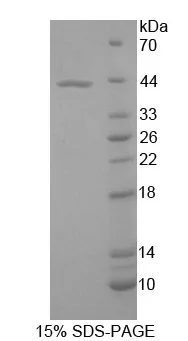 |
Greater than 90% as determined by reducing SDS-PAGE. |
靶点信息 Target Information
| 分子别名Alternative Names | HumORF8UBPYUbiquitin Carboxyl-Terminal Hydrolase 8Ubiquitin Specific Protease 8Deubiquitinating enzyme 8Ubiquitin isopeptidase YUbiquitin thioesterase 8 |
|---|---|
| 背景介绍Background | Hydrolase that can remove conjugated ubiquitin from proteins and therefore plays an important regulatory role at the level of protein turnover by preventing degradation. Converts both 'Lys-48' an 'Lys-63'-linked ubiquitin chains. Catalytic activity is enhanced in the M phase. Involved in cell proliferation. Required to enter into S phase in response to serum stimulation. May regulate T-cell anergy mediated by RNF128 via the formation of a complex containing RNF128 and OTUB1. Probably regulates the stability of STAM2 and RASGRF1. Regulates endosomal ubiquitin dynamics, cargo sorting, membrane traffic at early endosomes, and maintenance of ESCRT-0 stability. The level of protein ubiquitination on endosomes is essential for maintaining the morphology of the organelle. Deubiquitinates EPS15 and controles tyrosine kinase stability. Removes conjugated ubiquitin from EGFR thus regulating EGFR degradation and downstream MAPK signaling. Involved in acrosome biogenesis through interaction with the spermatid ESCRT-0 complex and microtubules. Deubiquitinates BIRC6/bruce and KIF23/MKLP1. Deubiquitinates BACE1 which inhibits BACE1 lysosomal degradation and modulates BACE-mediated APP cleavage and amyloid-beta formation. |
| 功能Function | Hydrolase that can remove conjugated ubiquitin from proteins and therefore plays an important regulatory role at the level of protein turnover by preventing degradation. Converts both 'Lys-48' an 'Lys-63'-linked ubiquitin chains. Catalytic activity is enhanced in the M phase. Involved in cell proliferation. Required to enter into S phase in response to serum stimulation. May regulate T-cell anergy mediated by RNF128 via the formation of a complex containing RNF128 and OTUB1. Probably regulates the stability of STAM2 and RASGRF1. Regulates endosomal ubiquitin dynamics, cargo sorting, membrane traffic at early endosomes, and maintenance of ESCRT-0 stability. The level of protein ubiquitination on endosomes is essential for maintaining the morphology of the organelle. Deubiquitinates EPS15 and controles tyrosine kinase stability. Removes conjugated ubiquitin from EGFR thus regulating EGFR degradation and downstream MAPK signaling. Involved in acrosome biogenesis through interaction with the spermatid ESCRT-0 complex and microtubules. Deubiquitinates BIRC6/bruce and KIF23/MKLP1. Deubiquitinates BACE1 which inhibits BACE1 lysosomal degradation and modulates BACE-mediated APP cleavage and amyloid-beta formation. |
| 亚细胞定位Subcellular Location | Cytoplasm. Nucleus. Endosome membrane; Peripheral membrane protein. Cell membrane; Peripheral membrane protein. |
| 数据库链接Databases |
基因功能参考文献45 条
- High expression of USP8 was correlated with advanced tumor stage and high recurrence risk. Moreover, USP8 was identified as a novel independent prognostic factor for CSCC patients. PMID: 30010158 : 30010158
- In summary, we show that, contrary to the pituitary ACTH-secreting tumors, the USP8 hotspot sequence on exon 14 is not mutated in tumors causing ectopic ACTH secretion syndrome (EAS). Although USP8 is expressed in all EAS tumors examined, our in vitro data indicate that it is not involved in the regulation of ectopic proopiomelanocortin transcription. PMID: 28710116 : 28710116
- USP8 deubiquitinates Sec31A and inhibits the formation of large COPII carriers, thereby suppressing collagen IV secretion. PMID: 29604273 : 29604273
- review: role of USP8 driver mutations in Cushing's Disease PMID: 28850717 : 28850717
- Data (including data from studies using knockout and transgenic mice/cells) suggest that CLEC16A, NRDP1, and USP8 form tripartite complex; CLEC16A-NRDP1-USP8 complex appears to rely on ubiquitin signals to promote mitophagy and maintain mitochondrial function necessary for beta-cell function. (CLEC16A = C-type lectin domain family 16 member A; NRDP1 = ubiquitin-protein ligase NRDP1; USP8 = ubiquitin specific peptidase 8) PMID: 29180353 : 29180353
- the EGFR-USP8-trichoplein-Aurora A axis is a critical signaling cascade that restricts ciliogenesis in dividing cells, and functions to facilitate cell proliferation PMID: 29472535 : 29472535
- in human cells, Usp8 knockdown increased the lysosomal degradation of alpha-synuclein. PMID: 27444016 : 27444016
- Overexpression of USP8 in lung adenocarcinoma is an early event during the course of tumor progression, and is related to EGFR expression. PMID: 28544031 : 28544031
- Somatic mutations in USP8 are common in Nelson's tumors, and are associated with less favorable outcome after surgery. PMID: 28982703 : 28982703
- Data indicate that USP8 functions as a novel deubiquitylase of FLIPL and inhibits extrinsic apoptosis by stabilizing FLIPL. PMID: 27321185 : 27321185
- Somatic USP8 gene mutations are a common cause of pediatric Cushing disease due to pituitary adenoma. PMID: 28505279 : 28505279
- findings demonstrate that USP8 plays a key role in the trafficking and degradation of BACE1 by deubiquitinating lysine 501. PMID: 27302062 : 27302062
- USP8 regulates VEGFR2 trafficking, signaling and proteolysis. PMID: 26459808 : 26459808
- Ubpy loss of function results in the accumulation of autophagosomes due to a blockade of the autophagy flux. PMID: 26571504 : 26571504
- Results show that in addition to the scaffolding function in complex formation, BRUCE has an E3 ligase function to promote BRIT1 deubiquitination by USP8 leading to accumulation of BRIT1 at DNA double-strand break. PMID: 26683461 : 26683461
- No somatic mutations were observed in USP8 in a cohort of GH-secreting pituitary adenomas. PMID: 26701869 : 26701869
- Studies indicate that ubiquitin specific protease 8 protein (USP8) mutations contribute to adrenocorticotropic hormone (ACTH) overproduction in Cushing's disease (CD). PMID: 26285834 : 26285834
- The presence of USP8 mutations may predict favorable responses to the somatostatin analog pasireotide in corticotroph adenomas of Cushing's disease. PMID: 26578638 : 26578638
- The identification of USP8 mutations as contributors to the pathogenesis of ACTH-secreting pituitary adenomas represents an exciting advance in our understanding of Cushing's disease and its potential treatment into the of precision medicine. PMID: 25930709 : 25930709
- these findings implicate a novel role for K6-linked Ub conjugates and USP8-mediated deubiquitination in the regulation of PARK2 in mitochondrial quality control PMID: 25700639 : 25700639
- In surgically resected primary USP8-mutated tumor cells, USP8 knockdown or blocking EGFR effectively attenuates ACTH secretion. Inhibition of USP8 or EGFR is promising for treating USP8-mutated corticotrophin adenoma. PMID: 25675982 : 25675982
- USP8 is frequently mutated in adenomas causing Cushing's disease, especially in those from female adult patients diagnosed at a younger age. PMID: 25942478 : 25942478
- Haplotype CAAG may be a down-regulating factor for the risk of non-obstructive azoospermia. PMID: 25863102 : 25863102
- BRUCE acts as a scaffold, bridging the ubiquitin-specific peptidase 8 (USP8) and BRIT1 in a complex to coordinate USP8-catalyzed deubiquitination of BRIT1. PMID: 25733871 : 25733871
- USP8 is required for ci-M6PR endosomal localisation. PMID: 24894536 : 24894536
- Somatic USP8 mutations in corticotroph adenomas clustered in the 14-3-3 protein binding motif and enhanced catalysis and proteolytic cleavage, which increased EGF receptor deubiqutination and signaling. USP8 mutants enhanced POMC promoter activity. PMID: 25485838 : 25485838
- USP8, and the endosomal sorting protein, VPS28, are the negative regulators of NOD2-induced IL-8 secretion. PMID: 25170077 : 25170077
- This work uncovers a novel role for USP8-mediated deubiquitination of K6-linked ubiquitin conjugates from parkin in mitochondrial quality control. PMID: 25216678 : 25216678
- UBE2E3 and UBPY participate in the regulation of TDP-43 ubiquitination, solubility, and neurodegeneration PMID: 24825905 : 24825905
- USP8 maintains a basal expression of HIF1alpha and HIF transcriptional output in normoxia. PMID: 24378640 : 24378640
- USP8 is involved in deubiquitination of LRIG1, influencing the efficiency of Met degradation. PMID: 24828152 : 24828152
- Balanced reciprocal cross-regulation of RNF41 and USP8 determines whether receptors are sorted for lysosomal degradation or recycling, this way regulating basal cytokine receptor levels. PMID: 23750007 : 23750007
- No relationship was found in serum XIAP and USP8 levels with clinical parameters, response to chemotherapy, and survival in patients with advanced stages of non-small cell lung cancer. PMID: 24344018 : 24344018
- Knockdown of ubiquitin-specific peptidase 8 (USP8) selectively kills gefitinib-resistant non-small lung cancer cells. PMID: 23748694 : 23748694
- The ESCRT accessory protein HD-PTP/PTPN23 associates with epidermal growth factor receptor (EGFR) and combines with the deubiquitinating enzyme UBPY/USP8 to transfer EGFR from ESCRT-0 to ESCRT-III and drive EGFR sorting to intralumenal vesicles. PMID: 23477725 : 23477725
- Usp8 is a target for SRC-mediated tyrosine phosphorylation in the N-terminal 504 amino acids upon EGF stimulation of EGFR. PMID: 23333852 : 23333852
- Ubiquitin-specific peptidase 8 (USP8) regulates endosomal trafficking of the epithelial Na+ channel PMID: 23297398 : 23297398
- a UBPY-derived peptide can outcompete ubiquitin for STAM2 SH3 domain binding PMID: 22841719 : 22841719
- USP8 is a positive regulator in Hh signaling by down-regulating Smo ubiquitination and thereby mediating Smo intracellular trafficking. PMID: 22253573 : 22253573
- Studies indicate that USP8/Ubpy and AMSH interact with ESCRT components to modulate the ubiquitination status of receptors and relevant sorting proteins. PMID: 21448666 : 21448666
- UBPY regulates the level of protein ubiquitination on endosomes, which is required for maintaining the morphology of the organelle PMID: 16771824 : 16771824
- The USP8 recognition domain of NRDP1 has a novel protein fold that interacts with a conserved peptide loop of the rhodanese domain. PMID: 17035239 : 17035239
- UBPY-mediated EGFR de-ubiquitination promotes EGFR degradation PMID: 17121848 : 17121848
- UBPY MIT domain and another ubiquitin isopeptidase, AMSH, reveals common interactions with CHMP1A and CHMP1B but a distinct selectivity of AMSH for CHMP3/VPS24, a core subunit of the ESCRT-III complex, and UBPY for CHMP7. PMID: 17711858 : 17711858
- Data suggest that AMSH and UBPY are essential for trafficking and down-regulation of PAR(2) but not for regulating PAR(2) dissociation from beta-arrestin2 or PAR(2)-mediated ERK2 activation. PMID: 19684015 : 19684015
蛋白复溶体积计算器缓冲液体积 = 蛋白质量 ÷ 蛋白浓度
输入任意两项,第三项自动计算 |
蛋白浓度稀释计算器初浓度 × 初体积 = 终浓度 × 终体积
输入任意三项,第四项自动计算 |



