


Recombinant Xylosyltransferase I (XYLT1)(N-6His)
Alternative NamesXT-I; XT1; PXYLT1; Protein O Xylosyltransferase 1
规格参数 Specifications
| 纯度Purity | Greater than 90% as determined by reducing SDS-PAGE. |
|---|---|
| 内毒素Endotoxin | <1 EU/µg as determined by LAL test. |
| 蛋白构建Protein Construction |
6HisN 端标签-【Gly773-Val910】序列区间
|
| Accession | Q86Y38 |
| 表达宿主Expression Host | E.coli |
| 种属Species | Homo sapiens (Human) |
| 预测分子量Predicted MW | 19.0 kDa |
| 制剂Formulation | Lyophilized from a 0.2 μm filtered solution of 100mMNaHCO<sub>3</sub>, 500mMNaCl, pH8.3, containing 1mM EDTA, 1mM DTT, 0.01% SKL, 5% Trehalose and Proclin300. |
| 运输方式Shipping | The product is shipped with ice bag. Upon receipt, store it immediately at the temperature listed below. |
| 稳定性&储存Stability & Storage | 12 months at -20°C to -80°C in lyophilized state.6 months at -20°C to -80°C under sterile conditions after reconstitution.7-10 days at 2°C to 8°C under sterile conditions after reconstitution.Please minimize freeze-thaw cycles. |
| 复溶Reconstitution | Reconstitute in ddH₂O to a concentration of 0.1-1.0 mg/mL. Do not vortex. |
!
本司产品仅用于科研,不用于临床诊断和治疗。
产品图片 Product Images点击图片可查看原图
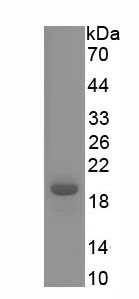 |
Greater than 90% as determined by reducing SDS-PAGE. |
靶点信息 Target Information
| 分子别名Alternative Names | XT-IXT1PXYLT1Protein O Xylosyltransferase 1 |
|---|---|
| 背景介绍Background | Catalyzes the first step in the biosynthesis of chondroitin sulfate and dermatan sulfate proteoglycans, such as DCN. Transfers D-xylose from UDP-D-xylose to specific serine residues of the core protein. Required for normal embryonic and postnatal skeleton development, especially of the long bones. Required for normal maturation of chondrocytes during bone development, and normal onset of ossification. |
| 功能Function | Catalyzes the first step in the biosynthesis of chondroitin sulfate and dermatan sulfate proteoglycans, such as DCN. Transfers D-xylose from UDP-D-xylose to specific serine residues of the core protein. Required for normal embryonic and postnatal skeleton development, especially of the long bones. Required for normal maturation of chondrocytes during bone development, and normal onset of ossification. |
| 亚细胞定位Subcellular Location | Golgi apparatus membrane; Single-pass type II membrane protein. Secreted. |
| 数据库链接Databases |
基因功能参考文献26 条
- In conclusion, we identified two genes, DZIP1 and XYLT1, potentially associated with nonsyndromic high myopia using whole exome sequencing and subsequent mutation screening analysis. PMID: 28085539 : 28085539
- Novel and recurrent XYLT1 mutations in two Turkish families with Desbuquois dysplasia, type 2, have been reported. PMID: 27881841 : 27881841
- Our study describes the first case of DBQD2 resulting from compound heterozygous XYLT1 mutation, expands the mutational spectrum of the disease and provides evidence that the severe growth retardation and microsomia observed in DBQD2 patients may result not only from the skeletal dysplasia itself but also from GH and IGF-1 deficiency. PMID: 27030147 : 27030147
- XYLT1 mutation is associated with short limb skeletal dysplasia. PMID: 26601923 : 26601923
- Human XYLT1 promoter sequence analysis and description. PMID: 25480529 : 25480529
- These results suggest that XT-1 expression is refractory to the disease process and to inhibition by inflammatory cytokines and that signaling through AP-1, Sp1, and Sp3 is important in the maintenance of XT-1 levels in NP cells. PMID: 25476526 : 25476526
- five distinct homozygous XYLT1 mutations may have a role in Desbuquois dysplasia type 2 PMID: 24581741 : 24581741
- A family study shows that functional alterations of XYLT1 cause an autosomal recessive short stature syndrome associated with intellectual disability. PMID: 23982343 : 23982343
- XYLT1 activity increased time-dependently in response to progressive myofibroblast transformation. PMID: 23747722 : 23747722
- AP-1 and Sp3 are key regulators of IL-1beta-mediated modulation of xylosyltransferase I expression. PMID: 23223231 : 23223231
- Xylosyltransferase-I regulates glycosaminoglycan synthesis during the pathogenic process of human osteoarthritis PMID: 22479506 : 22479506
- DXD motifs in human xylosyltransferase I are required for enzyme activity PMID: 15294915 : 15294915
- Elevated XYLT1 activities in pseudoxanthoma elasticum patients is a marker of proteoglycan biosynthesis. PMID: 16133423 : 16133423
- xylotransferase genes might be potential candidate genes predisposing to diabetic nephropathy in type 1 diabetic patients PMID: 16164625 : 16164625
- Over 80% of the nucleotide sequence of the XT-I-cDNA is necessary for expressing a recombinant enzyme with full catalytic activity. PMID: 16225459 : 16225459
- recombinant expression and cloning of active full-length xylosyltransferase I (XT-I) and characterization of subcellular localization of XT-I and XT-II PMID: 16569644 : 16569644
- Variations in the XYLT-II gene are genetic co-factors in the severity of PXE. PMID: 16571645 : 16571645
- Increased levels of xylosyltransferase I correlates with the formation of extracellular matrix during chondrogenic differentiation of mesenchymal stem cells. PMID: 16778156 : 16778156
- The XYLT-I c.343G>T polymorphism contributes to the genetic susceptibility to development of diabetic nephropathy in type 1 diabetic patients. PMID: 17003309 : 17003309
- TGF-beta(1) and mechanical stress induce xylosyltransferase I expression in cardiac fibroblasts and have impact for ECM remodeling in the dilated heart. PMID: 17635914 : 17635914
- For the rate-limiting enzyme in glycosaminoglycan synthesis XT-I, maximal mRNA expression and enzyme activity were observed 10 days after osteogenic induction of mesenchymal stem cells, simultaneously to the beginning of ECM mineralization. PMID: 17980567 : 17980567
- results show that XT-I polymorphisms potentially confer to the genetic susceptibility of abdominal aortic aneurysm PMID: 18294457 : 18294457
- These results point to skeletal growth and tissue remodeling as a cause of the high XT activity in children PMID: 18763033 : 18763033
- Data show that the xylosyltransferase I SNP is associated with a decreased glycosaminoglycan amount in the serum of healthy blood donors. PMID: 19014925 : 19014925
- No statistically significant association was found between four XYLT variants and hypertension or blood pressure, suggesting that they do not play a significant role in the development of essential hypertension. PMID: 19197251 : 19197251
- AP-1 Sp1 family of transcription factors are necessary for the transcriptional regulation of the XYLT1 gene. PMID: 19762916 : 19762916
蛋白复溶体积计算器缓冲液体积 = 蛋白质量 ÷ 蛋白浓度
输入任意两项,第三项自动计算 |
蛋白浓度稀释计算器初浓度 × 初体积 = 终浓度 × 终体积
输入任意三项,第四项自动计算 |



