


Recombinant Tripartite Motif Containing Protein 5 (TRIM5)(N-6His)
Alternative NamesTRIM5α; TRIM5alpha; TRIM5-alpha; RNF88; RING finger protein 88
规格参数 Specifications
| 纯度Purity | Greater than 90% as determined by reducing SDS-PAGE. |
|---|---|
| 内毒素Endotoxin | <1 EU/µg as determined by LAL test. |
| 蛋白构建Protein Construction |
6HisN 端标签-【Ala2-Thr261】序列区间
|
| Accession | Q9C035 |
| 表达宿主Expression Host | E.coli |
| 种属Species | Homo sapiens (Human) |
| 预测分子量Predicted MW | 33.7 kDa |
| 制剂Formulation | Lyophilized from a 0.2 μm filtered solution of PBS, pH7.4, containing 0.01% SKL, 1mM DTT, 5% Trehalose and Proclin300. |
| 运输方式Shipping | The product is shipped with ice bag. Upon receipt, store it immediately at the temperature listed below. |
| 稳定性&储存Stability & Storage | 12 months at -20°C to -80°C in lyophilized state.6 months at -20°C to -80°C under sterile conditions after reconstitution.7-10 days at 2°C to 8°C under sterile conditions after reconstitution.Please minimize freeze-thaw cycles. |
| 复溶Reconstitution | Reconstitute in 10mM PBS (pH7.4) to a concentration of 0.1-1.0 mg/mL. Do not vortex. |
!
本司产品仅用于科研,不用于临床诊断和治疗。
产品图片 Product Images点击图片可查看原图
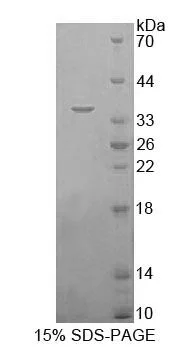 |
Greater than 90% as determined by reducing SDS-PAGE. |
靶点信息 Target Information
| 分子别名Alternative Names | TRIM5αTRIM5alphaTRIM5-alphaRNF88RING finger protein 88 |
|---|---|
| 背景介绍Background | Capsid-specific restriction factor that prevents infection from non-host-adapted retroviruses. Blocks viral replication early in the life cycle, after viral entry but before reverse transcription. In addition to acting as a capsid-specific restriction factor, also acts as a pattern recognition receptor that activates innate immune signaling in response to the retroviral capsid lattice. Binding to the viral capsid triggers its E3 ubiquitin ligase activity, and in concert with the heterodimeric ubiquitin conjugating enzyme complex UBE2V1-UBE2N (also known as UBC13-UEV1A complex) generates 'Lys-63'-linked polyubiquitin chains, which in turn are catalysts in the autophosphorylation of the MAP3K7/TAK1 complex (includes TAK1, TAB2, and TAB3). Activation of the MAP3K7/TAK1 complex by autophosphorylation results in the induction and expression of NF-kappa-B and MAPK-responsive inflammatory genes, thereby leading to an innate immune response in the infected cell. Restricts infection by N-tropic murine leukemia virus (N-MLV), equine infectious anemia virus (EIAV), simian immunodeficiency virus of macaques (SIVmac), feline immunodeficiency virus (FIV), and bovine immunodeficiency virus (BIV). Plays a role in regulating autophagy through activation of autophagy regulator BECN1 by causing its dissociation from its inhibitors BCL2 and TAB2. Also plays a role in autophagy by acting as a selective autophagy receptor which recognizes and targets HIV-1 capsid protein p24 for autophagic destruction. |
| 功能Function | Capsid-specific restriction factor that prevents infection from non-host-adapted retroviruses. Blocks viral replication early in the life cycle, after viral entry but before reverse transcription. In addition to acting as a capsid-specific restriction factor, also acts as a pattern recognition receptor that activates innate immune signaling in response to the retroviral capsid lattice. Binding to the viral capsid triggers its E3 ubiquitin ligase activity, and in concert with the heterodimeric ubiquitin conjugating enzyme complex UBE2V1-UBE2N (also known as UBC13-UEV1A complex) generates 'Lys-63'-linked polyubiquitin chains, which in turn are catalysts in the autophosphorylation of the MAP3K7/TAK1 complex (includes TAK1, TAB2, and TAB3). Activation of the MAP3K7/TAK1 complex by autophosphorylation results in the induction and expression of NF-kappa-B and MAPK-responsive inflammatory genes, thereby leading to an innate immune response in the infected cell. Restricts infection by N-tropic murine leukemia virus (N-MLV), equine infectious anemia virus (EIAV), simian immunodeficiency virus of macaques (SIVmac), feline immunodeficiency virus (FIV), and bovine immunodeficiency virus (BIV). Plays a role in regulating autophagy through activation of autophagy regulator BECN1 by causing its dissociation from its inhibitors BCL2 and TAB2. Also plays a role in autophagy by acting as a selective autophagy receptor which recognizes and targets HIV-1 capsid protein p24 for autophagic destruction. |
| 亚细胞定位Subcellular Location | Cytoplasm. Nucleus. |
| 数据库链接Databases |
基因功能参考文献50 条
- study demonstrates the feasibility of editing the TRIM5 gene in human cells and identifies the main challenges to be addressed in order to use this approach to confer protection from HIV-1 PMID: 29373607 : 29373607
- genetic polymorphism is associated with susceptibility to HIV infections in Brazil PMID: 27388872 : 27388872
- TRIM5 and TRIM22 single nucleotide polymorphisms are associated to increased odds of significant liver fibrosis and sustained virological response after pegIFNalpha/RBV therapy in human immunodeficiency virus/hepatitis C virus coinfected patients. PMID: 27590274 : 27590274
- TRIM5alpha polymorphisms were associated with proviral loads, indicating that TRIM5alpha could be implicated in HTLV-1 replication. PMID: 28420387 : 28420387
- TRIM5alpha potently restricts HIV-1 infection of Langerhans cells but not of subepithelial DC-SIGN+ dendritic cells PMID: 27919079 : 27919079
- Collectively, these results are consistent with observations that the turnover of TRIM5alpha proteins is sensitive to autophagy inhibition; however, the data presented here do not support observations that the inhibition of autophagy abrogates retroviral restriction by TRIM5 proteins. PMID: 26764007 : 26764007
- This meta-analysis indicates that TRIM5alpha H43Y polymorphism is associated with a decreased risk of HIV-1 infection in the homozygote comparison and recessive model. PMID: 26398573 : 26398573
- These results support the relevance of R332G-R335G and other mutants of TRIM5alphahu as candidate effectors for HIV-1 gene therapy. PMID: 26076730 : 26076730
- higher-order oligomerization of TRIM5alpha, which is promoted by the interaction with the retroviral capsid, enhances the E3 Ub ligase activity of TRIM5alpha and contributes to its antiretroviral function. PMID: 26212332 : 26212332
- co-immunoprecipitation experiments demonstrate that IE1CORE binds via the coiled-coil domain to PML and also interacts with TRIM5alpha PMID: 25412268 : 25412268
- Data suggest that due to its lack of stability and inability to accumulate in pronounced cytoplasmic bodies likely due to its high self-ubiquitination activity, huTRIM5alpha was unable to block HIV-1 infection. PMID: 24662946 : 24662946
- TRIM5alpha variations influence transduction efficiency with lentiviral vectors in both human and rhesus CD34(+) cells in vitro and in vivo. PMID: 24153115 : 24153115
- TRIMs interacts with ULK1 and Beclin 1 and regulates autophagy. PMID: 25127057 : 25127057
- TRIM5 acts as a selective autophagy receptor. Based on direct sequence-specific recognition, TRIM5 delivered its cognate cytosolic target, a viral capsid protein, for autophagic degradation. Thus, our study establishes that TRIMs can function both as regulators of autophagy and as autophagic cargo receptors, and reveals a basis for selective autophagy in mammalian cells. PMID: 25127057 : 25127057
- TRIM5alpha and TRIM22 have differential transcriptional regulation and distinct anti-HIV roles according to infection phase. PMID: 24478420 : 24478420
- In conclusion, association with microtubules and the translocation activity of dynein motor complexes are required to achieve efficient retrovirus restriction by TRIM5alpha. PMID: 24600008 : 24600008
- Data report that markers in two TRIMs, TRIM5 and TRIM22 and a marker in BST2, associated statistically with the risk of getting MS. PMID: 24066097 : 24066097
- Our data indicate that although the RhTRIMe7-CypA isoform does not appear to restrict HIV-1, it may act as a negative modulator of TRIM family proteins, presumably by competitive inhibition PMID: 24613845 : 24613845
- structural changes exerted on HIV-1 capsid (CA) assembly by TRIM5alpha binding PMID: 24158810 : 24158810
- Assisted evolution enables HIV-1 to overcome a high TRIM5alpha-imposed genetic barrier to rhesus macaque tropism. PMID: 24086139 : 24086139
- recruitment to the plasma membrane plays role in restriction of retroviral infection PMID: 23548691 : 23548691
- These study supports a model in which localized binding of TRIM5 to the retrovirus capsid nucleates rapid polymerization of a TRIM5 lattice on the capsid surface. PMID: 23785198 : 23785198
- HIV-2 capsid sequences expressed high levels of susceptibility to hTRIM5alpha. PMID: 23647667 : 23647667
- results show how TRIM5alpha affects various retroviral core components and indicate that proteasomes are required for TRIM5alpha-induced core disruption but not for TRIM5alpha-induced restriction PMID: 23505372 : 23505372
- These data suggest that HIV-1 escapes restriction by TRIM5alpha through the selective disruption of CypA-dependent, TRIM5alpha-mediated inhibition of nuclear import. PMID: 23448277 : 23448277
- Blocking the onset or delaying reverse transcription does not increase HIV-1 sensitivity to TRIM5alpha, indicating that the recognition of the capsids by human TRIM5alpha is completed rapidly, following entry into the cytoplasm. PMID: 23320071 : 23320071
- amino acid substitution G249D associated with increased susceptibility to HIV-1 infection PMID: 23379364 : 23379364
- The recognition of the entire capsid surface is a general strategy for TRIM5alpha to restrict murine leukemia viruses. PMID: 23536686 : 23536686
- Increased sensitivity to TRIM5alpha was observed for some capsid variants, suggesting that minor residues are selected against in human populations. PMID: 23601783 : 23601783
- TRIM5 is a restriction factor that blocks retrovirus infection soon after the virion core enters the cell cytoplasm. Restriction activity is targeted to the virion core via recognition of the capsid protein lattice that encases the viral genomic RNA.[Review] PMID: 22482711 : 22482711
- Findings have defined a novel function for TRIM5 as a pattern recognition receptor in innate immune recognition and provided valuable mechanistic insight into its role as a retroviral restriction factor. PMID: 21866272 : 21866272
- Proteasomal subunits are present in rhTRIM5alpha assemblies containing HIV-1 virions. PMID: 22078707 : 22078707
- Determinants of the higher order association of the restriction factor TRIM5alpha and other tripartite motif (TRIM) proteins. PMID: 21680743 : 21680743
- TRIM5alpha "cages" the HIV-1 core by forming an hexagonal array on the surface of the viral capsid. PMID: 21994740 : 21994740
- findings suggest that Gag cytotoxic T lymphocyte mutations may influence HIV-1 replication by modifying both viral infectivity and sensitivity to TRIM5alpha PMID: 21917976 : 21917976
- study concludes that interactions involving much, if not all, of the surface of the murine leukemia virus capsid protein are vital for TRIM5alpha binding PMID: 21483490 : 21483490
- The authors discovered the ability of human and rhesus TRIM5alpha to shuttle into and out of the nucleus. PMID: 21575157 : 21575157
- review of the structure and roles of TRIM5alpha protein, the interaction between Cyp cyclophilin A and TRIM5alpha, as well as gene therapy strategies associated with TRIM5alpha to inhibit HIV-1 infection[review] PMID: 21568899 : 21568899
- knockdown of TRIM5iota increases TRIM5alpha activity in human U373-X4 cells, indicating that physiological levels of expression of truncated TRIM5 isoforms in human cells can reduce the activity of TRIM5 PMID: 21632761 : 21632761
- The SUMO-1-mediated block of murine leukemia virus is mediated by human TRIM5alpha. CA mutations altering the SUMO conjugation sites reduce TRIM5alpha restriction. PMID: 21490953 : 21490953
- the N-terminal region of TRIM5alphaag and TRIM5alphacy are essential for the late restriction activity, while the C-terminal region of TRIM5alphacy negatively regulates the late restriction activity against HIV-1 PMID: 21264255 : 21264255
- the retroviral restriction factor TRIM5 has two additional activities that are linked to restriction: it constitutively promotes innate immune signalling and it acts as a pattern recognition receptor specific for the retrovirus capsid lattice PMID: 21512573 : 21512573
- retroviruses have evolved similar mechanisms to escape TRIM5alpha restriction via the interference of structurally homologous determinants in the viral capsid. PMID: 21169362 : 21169362
- The authors concluded that H43Y might account for the HIV-1 resistance due to TRIM5alpha gene in Chinese intravenous drug users. PMID: 21107267 : 21107267
- Innate immunity mediated by envelope of murine leukemia virus in human cells is TRIM5alpha independent. PMID: 20929586 : 20929586
- TRIM5alpha proteins have evolved to restrict a range of different retroviruses by assembling a deformable hexagonal scaffold that positions the capsid-binding domains to match the symmetry and spacing of the capsid surface lattice PMID: 21187419 : 21187419
- Both common and rare variants of TRIM5alpha are associated with the susceptibility to HIV-1 infection in Japanese and Indian subjects. PMID: 19710594 : 19710594
- The ability of human Trim5alpha to regulate TAB2 levels, to activate NF-kappaB, and to recognize retroviral capsids are genetically separable. PMID: 21035162 : 21035162
- These findings suggest that human TRIM5alpha is an intrinsic immunity factor against HIV-1 infection. PMID: 20493962 : 20493962
- Cytoplasmic body component TRIM5{alpha} requires lipid-enriched microdomains for efficient HIV-1 restriction. PMID: 20810659 : 20810659
蛋白复溶体积计算器缓冲液体积 = 蛋白质量 ÷ 蛋白浓度
输入任意两项,第三项自动计算 |
蛋白浓度稀释计算器初浓度 × 初体积 = 终浓度 × 终体积
输入任意三项,第四项自动计算 |



