


Recombinant Eukaryotic Elongation Factor 2 Kinase (EEF2K)(N-6His)
Alternative NameseEF-2K; Calcium/calmodulin-dependent eukaryotic elongation factor 2 kinase
规格参数 Specifications
| 纯度Purity | Greater than 95% as determined by reducing SDS-PAGE. |
|---|---|
| 内毒素Endotoxin | <1 EU/µg as determined by LAL test. |
| 蛋白构建Protein Construction |
6HisN 端标签-【Asp30-Leu328】序列区间
|
| Accession | O00418 |
| 表达宿主Expression Host | E.coli |
| 种属Species | Homo sapiens (Human) |
| 预测分子量Predicted MW | 38.7 kDa |
| 制剂Formulation | Lyophilized from a 0.2 μm filtered solution of PBS, pH7.4, containing 0.01% SKL, 1mM DTT, 5% Trehalose and Proclin300. |
| 运输方式Shipping | The product is shipped with ice bag. Upon receipt, store it immediately at the temperature listed below. |
| 稳定性&储存Stability & Storage | 12 months at -20°C to -80°C in lyophilized state.6 months at -20°C to -80°C under sterile conditions after reconstitution.7-10 days at 2°C to 8°C under sterile conditions after reconstitution.Please minimize freeze-thaw cycles. |
| 复溶Reconstitution | Reconstitute in 10mM PBS (pH7.4) to a concentration of 0.1-1.0 mg/mL. Do not vortex. |
!
本司产品仅用于科研,不用于临床诊断和治疗。
产品图片 Product Images点击图片可查看原图
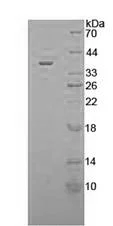 |
Greater than 95% as determined by reducing SDS-PAGE. |
靶点信息 Target Information
| 分子别名Alternative Names | eEF-2KCalcium/calmodulin-dependent eukaryotic elongation factor 2 kinase |
|---|---|
| 背景介绍Background | Threonine kinase that regulates protein synthesis by controlling the rate of peptide chain elongation. Upon activation by a variety of upstream kinases including AMPK or TRPM7, phosphorylates the elongation factor EEF2 at a single site, renders it unable to bind ribosomes and thus inactive. In turn, the rate of protein synthesis is reduced. |
| 功能Function | Threonine kinase that regulates protein synthesis by controlling the rate of peptide chain elongation. Upon activation by a variety of upstream kinases including AMPK or TRPM7, phosphorylates the elongation factor EEF2 at a single site, renders it unable to bind ribosomes and thus inactive. In turn, the rate of protein synthesis is reduced. |
| 数据库链接Databases |
基因功能参考文献43 条
- that eukaryotic elongation factor 2 kinase might inhibit TGF-beta1-induced normal lung fibroblast (NHLF) proliferation and differentiation and activate NHLF cell apoptosis and autophagy through p38 MAPK signaling PMID: 29355493 : 29355493
- Our study provides first evidence that TQ treatment inhibits cell proliferation, migration/invasion, and tumor growth, in part through the inhibition of eEF-2K signaling in Triple-negative breast cancer (TNBC) . Thus, our findings suggest that systemic TQ treatment may be used as a targeted therapeutic strategy for the inhibition of eEF-2K in TNBC tumor growth and progression. PMID: 29971628 : 29971628
- The mechanism for Fluoxetine-induced autophagic cell death was associated with inhibition of eEF2K and activation of AMPK-mTOR-ULK complex axis. PMID: 29094413 : 29094413
- This study provides new insights into the control of eEF2K by AMPK. PMID: 28502587 : 28502587
- Data suggest forkhead box M1 (FOXM1)/eukaryotic elongation factor 2 kinase (eEF2K) axis as a molecular target in breast and other cancers. PMID: 26918606 : 26918606
- These new substrates suggest that eEF2K has a more diverse role in regulating cellular energy usage that involves multiple pathways and regulatory feedback. PMID: 27760376 : 27760376
- Myostatin inhibits eEF2K-eEF2 by regulating AMPK to suppress protein synthesis. PMID: 29024627 : 29024627
- The structural basis for the recognition of EEF2K by calmodulin has been presented. PMID: 27499441 : 27499441
- eEF2K activity is increased in postmortem Alzheimer's disease (AD) patient cortex and hippocampus, and in the hippocampus of aged transgenic AD mice. eEF2K inhibition using pharmacological or genetic approaches prevented the toxic effects of Abeta42 oligomers on neuronal viability and dendrite formation in vitro. Findings highlight the potential utility of eEF2K inhibition to reduce Abeta-mediated oxidative stress in AD. PMID: 27752775 : 27752775
- Results demonstrated that the promotive effect of eEF-2K on glycolysis resulted from the kinase-mediated restriction of synthesis of the protein phosphatase 2A-A (PP2A-A). PMID: 27181208 : 27181208
- This study reports how phosphorylation of a regulatory site (Ser-500) integrates with Ca(2+) and CaM to influence eEF-2K activity. PMID: 27956550 : 27956550
- Article reviews recent evidence concerning the role of eEF2K in human diseases; growing evidence links eEF2K to a range of human diseases, including cardiovascular conditions (atherosclerosis, via macrophage survival) and pulmonary arterial hypertension, as well as solid tumors, where eEF2K appears to play contrasting roles depending on tumor type and stage. eEF2K is also involved in neurological disorders. [Review] PMID: 26806303 : 26806303
- Recent evidence shows that eEF2K plays an important role in learning and memory, processes that require the synthesis of new proteins and involve Ca-mediated signalling. eEF2K is activated under conditions of nutrient and energy depletion PMID: 26009171 : 26009171
- Results show that eEF2K is rapidly activated in response to acidosis in cells, an effect that is followed by its downregulation. PMID: 25776553 : 25776553
- silencing of EEF2K promotes autophagic survival via activation of the AMPK-ULK1 pathway in colon cancer cells PMID: 24955726 : 24955726
- Deletion of Pten and p53 in mammary epithelium accelerates triple-negative breast cancer with dependency on eEF2K activity. PMID: 25330770 : 25330770
- Data show that eEF2K is activated during hypoxia or upon inhibition of prolyl hydroxylases and inhibited by its hydroxylation on a highly conserved proline residue, restricting its activity during normoxia. PMID: 25755286 : 25755286
- our results show, for the first time, that eEF-2K is involved in regulation of the invasive phenotype of PaCa cells through promoting a new signalling pathway, which is mediated by TG2/b1 integrin/Src/uPAR/MMP-2 PMID: 25215932 : 25215932
- data suggest that achieving an active conformation, rather than eEF2K activity per se, is required for its susceptibility to degradation. PMID: 25670349 : 25670349
- data show that the major trigger for activation of eEF2K upon mild cooling is the release of Ca2+ ions from the endoplasmic reticulum (ER) PMID: 25353634 : 25353634
- mTORC1 pathway and the oncogenic Ras/Raf/MEK/extracellular signal-regulated kinase (ERK) pathway cooperate to restrict eEF2K activity. PMID: 25182533 : 25182533
- eEF-2K activation appears to be analogous to an amplifier, where output volume may be controlled by either toggling the power switch or altering the volume control PMID: 25012662 : 25012662
- The roles of specific residues, selected on the basis of structural data for MHCK A and TRPM7, in the function of eEF2K, is studied. PMID: 24732796 : 24732796
- down-regulation of eEF-2K leads to induction of intrinsic, extrinsic as well as AIF-dependent apoptosis. PMID: 24193916 : 24193916
- Eukaryotic elongation factor 2 kinase regulates the development of hypertension through oxidative stress-dependent vascular inflammation. PMID: 23812389 : 23812389
- Data highlight a conserved role for eEF2K in protecting cells from nutrient deprivation and in conferring tumor cell adaptation to metabolic stress. PMID: 23706743 : 23706743
- the disruption of eEF-2K expression in breast cancer cells results in the down-regulation of signaling pathways affecting growth, survival and resistance and has potential as a therapeutic approach for the treatment of breast cancer. PMID: 22911754 : 22911754
- EEF2 phosphorylation by cyclin A-cyclin-dependent kinase 2 (CDK2) on a novel site, serine 595 (S595), directly regulates T56 phosphorylation by eEF2K. PMID: 23184662 : 23184662
- eEF-2 kinase fills critical niches in the life of a cancer cell and the eEF-2/eEF-2 kinase pathway is a key biochemical sensor. PMID: 22932089 : 22932089
- Burn induces prolonged activation of eEF2K and eEF2 in pediatric patients. PMID: 22269896 : 22269896
- These data indicate that eEF-2K is regulated at multiple levels with phosphorylation playing a critical role in the enzyme's turnover under stressful conditions. PMID: 22749997 : 22749997
- several autophosphorylation sites, including Thr(348), Thr(353), Ser(366) and Ser(445), all of which are highly conserved among vertebrate PMID: 22216903 : 22216903
- Phosphorylation of Ser-500 lags behind the phosphorylation of Thr-348 and is associated with the Ca(2+)-independent activity of eEF-2K(eEF-2K) PMID: 22329831 : 22329831
- highly conserved residues in the C-terminal tip of eEF2K are essential for the phosphorylation of eEF2 PMID: 22115317 : 22115317
- results suggest that the expression of eEF-2 kinase contributes to migration and invasion of human glioma cells by protecting them from anoikis. PMID: 21278783 : 21278783
- activation of eEF-2 kinase-mediated autophagy plays a protective role for cancer cells under metabolic stress conditions PMID: 20300520 : 20300520
- our results suggest that anisomycin or TNF-alpha inhibit eEF2 kinase via the phosphorylation of Ser-359. PMID: 12171600 : 12171600
- AMPK and eEF2 kinase may provide a key link between cellular energy status and the inhibition of protein synthesis, a major consumer of metabolic energy PMID: 14709557 : 14709557
- Results show that eukaryotic elongation factor 2 kinase is a target for mTOR signaling independently of previously known downstream components of the pathway. PMID: 15024086 : 15024086
- Levels of p-eEF2K were significantly increased, and total eEF2 significantly decreased in Alzheimer disease PMID: 16098202 : 16098202
- These results suggest that eEF-2 kinase plays a regulatory role in the autophagic process in tumor cells and may promote cancer cell survival under conditions of nutrient deprivation. PMID: 16921268 : 16921268
- These data closely match the control of Ser359 phosphorylation and indicate that cdc2 may be regulated by mTORC1. PMID: 18337751 : 18337751
- The target cells (HGC-27) expressed EF-2K and MHC-class I together with costimulatory molecules from heat stress. This antigen specific immune mechanism could have a prominent role in the pathogenesis of gastric ulcer. PMID: 19636416 : 19636416
蛋白复溶体积计算器缓冲液体积 = 蛋白质量 ÷ 蛋白浓度
输入任意两项,第三项自动计算 |
蛋白浓度稀释计算器初浓度 × 初体积 = 终浓度 × 终体积
输入任意三项,第四项自动计算 |



