


Recombinant Eukaryotic Translation Elongation Factor 1 Alpha 2 (EEF1a2)(N-6His)
Alternative NamesSTN; EF1A; EEF1AL; EF-1-alpha-2; HS1; STNL; Statin-Like; Statin-S1; Eukaryotic elongation factor 1 A-2
规格参数 Specifications
| 纯度Purity | Greater than 90% as determined by reducing SDS-PAGE. |
|---|---|
| 内毒素Endotoxin | <1 EU/µg as determined by LAL test. |
| 蛋白构建Protein Construction |
6HisN 端标签-【Gly213-Lys463】序列区间
|
| Accession | Q05639 |
| 表达宿主Expression Host | E.coli |
| 种属Species | Homo sapiens (Human) |
| 预测分子量Predicted MW | 30.7 kDa |
| 制剂Formulation | Lyophilized from a 0.2 μm filtered solution of PBS, pH7.4, containing 0.01% SKL, 1mM DTT, 5% Trehalose and Proclin300. |
| 运输方式Shipping | The product is shipped with ice bag. Upon receipt, store it immediately at the temperature listed below. |
| 稳定性&储存Stability & Storage | 12 months at -20°C to -80°C in lyophilized state.6 months at -20°C to -80°C under sterile conditions after reconstitution.7-10 days at 2°C to 8°C under sterile conditions after reconstitution.Please minimize freeze-thaw cycles. |
| 复溶Reconstitution | Reconstitute in 10mM PBS (pH7.4) to a concentration of 0.1-1.0 mg/mL. Do not vortex. |
!
本司产品仅用于科研,不用于临床诊断和治疗。
产品图片 Product Images点击图片可查看原图
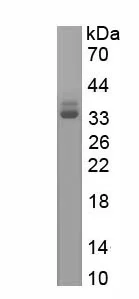 |
Greater than 90% as determined by reducing SDS-PAGE. |
靶点信息 Target Information
| 分子别名Alternative Names | STNEF1AEEF1ALEF-1-alpha-2HS1STNLStatin-LikeStatin-S1Eukaryotic elongation factor 1 A-2 |
|---|---|
| 背景介绍Background | This protein promotes the GTP-dependent binding of aminoacyl-tRNA to the A-site of ribosomes during protein biosynthesis. |
| 功能Function | This protein promotes the GTP-dependent binding of aminoacyl-tRNA to the A-site of ribosomes during protein biosynthesis. |
| 亚细胞定位Subcellular Location | Nucleus. |
| 数据库链接Databases |
基因功能参考文献37 条
- The overexpression of EEF1A2 is a frequent event in localized prostate cancer and is associated with histopathology features and a shorter biochemical recurrence-free survival. Due to its independence from serum PSA levels, EEF1A2 could serve as valuable biomarker in risk-stratification of localized prostate cancer PMID: 28923030 : 28923030
- We report a pair of siblings carrying a homozygous missense mutation p.P333L in EEF1A2 who exhibited global developmental delay, failure to thrive, dilated cardiomyopathy and epilepsy, ultimately leading to death in early childhood. EEF1A2 appears to be critical for normal heart function in humans, and its deficiency results in clinical abnormalities in neurologic function as well as in skeletal and cardiac muscle defects PMID: 28911200 : 28911200
- eEF1A2 is highly expressed in hepatocellular carcinoma. Its silencing significantly decreases HCC tumorigenesis, likely by inhibiting PI3K/Akt/NF-kappaB signaling. PMID: 27122673 : 27122673
- Differential gene expression analysis demonstrated significant upregulation of PDZK1IP1, EEF1A2 and RPL41 (ENSG00000279483) genes in the intrahepatic cholangiocarcinoma samples when compared with the matched paratumor samples. PMID: 27082702 : 27082702
- In both cases, a de novo recurrent heterozygous mutation in EEF1A2 [c.364G>A (p.E122K)] was identified by whole-exome sequencing. CONCLUSION: This report provides clinical data on epileptic encephalopathy in patients with EEF1A2 mutation. Continuous high-voltage delta activity seen over both parietal areas may be a unique manifestation of EEF1A2 mutation. PMID: 26682508 : 26682508
- By directly targeting eEF1A2. PMID: 25744894 : 25744894
- Both eEF1A1 and eEF1A2 colocalise with all eEF1B subunits, in such close proximity that they are highly likely to be in a complex. PMID: 25436608 : 25436608
- De novo EEF1A2 mutations in patients with characteristic facial features, intellectual disability, autistic behaviors and epilepsy. PMID: 24697219 : 24697219
- Finally, a strong association between the expression of EEF1A2, phosphorylated AKT and MDM4 was observed in human HCC samples. Strong activation of the EEF1A2/PI3K/AKT/mTOR/MDM4 signaling pathway was observed in HCC patients PMID: 25394965 : 25394965
- Overexpression of eEF1A2 was correlated with worse outcomes in gastric cancer patients, suggesting its critical roles in the carcinogenesis of gastric cancer. PMID: 25601347 : 25601347
- miR-663 and miR-744 mediate inhibition of the proto-oncogene eEF1A2 expression that results in retardation of the MCF7 cancer cells proliferation. We also observed upregulation of miR-663 and miR-744 with corresponding downregulation of eEF1A2 in resveratrol-treated MCF7 cells, suggesting that resveratrol may influence eEF1A2 expression through a miRNA-dependent pathway. PMID: 23695020 : 23695020
- Our data suggests that eEF1A2 plays an important role in prostate cancer development, especially in inhibiting apoptosis. PMID: 24853801 : 24853801
- The activation level of the EEF1A2/PI3K/AKT/mTOR/MDM4 axis significantly influences the survival probability of hepatocellular carcinoma patients PMID: 24285179 : 24285179
- There was no significant correlation between eEF1A2 protein and mRNA expression levels. Negative immunostaining of eEF1A2 predicted for poor prognosis of NSCLC. PMID: 24510995 : 24510995
- results provide evidence of eEF1A2 as a potential therapeutic target in the treatment of aggressive pancreatic cancer PMID: 23739844 : 23739844
- Data conclude that the interaction of p16(INK4a) with eEF1A2, and subsequent downregulation of the expression and function of eEF1A2 is a novel mechanism explaining the anti-proliferative effects of p16(INK4a). PMID: 23444377 : 23444377
- a role for a RACK1/JNK/eEF1A2 complex in the quality control of newly synthesized polypeptides in response to stress PMID: 23608534 : 23608534
- The eEF1A2 likely plays an important role in mammary neoplasia and acinar development. PMID: 21851817 : 21851817
- Observational study of gene-disease association, gene-gene interaction, and genetic testing. (HuGE Navigator) PMID: 20864512 : 20864512
- Levels of eEF1A2 and alpha-actinin-4 mRNA appeared to be unrelated to breast tumour size, except for a significant down-regulation of alpha-actinin-4 mRNA in T3 cases. PMID: 20819441 : 20819441
- EEF1A2 may play contribute to the induction or progression of some plasmacytomas and a small percentage of multiple myeloma. PMID: 20505761 : 20505761
- overall, this study does not support an associated between statin use and prostate cancer but a reduced risk cannot be ruled out. PMID: 18322813 : 18322813
- this population-based study of individuals with incident AD, use of statins and beta-blockers was associated with delay of functional decline. PMID: 18978249 : 18978249
- the interaction of ZPR1 and eEF1alpha PMID: 19966453 : 19966453
- This is a putative oncogene in ovarian cancer. PMID: 12053177 : 12053177
- Review. EEF1A2 is an important ovarian oncogene. The protein elongation network can activate tumorigenesis and inhibit apoptosis. PMID: 14588074 : 14588074
- These results indicate that the use of cellular promoters such as those for EF-1alpha and ubiquitin C might direct prolonged gene expression in hematopoietic and mesenchymal progenitor cells. PMID: 15893736 : 15893736
- eEF1A2 may have a role in cytoskeletal remodelling or apoptosis in breast neoplasms PMID: 16156888 : 16156888
- Overexpression of EEF1A2 and KCIP-1 is associated with lung adenocarcinoma PMID: 16369491 : 16369491
- there is a physical and functional relationship between eEF1A2 and PI4KIIIbeta PMID: 17088255 : 17088255
- Regulates oncogenesis through Akt-dependent cytoskeletal remodeling. PMID: 17130842 : 17130842
- The oncogenicity of eEF1A2 may be related either to its role in protein synthesis or to potential non-canonical functions. PMID: 17437010 : 17437010
- The expression level of EEF1A2 correlates with cell growth but not apoptosis in hepatocellular carcinoma cell lines with different differentiation grades. PMID: 17825975 : 17825975
- EEF1A2 is highly homologous and functionally similar to the EEF1A1 oncogene, and was found to be restricted only to the normal tissues of the heart, brain, and skeletal muscle PMID: 17908984 : 17908984
- Study finds that eEF1A2 stimulates formation of filopodia by increasing the cellular abundance of cytosolic and plasma membrane-bound phosphatidylinositol-4,5 bisphosphate. PMID: 18474610 : 18474610
- eEF1A2 might play an important role in pancreatic carcinogenesis, possibly by acting as a tumour oncogene. PMID: 19138673 : 19138673
- Studies indicate that the EEF1A2 abnormal expression in cancers correlates with a poor prognosis. PMID: 19723040 : 19723040
蛋白复溶体积计算器缓冲液体积 = 蛋白质量 ÷ 蛋白浓度
输入任意两项,第三项自动计算 |
蛋白浓度稀释计算器初浓度 × 初体积 = 终浓度 × 终体积
输入任意三项,第四项自动计算 |



