


Recombinant Chromodomain Helicase DNA Binding Protein 8 (CHD8)(N-6His)
Alternative NamesHELSNF1; DUPLIN; Helicase With SNF2 Domain 1; ATP-dependent helicase CHD8
规格参数 Specifications
| 纯度Purity | Greater than 90% as determined by reducing SDS-PAGE. |
|---|---|
| 内毒素Endotoxin | <1 EU/µg as determined by LAL test. |
| 蛋白构建Protein Construction |
6HisN 端标签-【Leu823-Arg1288】序列区间
|
| Accession | Q9HCK8 |
| 表达宿主Expression Host | E.coli |
| 种属Species | Homo sapiens (Human) |
| 预测分子量Predicted MW | 57.7 kDa |
| 制剂Formulation | Lyophilized from a 0.2 μm filtered solution of PBS, pH7.4, containing 0.01% SKL, 1mM DTT, 5% Trehalose and Proclin300. |
| 运输方式Shipping | The product is shipped with ice bag. Upon receipt, store it immediately at the temperature listed below. |
| 稳定性&储存Stability & Storage | 12 months at -20°C to -80°C in lyophilized state.6 months at -20°C to -80°C under sterile conditions after reconstitution.7-10 days at 2°C to 8°C under sterile conditions after reconstitution.Please minimize freeze-thaw cycles. |
| 复溶Reconstitution | Reconstitute in 10mM PBS (pH7.4) to a concentration of 0.1-1.0 mg/mL. Do not vortex. |
!
本司产品仅用于科研,不用于临床诊断和治疗。
产品图片 Product Images点击图片可查看原图
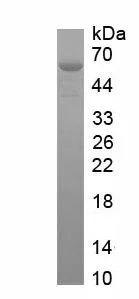 |
Greater than 90% as determined by reducing SDS-PAGE. |
靶点信息 Target Information
| 分子别名Alternative Names | HELSNF1DUPLINHelicase With SNF2 Domain 1ATP-dependent helicase CHD8 |
|---|---|
| 背景介绍Background | DNA helicase that acts as a chromatin remodeling factor and regulates transcription. Acts as a transcription repressor by remodeling chromatin structure and recruiting histone H1 to target genes. Suppresses p53/TP53-mediated apoptosis by recruiting histone H1 and preventing p53/TP53 transactivation activity. Acts as a negative regulator of Wnt signaling pathway by regulating beta-catenin (CTNNB1) activity. Negatively regulates CTNNB1-targeted gene expression by being recruited specifically to the promoter regions of several CTNNB1 responsive genes. Involved in both enhancer blocking and epigenetic remodeling at chromatin boundary via its interaction with CTCF. Acts as a suppressor of STAT3 activity by suppressing the LIF-induced STAT3 transcriptional activity. Also acts as a transcription activator via its interaction with ZNF143 by participating in efficient U6 RNA polymerase III transcription. |
| 功能Function | DNA helicase that acts as a chromatin remodeling factor and regulates transcription. Acts as a transcription repressor by remodeling chromatin structure and recruiting histone H1 to target genes. Suppresses p53/TP53-mediated apoptosis by recruiting histone H1 and preventing p53/TP53 transactivation activity. Acts as a negative regulator of Wnt signaling pathway by regulating beta-catenin (CTNNB1) activity. Negatively regulates CTNNB1-targeted gene expression by being recruited specifically to the promoter regions of several CTNNB1 responsive genes. Involved in both enhancer blocking and epigenetic remodeling at chromatin boundary via its interaction with CTCF. Acts as a suppressor of STAT3 activity by suppressing the LIF-induced STAT3 transcriptional activity. Also acts as a transcription activator via its interaction with ZNF143 by participating in efficient U6 RNA polymerase III transcription. |
| 亚细胞定位Subcellular Location | Nucleus. |
| 数据库链接Databases |
基因功能参考文献23 条
- The Autism spectrum disorder candidate genes SATB2, CHD8 and EHMT1 show enriched expression in neurons, especially inhibitory neurons PMID: 29317598 : 29317598
- SHANK3, CHD8, and ADNP had distinctly higher scores than all other genes in the dataset describing the genes associated with autism spectrum disorders. PMID: 27790361 : 27790361
- present observation and published data suggest that phenotype present in patients with duplication of 14q11.2 region, encompassing the SUPT16H and CHD8 genes, resemble in some extend features described in cases carrying microdeletion of that genomic region PMID: 26834018 : 26834018
- Review of 16 other CHD8 mutation cases suggests that clinical features and their severity vary considerably across individuals; however, these data support a CHD8 mutation syndrome, further highlighting the importance of genomic medicine to guide clinical assessment and treatment PMID: 26789910 : 26789910
- Our clinical case supports the hypothesis that CHD8 may play a central role in neuronal cell development and Autism spectrum disorders risk PMID: 26921529 : 26921529
- Study provides evidence that links the CHD8 chromatin remodeler to the cancer maintenance functions of BRD4 and NSD3. PMID: 26626481 : 26626481
- Taken together our data demonstrate that CHD8 is involved in late stages of progesterone receptor enhancers activation. PMID: 25894978 : 25894978
- Loss of CHD8 contributes to autism spectrum disorder by perturbing an ancient gene regulatory network during human brain development. PMID: 25752243 : 25752243
- CHD8 insufficiency results in altered gene expression of coding genes and noncoding RNAs. The changes among protein-coding genes involved genes that are enriched in neuronal development and in previously identified autism candidate genes. PMID: 25989142 : 25989142
- In the first detailed analysis in cancer, a marked loss of CHD8 expression and increased BORIS/CTCF ratio indicate frequent disruption of CTCF and its effector genes in PCa. PMID: 25499215 : 25499215
- Recurrent approximately 100 Kb microdeletion in the chromosomal region 14q11.2, involving CHD8 gene, is associated with autism and macrocephaly. PMID: 25257502 : 25257502
- CHD8 precipitates a network of gene-expression changes involved in neurodevelopmental pathways in which many autism spectrum disorder-associated genes may converge on shared mechanisms of pathogenesis PMID: 25294932 : 25294932
- indings suggest that CHD8 disruptions represent a specific pathway in the development of Autism spectrum disorder (ASD) and define a distinct ASD subtype. Common phenotypic features include increased head size; a facial phenotype marked by prominent forehead, wide-set eyes, and pointed chin; as well as increased rates of GI complaints and marked sleep dysfunction. PMID: 24998929 : 24998929
- CHD8 is required for E2F-dependent transcription activation of S-phase genes PMID: 24265227 : 24265227
- Loss of CHD8 expression is associated with aggressiveness in gastric cancer. PMID: 23835524 : 23835524
- results from de novo events and a large parallel case-control study provide strong evidence in favour of CHD8 and KATNAL2 as genuine autism risk factors PMID: 22495311 : 22495311
- CHD8 promotes the association of beta-catenin and histone H1, with formation of the trimeric complex on chromatin being required for inhibition of beta-catenin-dependent transactivation. PMID: 22083958 : 22083958
- The recruitment of AR to the TMPRSS2 promoter in response to androgen treatment requires CHD8. PMID: 20308527 : 20308527
- This study provides evidence of a novel interaction between BRCA1 and beta-catenin, and that loss of BRCA1 leads to impaired expression of the nuclear form of beta-catenin, which may contribute to the pathogenesis of breast cancer. PMID: 20215423 : 20215423
- Results show that Depletion of CHD8 enhances HOXA2 expression and a loss of the WDR5/Ash2L/RbBP5 subcomplex. PMID: 20085832 : 20085832
- Staf activates U6 transcription from a preassembled chromatin template in vitro and associates with several proteins linked to chromatin modification, among them chromodomain-helicase-DNA binding protein 8 (CHD8). PMID: 17938208 : 17938208
- CHD8 is an ATP-dependent chromatin remodeling factor that regulates beta-catenin target genes PMID: 18378692 : 18378692
- CHD8 interacts with elongating RNA polymerase II and controls expression of CCNE2 and TYMS genes. PMID: 19255092 : 19255092
蛋白复溶体积计算器缓冲液体积 = 蛋白质量 ÷ 蛋白浓度
输入任意两项,第三项自动计算 |
蛋白浓度稀释计算器初浓度 × 初体积 = 终浓度 × 终体积
输入任意三项,第四项自动计算 |



