


Recombinant Diacylglycerol Kinase Zeta (DGKz)(N-6His)
Alternative NamesDAGK5; DAGK6; DGK-ZETA; hDGKzeta; Diglyceride kinase zeta
规格参数 Specifications
| 纯度Purity | Greater than 97% as determined by reducing SDS-PAGE. |
|---|---|
| 内毒素Endotoxin | <1 EU/µg as determined by LAL test. |
| 蛋白构建Protein Construction |
6HisN 端标签-【Val695-Ala932】序列区间
|
| Accession | Q13574 |
| 表达宿主Expression Host | E.coli |
| 种属Species | Homo sapiens (Human) |
| 预测分子量Predicted MW | 30.1 kDa |
| 制剂Formulation | Lyophilized from a 0.2 μm filtered solution of PBS, pH7.4, containing 0.01% SKL, 1mM DTT, 5% Trehalose and Proclin300. |
| 运输方式Shipping | The product is shipped with ice bag. Upon receipt, store it immediately at the temperature listed below. |
| 稳定性&储存Stability & Storage | 12 months at -20°C to -80°C in lyophilized state.6 months at -20°C to -80°C under sterile conditions after reconstitution.7-10 days at 2°C to 8°C under sterile conditions after reconstitution.Please minimize freeze-thaw cycles. |
| 复溶Reconstitution | Reconstitute in 10mM PBS (pH7.4) to a concentration of 0.1-1.0 mg/mL. Do not vortex. |
!
本司产品仅用于科研,不用于临床诊断和治疗。
产品图片 Product Images点击图片可查看原图
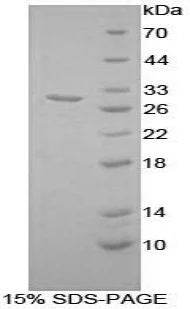 |
Greater than 97% as determined by reducing SDS-PAGE. |
靶点信息 Target Information
| 分子别名Alternative Names | DAGK5DAGK6DGK-ZETAhDGKzetaDiglyceride kinase zeta |
|---|---|
| 背景介绍Background | Diacylglycerol kinase that converts diacylglycerol/DAG into phosphatidic acid/phosphatidate/PA and regulates the respective levels of these two bioactive lipids. Thereby, acts as a central switch between the signaling pathways activated by these second messengers with different cellular targets and opposite effects in numerous biological processes. Also plays an important role in the biosynthesis of complex lipids. Does not exhibit an acyl chain-dependent substrate specificity among diacylglycerol species. Can also phosphorylate 1-alkyl-2-acylglycerol in vitro but less efficiently and with a preference for alkylacylglycerols containing an arachidonoyl group. The biological processes it is involved in include T cell activation since it negatively regulates T-cell receptor signaling which is in part mediated by diacylglycerol. By generating phosphatidic acid, stimulates PIP5KIA activity which regulates actin polymerization. Through the same mechanism could also positively regulate insulin-induced translocation of SLC2A4 to the cell membrane.; Regulates RASGRP1 activity.; Does not regulate RASGRP1 activity. |
| 功能Function | Diacylglycerol kinase that converts diacylglycerol/DAG into phosphatidic acid/phosphatidate/PA and regulates the respective levels of these two bioactive lipids. Thereby, acts as a central switch between the signaling pathways activated by these second messengers with different cellular targets and opposite effects in numerous biological processes. Also plays an important role in the biosynthesis of complex lipids. Does not exhibit an acyl chain-dependent substrate specificity among diacylglycerol species. Can also phosphorylate 1-alkyl-2-acylglycerol in vitro but less efficiently and with a preference for alkylacylglycerols containing an arachidonoyl group. The biological processes it is involved in include T cell activation since it negatively regulates T-cell receptor signaling which is in part mediated by diacylglycerol. By generating phosphatidic acid, stimulates PIP5KIA activity which regulates actin polymerization. Through the same mechanism could also positively regulate insulin-induced translocation of SLC2A4 to the cell membrane.; Regulates RASGRP1 activity.; Does not regulate RASGRP1 activity. |
| 亚细胞定位Subcellular Location | Nucleus. Cytoplasm, cytosol. Cell membrane. Cell projection, lamellipodium. |
| 数据库链接Databases |
基因功能参考文献24 条
- Results show that DGKzeta is downregulated in bone marrow mononuclear cells and associated with the severity of aplastic anemia (AA). Also, DGKzeta is a downstream target gene of miR34a. Their dysregulation enhances T-cell activation in AA cells. PMID: 28008152 : 28008152
- These results established the positive correlation between DGKzeta expression and gliomagrade. PMID: 26452358 : 26452358
- these data suggest that the activation of DGKzeta downstream of antigen recognition provides a mechanism that ensures the activation of PA-dependent signaling as a direct result of the strength of TCR-dependent DAG mobilization. PMID: 27999176 : 27999176
- Diacylglycerol kinases alpha and zeta are up-regulated in cancer in cancer, and contribute towards tumor immune evasion and T cells clonal anergy. (Review) PMID: 27697466 : 27697466
- DGKzeta knockdown engenders enhancement of NF-kappaB pathway in response to TNF-alpha. [review] PMID: 26521214 : 26521214
- Redundant and specialized roles for diacylglycerol kinases alpha and zeta in the control of T cell functions. PMID: 25921290 : 25921290
- This study shows that DGKzeta knockdown facilitates degradation of IkappaB, followed by nuclear translocation of NF-kappaB p65 subunit. PMID: 25450975 : 25450975
- Elevated DGKzeta expression contributes to increased Rho GTPase activation and the enhanced motility of metastatic cancer cells. PMID: 24646293 : 24646293
- Data indicate that after P2Y6 receptor stimulation both phospholipase D (PLD) and DGKzeta enzymes are responsible for producing phosphatidic acid (PA). PMID: 23723068 : 23723068
- DGK-zeta translocated rapidly to the plasma membrane at early stages of immunological synapse (IS) formation independent of enzyme activity; study highlights a DGKzeta-specific function for local diacylglycerol metabolism at the IS and offers new clues to its mode of regulation PMID: 21937721 : 21937721
- Antigen-specific CD8-positive T cells from DGKzeta-deficient transgenic mice show enhanced expansion and increased cytokine production after lymphocytic choriomeningitis virus infection, yet DGK-deficient memory CD8+ T cells exhibit impaired expansion. PMID: 22271650 : 22271650
- Nucleosome assembly protein (NAP) 1-like 1 (NAP1L1) and NAP1-like 4 (NAP1L4) are identified as novel DGKzeta binding partners. PMID: 21996351 : 21996351
- Data show that Diacylglycerol that 2-arachidonoyl glycerol is a very poor substrate for either the epsilon or the zeta isoforms of diacylglycerol kinases. PMID: 21194521 : 21194521
- structural domain requirements for translocation and activity PMID: 12015310 : 12015310
- PKC alpha phosphorylates diacylglycerol kinase zeta in cells, and this phosphorylation inhibits its kinase activity to remove cellular diacylglycerol, thereby affecting cell growth. PMID: 12890670 : 12890670
- role in controlling the induction of luteinizing hormone beta transcription by ERK1/2 PMID: 14707140 : 14707140
- DGKzeta generating PA, stimulates PIP5KIalpha activity to increase local PIP2, which regulates actin polymerization. PMID: 15157668 : 15157668
- DGKzeta-derived phosphatidic acid acts as a mediator of mTOR signaling PMID: 15632115 : 15632115
- DGKzeta may act in vivo as a downstream effector of pRB to regulate nuclear levels of diacylglycerol and phosphatidic acid PMID: 16286473 : 16286473
- 2,3-dioleoylglycerol binds to a site on the alpha and zeta isoforms of diacylglycerol kinase that is exposed as a consequence of the substrate binding to the active site. PMID: 18004883 : 18004883
- PKD activation is induced by DGKzeta, suggesting DGK is an upstream regulator of oxidative stress-induced activation of the PKD signaling pathway in intestinal epithelial cells. PMID: 18694729 : 18694729
- In DGKzeta-deficient fibroblasts PAK1 phosphorylation and Rac1-RhoGDI dissociation were attenuated, leading to reduced Rac1 activation after platelet-derived growth factor stimulation. PMID: 19211846 : 19211846
- None of SNPs of diacylglycerol kinase zeta tested showed association with bipolar disorder in Sardinian sample. PMID: 19308020 : 19308020
- Negative regulation of T cell receptor induced activation of the Ras-Erk1/2-AP1 pathway by DGKz PMID: 12070163 : 12070163
蛋白复溶体积计算器缓冲液体积 = 蛋白质量 ÷ 蛋白浓度
输入任意两项,第三项自动计算 |
蛋白浓度稀释计算器初浓度 × 初体积 = 终浓度 × 终体积
输入任意三项,第四项自动计算 |



